- Sample quality is more important than sample quantity.
- One poor sample can misclassify thousands of tonnes.
- High-grade ore deserves closer drilling spacing.
- Always validate laboratory results before updating the model.
- Control dilution at the mining face—it cannot be recovered later.
- Keep ore and waste physically separated at all stages.
- Reconcile every mining bench and production period.
- Update the geological model continuously as new information becomes available.
- Use digital tools (GPS, drones, fleet management, block models) to improve precision.
- Aim for reconciliation of 95–105%, dilution below project targets, and the lowest practical ore loss.
- If grade control is poor, even an excellent resource model will not deliver expected project value.
- Good grade control increases revenue, extends mine life, reduces processing costs, and improves investor confidence.
La ausencia de un modelo geometalúrgico equivale, en términos operacionales, a explotar un yacimiento a “ciegas”. Esta situación adquiere mayor relevancia cuando la alimentación proviene de distintas zonas del depósito, cada una con características geológicas y metalúrgicas diferentes. En la minería del cobre, donde los yacimientos son cada vez más profundos, con leyes decrecientes y mineralogías más complejas, la integración de información geológica, minera y metalúrgica resulta clave para reducir incertidumbre y optimizar el procesamiento.
La geometalurgia se ha consolidado como un enfoque integrador que conecta disciplinas como geología, minería y metalurgia para anticipar el comportamiento del mineral a lo largo de la cadena de valor, desde la exploración hasta el procesamiento. Para ello se requieren programas basados en muestreo representativo, caracterización mineralógica detallada, pruebas metalúrgicas estructuradas y modelos predictivos capaces de retroalimentarse con información operacional.
Uno de los principales desafíos aparece durante el blending de minerales con propiedades distintas. Aunque exista conocimiento detallado de cada unidad geometalúrgica por separado, el comportamiento del material una vez mezclado puede diferir significativamente de lo esperado. Propiedades críticas como dureza, liberación mineral, asociaciones mineralógicas, contenido de ganga o presencia de elementos penalizables no necesariamente se combinan de forma proporcional.
Muchos modelos tradicionales asumen relaciones lineales entre los materiales mezclados. Bajo esta premisa, una mezcla compuesta por proporciones iguales de dos minerales debería generar un comportamiento intermedio. Sin embargo, en la práctica industrial esto rara vez ocurre. Las interacciones mineralógicas pueden producir efectos no lineales o interferencias que modifican la respuesta del mineral en etapas como molienda y flotación, reduciendo la capacidad predictiva de los modelos convencionales.
La incorporación de inteligencia artificial permite abordar este problema mediante el análisis de grandes volúmenes de datos provenientes de información geológica, mineralógica, ensayos metalúrgicos y variables operacionales de planta. Mediante algoritmos de aprendizaje automático es posible modelar relaciones complejas entre variables y predecir con mayor precisión cómo afectará una mezcla determinada al desempeño metalúrgico del proceso.
Las plataformas avanzadas de optimización integran variables geológicas, metalúrgicas y operativas para definir la combinación más adecuada de mineral enviada a chancado primario y posteriormente a molienda y flotación. Estas herramientas también consideran restricciones operacionales como capacidad de chancado, disponibilidad de stockpiles y tiempos de despacho desde los frentes mineros. El resultado es una reducción de la variabilidad en la alimentación a planta y mayor estabilidad del proceso metalúrgico.
Comparto estudio “The Effect of Stress Damage on Dilution in Narrow Vein Mines” el cual analiza cómo los altos esfuerzos en el macizo rocoso pueden generar mayor dilución en minería subterránea de vetas angostas.
El efecto del daño por esfuerzos en la dilución se ha vuelto cada vez más relevante a medida que aumenta la profundidad de la minería. En el caso de la minería de vetas angostas, la extracción progresiva de long-hole rings puede generar una zona de altos esfuerzos que se desplaza hacia el brow del caserón. Esto provoca que el hanging wall (pared colgante) y el footwall (pared yacente) experimenten un aumento significativo en la relación esfuerzo–resistencia cuando el brow avanza. En algunos casos, esta relación puede ser lo suficientemente alta como para producir fracturamiento o daño en el macizo rocoso.
El objetivo del estudio descrito en este trabajo fue investigar si el daño por esfuerzos produce un aumento significativo de la dilución. Para ello, se analizó la sobre–excavación (overbreak) en 410 casos de estudio de la mina de oro Kundana en Australia Occidental. El personal de la mina ya había realizado estudios de calibración de los niveles de esfuerzo que generan daño en el macizo rocoso. Esta calibración, junto con modelamiento numérico, mostró que las paredes de caserones afectadas por daño por esfuerzos presentaban en promedio 50% más sobre–excavación que aquellas donde los esfuerzos no superaban el criterio de daño.
Para un ancho de minado de diseño de 1,5 metros, y considerando que ambas paredes del caserón están afectadas, esto representa un aumento del 36% en la dilución. Sin embargo, después de ajustar los resultados para posibles fuentes de sesgo, la diferencia se redujo a un promedio de 0,10 metros por pared del caserón, lo que representa aproximadamente 13% de dilución para el ancho de minado considerado.
Por lo tanto, el potencial de sobre–excavación asociado al daño por esfuerzos debería ser considerado como parte de cualquier evaluación de dilución en minería de vetas angostas.
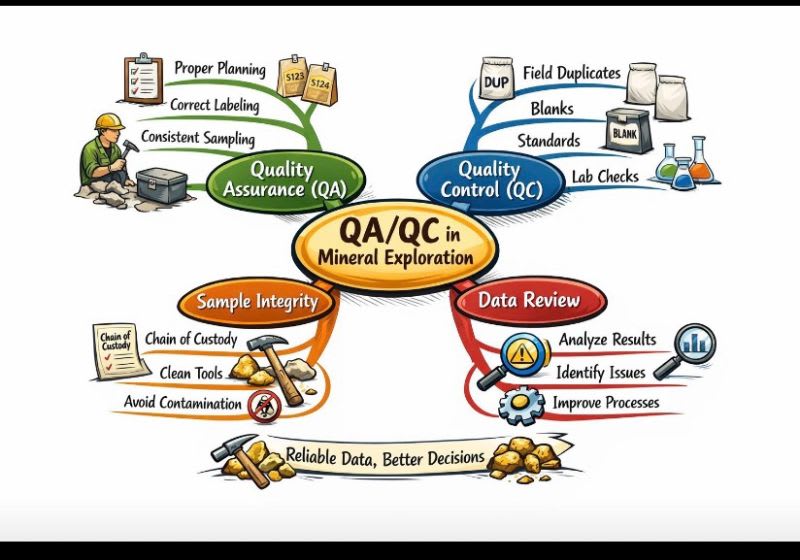
Dans les opérations minières, la qualité des données est aussi importante que la production elle-même. En grade control, le QAQC (Quality Assurance & Quality Control) joue un rôle essentiel pour garantir la fiabilité des teneurs et sécuriser la prise de décision.
🔎 Pourquoi le QAQC est indispensable ?
• Assurer la précision des résultats analytiques
• Détecter rapidement les erreurs d’échantillonnage ou de laboratoire
• Réduire les risques financiers liés aux mauvaises estimations de teneur
• Renforcer la confiance entre terrain, laboratoire et géologie
🧪 Les outils clés du QAQC :
✔️ Blanks – pour vérifier la contamination
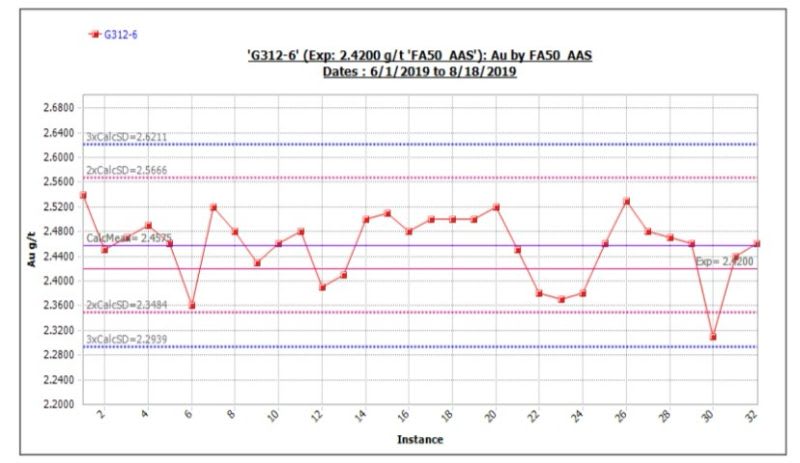
✔️ Standards/CRM – pour contrôler la précision des analyses
✔️ Duplicates – pour évaluer la reproductibilité
✔️ Suivi des tendances et validation des lots avant utilisation
Un programme QAQC bien appliqué permet de transformer des données brutes en informations fiables, essentielles pour optimiser l’exploitation et réduire les incertitudes.
En mine, de bonnes décisions commencent toujours par de bonnes données.
[PT] O estudo demonstra como inferir rapidamente a área específica de sistemas particulados a partir da distribuição granulométrica (parâmetro de “nitidez”) usando modelos Gates–Gaudin–Schuhmann, Gaudin–Meloy e Rosin–Rammler. Os resultados mostram boa aderência estatística, com destaque para Rosin–Rammler quando esta descreve melhor a PSD, oferecendo um atalho útil para controle de processos em que métodos instrumentais seriam lentos ou caros. É uma ferramenta prática para operações de beneficiamento que precisam de respostas rápidas.
[EN] This work shows how to quickly infer specific surface area from particle-size distributions via the sharpness parameter using GGS, Gaudin–Meloy, and Rosin–Rammler models. Results indicate strong statistical fit, especially for Rosin–Rammler when it best describes the PSD, providing a practical shortcut for process control where instrumental SSA methods are too slow or costly. A handy tool for mineral processing teams needing fast, data-driven estimates.
[PT] Resultado de um PoC em escala piloto, o trabalho modela o processo de sinterização para prever o FeO final a partir de mistura de minérios, combustível, fundentes e variáveis de processo. Com cerca de 300 testes, técnicas de aprendizado de máquina geraram um modelo com R² > 0,92, validando a metodologia para controle de qualidade e otimização na siderurgia. Um exemplo sólido de IA aplicada com impacto direto em produtividade.
[EN] From a pilot-scale PoC, this paper models the sintering process to predict final FeO using ore blends, fuel, fluxes, and process variables. Across ~300 tests, machine-learning delivered a model with R² > 0.92, validating the approach for quality control and process optimisation in steelmaking. A strong case of applied AI driving measurable productivity gains.
S'il y a un problème commun entre les projets et les mines, c'est bien la question controversée de
la dilution minière. La dilution est l'un des facteurs importants qui peuvent avoir un impact
significatif sur l'économie d'un projet minier. Cet article cherche à aborder les 4W (What : Quoi)
de la dilution : Quoi, Pourquoi, Quoi et Quand.
En termes simples, la dilution fait référence aux déchets qui ne sont pas séparés du minerai
pendant les étapes de l'extraction et qui sont envoyés à l'usine de traitement (Ebrahimi, 2013).
[PT] O artigo propõe o uso do método de Monte Carlo para simular padrões geométricos de gabaritos visuais utilizados na avaliação prévia de teores e concentração de fases em campo. A partir de modelagem matemática das fases mineralógicas e de alterações em parâmetros estatísticos que regem a distribuição espacial das fases, obtêm‑se correlações entre os parâmetros e os padrões de superfície simulados. A ferramenta permite estimar rapidamente o teor de blocos de lavra através da análise visual das faces expostas ou apoiar análises petrográficas e metalográficas.
[EN] This paper proposes using the Monte Carlo method to simulate geometric patterns of visual templates employed for preliminary assessment of ore grades and phase concentrations. By mathematically modelling mineralogical phases and varying certain parameters of their spatial distribution, correlations are established between these parameters and the resulting surface patterns. The method facilitates rapid estimation of ore grades from visual inspection of exposed bench faces and supports petrographic or metallographic analyses.
Grade control is a fundamental aspect of mine operations that ensures the accurate extraction of ore at the desired quality and grade. It involves continuous sampling, data analysis, and decision-making to distinguish ore from waste, preventing dilution and maximizing profitability.
The process starts with geological mapping and sampling from blast holes or drill cores, followed by laboratory analysis and statistical interpretation. Accurate grade control helps determine the boundaries of economic ore zones and guides excavation to maintain consistent feed for the processing plant.
Modern grade control employs digital mine models, geostatistical estimation, and real-time data integration to enhance decision accuracy. These tools help reduce resource loss, optimize milling operations, and ensure that mine plans align with market and production targets.
Effective grade control not only safeguards revenue but also supports sustainable resource utilization by minimizing unnecessary extraction and waste generation.
Source: Dominy, S. C., Noppe, M. A., & Annels, A. E. (2002). Errors and Uncertainty in Mineral Resource and Ore Reserve Estimation: The Importance of Getting It Right. Exploration and Mining Geology, 11(1–4), 77–98.
In mining, planned vs. actual reconciliation is much more than a monthly report: it is the “thermometer” of the operation.
👉 For the company, it means evaluating operational efficiency and adjusting costs.
👉 For the mine, it shows how closely planning adheres to real mining conditions.
👉 For investors, it is proof of transparency and predictability of results.
In general, the process consists of comparing:
What was planned (block models, mine sequencing, production targets);
With what was executed (moved volumes, actual grades, delivered production).
This analysis allows deviations to be identified, models to be corrected, sequencing to be improved, and resources to be optimized.
In coal mining, reconciliation becomes even more critical:
⚒️ Quality variations (ash, moisture, calorific value) can directly impact contracts and financial outcomes.
⚒️ Quick adjustments ensure that planning remains aligned with plant or market requirements.
In the end, reconciliation is not just a control measure but a continuous learning process that builds trust across the entire mining value chain. And this trust is only possible when the starting point — the block model — is properly validated. After all, there is no reliable reconciliation without a solid model, just as there is no efficient planning without reconciliation to test and feed it back.
Source: Credit to Anuar Bergamaschi Pires
16 Grade control
Covers production-stage geological control to ensure ore quality and reconciliation.
Technical trainings on grade control systems and workflows.
No events scheduled
16 Grade control
Covers production-stage geological control to ensure ore quality and reconciliation.
Grade control specialists share operational insights.