






Posts Header

14 Optimization and design

Covers mine design and optimization for open pit and underground operations in 2D and 3D.

Technical content on pit optimization, layouts, routes, and stochastic design approaches.

ZVENIA Mining
Corporate at ZVENIA 01/12/2025

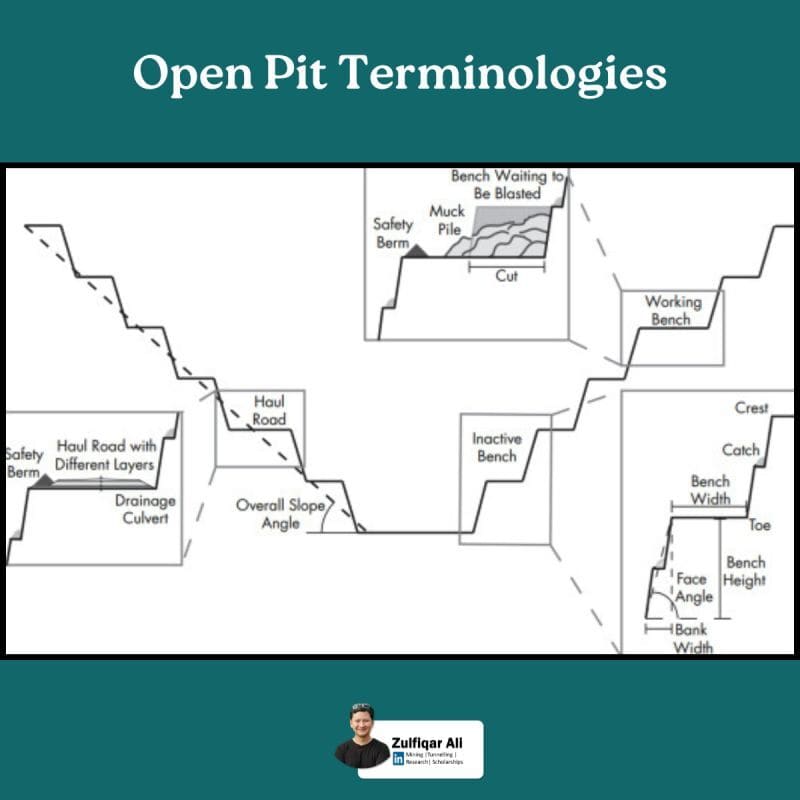
Open-Pit Mining Terminologies

Fundamental Pit Geometry ▪ Pit: The large, terraced excavation created to extract ore from near-surface deposits. ▪ Bench: A horizontal step cut into the pit, formed during mining to provide stability and access. ▪ Berm: A safety strip or horizontal shelf left between benches to catch falling rocks and support stability. ▪ Batter: The sloping surface of a bench wall. ▪ Batter Angle: The angle of inclination of the bench wall, measured from the horizontal. ▪ Face: The active rock surface where drilling, blasting, and loading occur. ▪ Crest: The top edge of a bench or slope. ▪ Toe: The bottom point where the bench slope meets the horizontal floor. ▪ Inter-Ramp Angle (IRA): The angle formed by a stack of benches without considering the berms at every level. ▪ Overall Angle: The final stable slope angle from pit crest to pit bottom, accounting for all benches and berms. Mining Operations & Equipment ▪ Pit Stages: Sequential mining phases that advance the pit outward and downward in planned steps. ▪ Loading: The process of picking up blasted rock using machinery such as shovels, excavators, or loaders. ▪ Hauling: Transporting ore or waste rock from the pit to dumps, crushers, or stockpiles using haul trucks. ▪ Haul Road: Engineered roads designed within the pit for the safe movement of heavy machinery. ▪ Shovel / Excavator: Primary loading equipment used to dig and load blasted rock. ▪ Front-End Loader: A versatile machine used for loading, stockpiling, and short-distance material movement. ▪ Dump: A designated area where waste rock is deposited. ▪ ROM (Run of Mine): Material delivered directly from the mine to the processing plant without any pre-crushing. ▪ Drilling: The creation of blast holes for explosives. ▪ Blasting: Fragmentation of rock using explosives to allow efficient excavation.

Source: Credit to Zulfiqar Ali
Open-Pit Mining Terminologies
Paulo Lopes
Mining Engineer at Beyond Mining 19/11/2025

Modelos para previsão do TML de finos de minério de ferro — Doutorado (2019)

[PT] A tese propõe modelos para prever o TML (PFD80) exigido pela IMO, reduzindo tempo de resposta e volume de amostra em relação a ensaios tradicionais. Mostra que granulometria (p.ex., D60/D10) é o principal fator, enquanto mineralogia/química e hidratação modulam o TML por meio de porosidade e retenção de água. Os modelos dão suporte a decisões de embarque mais rápidas e seguras. É uma solução operacional que melhora compliance e minimiza riscos logísticos. [EN] The PhD proposes models to predict the TML (PFD80) mandated by the IMO, cutting turnaround time and sample requirements versus standard tests. It shows particle-size distribution (e.g., D60/D10) as the key driver, while mineralogy/chemistry and hydration affect TML via porosity and water retention. The models enable faster, safer shipment decisions. It’s an operational solution that strengthens compliance and mitigates logistics risk.

Source: Credits to Rodrigo Fina
Emin Tagiyev
Mining Engineering student at SOCAR 24/10/2025

Optimizing Heap Leaching: How Material and Fluid Properties Affect Metal Recovery

Heap leaching is a process where crushed ore is stacked on a lined pad and irrigated with a chemical solution that dissolves valuable metals for recovery. The efficiency of the process depends heavily on how the solution flows through the ore, which is influenced by particle size, shape, porosity, fines content, wettability, and fluid viscosity. High porosity and the presence of fines increase liquid hold-up and residence time, while spherical particles can cause channeling, creating fast flow paths that reduce contact with the ore. More wettable particles help spread the solution evenly, and higher fluid viscosity slows flow, increasing retention time. For effective irrigation, drip systems are preferred because they provide precise, controlled delivery of solution, reducing evaporation and promoting uniform wetting. Emitter spacing and flow rates must be adjusted according to ore characteristics; beds with high porosity or mixed fines require closer spacing or lower flow rates to prevent preferential channels. Initial wetting should start at low flow to allow fines to settle and establish uniform capillary distribution, followed by steady operational flow. Agglomerating fines or using binders can help maintain predictable permeability and reduce uneven flow. Monitoring and controlling the process is essential. Moisture distribution, flow uniformity, and solution properties should be regularly measured. Filtration and anti-clogging measures prevent emitter blockages, and adjustments to pump pressure and flow can compensate for changes in fluid viscosity or composition. Optimized irrigation improves metal recovery, reduces reagent consumption, minimizes solution losses, and lowers environmental impact. Implementing pilot tests or lab-scale trials can help determine the best irrigation strategy for each heap, ensuring consistent and efficient leaching performance.

Lerato Lare Tukula
Mining Engineer at Storm Mountain Diamonds Mine 15/10/2025

Mine to design reconciliation

Mine-to-Design Reconciliation: Turning Data into Safer, Smarter Mining At the heart of effective open-pit operations lies one critical question: are we mining to design? Using monthly survey data(topography/pit-scan) imported into GEM4D, this reconciliation process compared the pushback design with the as-mined surfaces to evaluate compliance and identify areas requiring corrective action. A color-coded 3D analysis of variances of ±2.5 metres between design and actual pit surfaces is used whereby: • Over-breaks (+2.5 m, blue zones) indicates areas mined beyond design limits. This compromises wall stability and increases the risk of rockfall. • Under-breaks (-2.5 m, red zones) highlight frozen toes and incomplete blasting, often caused by (short drill holes, incorrect burden and spacing, weak bottom charge and inadequate stemming), which also reduce bench catchment effectiveness and safety. By mapping these deviations, the team is able to pinpoint visually where design adherence is lost, assess geotechnical risk, and plan corrective measures such as targeted re-blasting and slope reconditioning. Continuous monitoring through survey updates and movement radar ensures that compromised areas are flagged in the pit hazard plan, reinforcing both safety and design discipline. This exercise demonstrates that mine-to-design reconciliation is not just a compliance check, it’s a powerful feedback loop that improves safety, slope stability, and long-term economic performance. As geological structures and operational realities evolve, frequent design validation keeps open-pit operations aligned, efficient, and resilient.

Mine  to design reconciliation
Mohamed Coulibaly
Mining Engineering at LMSA 13/10/2025

Conformité à la conception dans les Mines à Ciel Ouvert

Les sociétés minières qui réussissent gèrent leur planification minière comme un processus intégré et hiérarchique. Les niveaux hiérarchiques sont basés sur l'horizon de planification, allant de la planification à long terme à la planification à court terme. Le plan à long terme définit l'orientation stratégique globale et se concentre sur la réalisation des objectifs de l'entreprise à long terme. Les plans à long terme abordent essentiellement la question « Où » : où voulons-nous nous voir en tant que mine/organisation à l'avenir ? Les plans à plus court terme fournissent progressivement plus de détails et de précision dans une quête pour répondre à la question « Comment » : comment pouvons-nous atteindre au mieux le « où » qui est défini à long terme. En termes simples, les plans à court terme définissent les tactiques d'extraction et allouent les ressources (humaines et matérielles) afin de réaliser le plan à long terme.

Mohamed Coulibaly
Mining Engineering at LMSA 13/10/2025

Les Rampes ou Tranchées d’Accès dans les Mines à Ciel Ouvert

Les minerais métalliques sont enfouis sous une couche de sol ordinaire ou de roches (appelée ‘morts terrains’ ou ‘déchets de roche’) qui doit être déplacée ou creusée pour permettre l’accès au dépôt de minerai métallique. L’accès au gisement est assuré par le creusement des tranchées ou inclinées pouvant être soit extérieures, soit intérieures. Les Rampes d’Accès ou encore appelés les Tranchées d’Accès sont les premiers maillons de la conception des fosses d’exploitation minière. Une bonne conception des voies d’accès diminue les pertes de rendement et permet également une optimisation de la production manière. Les ondulements des routes affectent également négativement la durée de vie des pneus, la consommation de carburant, la durée de vie du châssis du camion, la perte de production, etc.

Mohamed Coulibaly
Mining Engineering at LMSA 13/10/2025

Mine Pits Pushbacks

Ce document explique pourquoi un-Pushback et les types de Pushbacks. Les pushbacks jouent un rôle crucial dans la conception et l'optimisation des mines à ciel ouvert. La planification de la production est basée sur l'ensemble sous-jacent de pushbacks, de sorte que la manière et l'approche selon lesquelles les refoulements sont sélectionnés, conçus et programmés ont un impact remarquable principalement sur la rentabilité de la mine. Les mines à ciel ouvert sont exploitées banc par banc depuis le banc supérieur jusqu'au fond de la fosse. Il n'y a aucun moyen de s'en sortir.

Isaac Nwafor
Geotechnical intern at AOA Geo-net limited 12/10/2025

Optimization and Design in Mining: Balancing Efficiency, Safety, and Sustainability

Optimization and design in mining refer to the process of developing efficient mine layouts and production strategies that maximize resource recovery while minimizing costs, risks, and environmental impact. Mine design integrates geological, geotechnical, and economic data to determine the best configuration for excavation, haulage, and processing. Optimization tools such as linear programming, genetic algorithms, and simulation models are applied to evaluate multiple scenarios and select the most profitable and sustainable approach. An optimized design doesn’t only enhance production efficiency; it also improves safety by reducing unstable pit slopes, unnecessary waste removal, and equipment overuse. Furthermore, the integration of digital technologies like mine scheduling software and AI-based analytics has revolutionized decision-making, allowing for adaptive planning and real-time monitoring. Ultimately, optimization and design ensure that mining operations are technically sound, economically viable, and environmentally responsible the true foundation of sustainable resource development.

Source: Hustrulid, W., Kuchta, M., & Martin, R. (2013). Open Pit Mine Planning and Design. CRC Press.
Optimization and Design in Mining: Balancing Efficiency, Safety, and Sustainability
Benitta Wiafe
Mining Engineer 05/09/2025

Managing Uncertainty in Mining

⚒️ Mining has always been about managing uncertainty. But in today’s complex operations, the traditional ways of thinking about risk are no longer enough. For a long time now, reliability engineering has been at the heart of safe and efficient mining. Yet too often, it remains reactive—fixing failures after they occur. What if we could shift the focus from reacting to anticipating? This is where data science and machine learning come in. By combining predictive analytics with optimization models, mining companies can: ✅ Forecast equipment failures before costly downtime ✅ Optimize production schedules under uncertainty ✅ Quantify and manage geological risks with greater confidence In my own research, I’ve been exploring how geostatistics and AI can work together to transform uncertainty into opportunity. The more effectively we use these tools, the more resilient and sustainable our industry becomes. The next competitive advantage in mining won’t come solely from scale or efficiency. It will come from how well we use data to anticipate risk and optimize reliability.

Managing Uncertainty in Mining
Hamza KHALIFI
Mining eng. PhD Student at University Mohammed VI Polytechnic 26/08/2025

A mathematical model for optimising cut-off grade and stockpiling policies in open-pit mines with grade engineering

This work extends Lane’s cut-off grade optimization framework by integrating pre-concentration and stockpiling decisions. Applied to a copper deposit, the model improved recovery, reduced waste, extended mine life, and increased NPV, demonstrating both economic and sustainability benefits. Source: https://www.sciencedirect.com/science/article/pii/S0301420725002582

ZVENIA Mining
Corporate at ZVENIA 08/08/2025

Mining's three-body problem

Cutoff, production rate, value - shift one, shift them all. How do you strike the right balance? A sensitivity analysis is commonplace in any technical report - assessing project value when a single variable changes in isolation. The problem is that a single variable seldom if ever changes in isolation. Every decision has a ripple effect. You can't optimize one variable without impacting the others. Yet many project charters etch a singular focus from the start- whether it’s minimizing capital intensity, maximizing throughput, or squeezing cost per tonne. As a result, studies tend fixate on technical hurdles, while overlooking business fundamentals and project delivery drivers. I'm not throwing shade at the importance of technical rigor. But a technically sound project that never gets built is just a good-looking spreadsheet. So how do we widen our focus? Start by modeling mining's three-body problem - cutoff, production rate, and value. The concept is simple: > Model scenarios using different cutoffs, methods, production rates > Estimate resulting NPVs > Identify where the value peaks It's powerful at concept, scoping or PFS, where the range of outcomes is still wide enough to test. For project teams, it exposes trade offs that aren't obvious in isolation. But the value of this method hinges on your assumptions. Cost curves, recovery factors, geotechnical constraints, commodity pricing. Get these wrong and your "value" is nothing but a mirage. Still, when grounded in good data and sound judgement, it can change the trajectory of a project. It moves the conversation from: “What can we do with this deposit?” to “What should we do to maximize its value?” It's not just a technical exercise. It's a strategy tool, best applied before your options narrow. The insights are worth the effort, but remember... Garbage in still means garbage out. Have you tried balancing mining's three-body problem? How did it influence your design or strategy?

Source: Credit to Brian Villeneuve
Mining's three-body problem
ZVENIA Mining
Corporate at ZVENIA 01/08/2025

Digging Deeper: Open Source Alternatives to Pit Optimisation in Python

Earlier, I published an article detailing how I did some vibe coding to build a Python-based implementation of a pit optimiser using the Pseudoflow algorithm. While it is a powerful tool well-suited to this task, it has a significant limitation: it is not open source. According to its license, it may be used for educational, research, and not-for-profit purposes without a signed licensing agreement. However, anyone wishing to use it for commercial applications must contact the original developer to obtain a commercial license. This limitation creates a real obstacle for practitioners and developers who want to integrate pit optimisation into open‑source mining tools, commercial software, or industrial workflows without running into legal or financial hurdles. And honestly, it doesn’t work for me either. Imagine wanting to start your own mining consultancy but too broke to buy commercial mining software. Even if you build your own tool, you can’t legally use it to make a profit because of licensing restrictions — you’re basically doomed before you even start. But for every wall that stands in your way, there’s always a way through. And that’s exactly where open source changes the game. It levels the playing field — you don’t need deep pockets, just skill, time, and the determination to build something that works. And just like the Bear Grylls meme... That’s why I’ve decided to shift gears and focus on building an open‑source alternative to the Ultimate Pit Limit (UPL) optimiser — free, transparent, and accessible to anyone, whether for research or for business. And this is just the starting line. Pit optimisation is only the first step toward a bigger vision of open‑source mining software — a future where tools aren’t locked behind paywalls or buried in restrictive licenses. Pseudoflow is powerful, no doubt. But it doesn’t fit that vision. Open source does. Exploring Open Source Alternatives Looking for an open‑source alternative to pseudoflow for pit optimisation, I asked my "LLM advisor" for some pointers and ended up with two python graph libraries that can handle max‑flow/min‑cut algorithms — the core of pit optimisation logic. These are iGraph and PyMaxflow. Both are fully open source and widely used in the graph theory and computer vision communities, respectively. 1. igraph igraph is a general-purpose graph library available in Python, R, and C, widely used for network analysis and graph theory tasks. Interestingly, it also includes a maximum flow solver, which I initially overlooked. My original pit optimiser used igraph solely for graph construction, while the flow computation was handled by the external Pseudoflow library. Only later did I realise (thanks to Chat GPT) that igraph itself can solve max-flow problems. igraph is released under the GNU General Public License (GPL), making it fully open source and suitable for both academic and commercial use — as long as GPL license terms are respected. Algorithm Used igraph implements the Push-Relabel algorithm (also known as the Goldberg-Tarjan algorithm), a well-known method for solving the max-flow problem. This algorithm is efficient and generally performs well for large and dense graphs, though it may not be as fast as some specialised implementations for certain sparse or structured inputs, like mining block models. I believe that some commercial pit optimisation software also implements Push-Relabel (or variants of it), likely due to its balance between theoretical guarantees and practical efficiency. This further supports the idea that igraph, while not originally designed for mining, can serve as a viable backbone for prototyping or even powering lightweight open-source optimisers. Usage You can find the repo for the pit optimiser using igraph here: https://github.com/m-r-v-n/pit-opt-igraph Sample block model file used for the optimisation: https://github.com/m-r-v-n/pit-opt-igraph/blob/main/marvin_copper_final.csv Usage remains largely the same as in the original optimiser. The key difference is that it no longer requires explicit search boundary parameters for the X and Y axes. Instead, the spatial search area is now automatically calculated based on the num_blocks_above parameter. This makes the setup simpler and more intuitive, while still maintaining control over the vertical extent for the slope calculation 2. PyMaxflow PyMaxflow is a Python wrapper around a C++ implementation of the Boykov–Kolmogorov (BK) max-flow/min-cut algorithm, originally developed for image segmentation in computer vision — a problem that’s structurally quite similar to pit optimisation. Given its performance characteristics and specialisation, PyMaxflow is a strong candidate for building a robust, open-source Pit Optimiser. The BK algorithm isn’t always the fastest in theory, but it performs exceptionally well in practice on many sparse, grid-like graphs — which closely resemble mining block models. Like igraph, PyMaxflow is released under the GNU GPL license, making it fully open source and freely usable in both academic and commercial settings — as long as you comply with GPL terms. Usage You can find the repo for the pit optimiser using PyMaxflow here: https://github.com/m-r-v-n/pit-opt-pmf Sample block model file used for the optimisation: https://github.com/m-r-v-n/pit-opt-pmf/blob/main/marvin_pmf.csv Just like the igraph-based Pit Optimiser, usage is nearly identical to the previous Pseudoflow Pit Optimiser - the only required parameter for the search boundary calculation is num_blocks_above. Also, for the Pymaxflow input data, the index column in the block model file must start at 0 (zero-based indexing). If it starts at 1 or any other value, the optimiser will raise an error during graph construction or execution. Be sure to check and adjust your input data to prevent issues. Optimisation Result Below you can see the optimisation result from the Pseudoflow, igraph, and PyMaxflow. The Pseudoflow result is the one used from the previous article while the igraph and PyMaxflow result were made at a later time. All 3 were done in a free tier Google Colab All three implementations produced the same undiscounted cashflow, but the real differentiator was optimisation time: Pseudoflow: 31.76 seconds igraph (Push–Relabel): 2.19 seconds PyMaxflow (BK): 0.77 seconds Just a quick heads-up: all of these tests were run in a Python environment, so results may vary if you try them in a different setup like C++. Performance will also vary depending on the machine — for example, when I ran PyMaxflow multiple times in Colab, the optimisation time ranged anywhere from 0.3 s to 1 s. That said, even with that variability, PyMaxflow’s performance really stood out — and as a miner, I have to dig deeper (pun intended). A quick search online led me to a 2020 academic article exploring the use of the BK algorithm for ultimate pit limit optimisation — clear evidence that the algorithm is applicable beyond its original field. The PyMaxflow library has been publicly available in PyPi since 2014. This library is based on the 2004 version of the BK algorithm as described in: "An Experimental Comparison of Min-Cut/Max-Flow Algorithms for Energy Minimization in Vision," by Yuri Boykov and Vladimir Kolmogorov, published in IEEE Transactions on Pattern Analysis and Machine Intelligence (PAMI), September 2004. So yeah, the BK algorithm has been around since 2004 — but did no one in mining (including me) actually notice? Or were we all just too busy mining our business? (Another pun intended.) Anyway, while the optimisation itself is impressively fast in Python, the real bottleneck isn’t the solver — it’s the graph construction, particularly the generation of precedence arcs. This step is both computationally intensive and memory-hungry, often accounting for the bulk of the total runtime. With tens or even hundreds of millions of arcs, it can quickly overwhelm your system’s RAM, making it difficult to run on a standard machine without encountering performance drops or crashes. This is especially true with my implementation, which includes support for variable slope angles — a feature that adds even more complexity to the arc-generation logic. If you find ways to optimise or improve it, I’d genuinely love to hear about it — feel free to reach out and share your improvements! PyMaxflow Limits I did some stress testing in Google Colab using the 300 GB RAM backend, and frustratingly, the process crashed once the number of generated arcs hit around 1 billion. I spent quite a bit of time assuming the issue was in my code, only to eventually uncover the real culprit: a 32-bit limitation that caps the number of arcs at 2³⁰ - 1. No matter how much memory you have, once you hit that threshold — it's game over. Now, theoretically, it might be possible to lift that cap by tweaking the library to support 64-bit indexing. Whether that’s practical or advisable… well, let’s just say there could be ways. But for most users, it’s probably better to manage arc count conservatively and stay well below the limit. Wrapping Up And I guess that’s it — for now. What started as a search for an open-source alternative quickly evolved into a deep dive into optimisation speed, algorithmic trade-offs, and performance tuning. From Pseudoflow to Push–Relabel to Boykov–Kolmogorov, it’s clear there’s more than one way to optimise a pit — and some are faster, lighter, and freer than others. But don’t think of the tools I’ve shared here as a finished product. Think of them like a car with stock parts — functional, (un)reliable, and ready to go. With the right tuning, upgrades, and creativity, you can turn it into a 10-second car. There’s still plenty of room for improvement, especially around memory usage and arc generation performance. If you find ways to optimise or extend it, I’d genuinely love to hear about it. What’s Next? Pit optimisation is only one piece of the mine planning puzzle. The next big step? Long-term scheduling — and that’s exactly what I’m diving into now. I’ve been digging into optimisation techniques for block sequencing beyond classic MIP — things like simulated annealing, tabu search, large neighborhood search, hybrid methods, and maybe even a bit of reinforcement learning. It’s a tougher challenge, but definitely an exciting one! And yes, it will be open source. Stay tuned — I’ll be sharing progress and updates soon! Until then, happy optimising!

Source: Credit to Marvin Ubaldo
Digging Deeper: Open Source Alternatives to Pit Optimisation in Python
Jivan Galstyan
Senior Mining Engineer 22/07/2025

1° change in overall slope reshape the pit

This visual compares 40° vs 41°, with all other inputs held constant. This not a recommendation but It's simply a demonstration of how sensitive pit geometry is to small changes in slope angle. Geotechnical and safety considerations remain essential. (Non realistic datas)

1° change in overall slope reshape the pit
ZVENIA Mining
Corporate at ZVENIA 09/07/2025

OPTIMISATION NOTE#1

In the context of mining value chain optimization, specifically Mine-to-Mill (M2M), an expensive day in blasting can translate into a highly profitable day for the entire value chain. Now, lets "assume", we do a great job at the operational level and manage to sustain it over the Life-of-Mine (LOM). QUESTION: What impact can poor Strategic (Long-Term) Mine Planning, or 'SMP,' have on an operation's profitability over the Life-of-Mine (LOM)? A poorly developed SMP featuring sub-optimal pit limit, COGs, mining direction, pushbacks and production schedules can result in hundreds of millions of dollars lost over the LOM. This means that decisions about what to mine, how to mine it, and when to mine each block are far more critical to overall value realization than downstream performance in blasting, loading and hauling, milling, or flotation alone. If we fail at the Strategic Mine Planning stage, no matter how much is invested in metallurgical characterization, how well we do Drill & Blast, how intensively Mine-to-Mill optimization campaigns are conducted, or what new technologies are applied to enhance process plant KPIs; it won’t be enough. That is, the value loss resulting from poor upstream strategic decisions can rarely, IF EVER, be fully recovered. That is, an operation can’t optimize its way out of a flawed Strategic Mine Plan and unfortunately all the hard work and downstream investments can be completely undermined by poor LOM decisions. So, we should get the big decisions right first; a flawed mine plan ruins everything downstream.

Source: Credit to Farhad FARAMARZI, Technical Lead at GEOVIA
OPTIMISATION NOTE#1
ZVENIA Mining
Corporate at ZVENIA 03/07/2025

Crow Pillar Between Open Pit and Underground Mines

Geotechnical engineering plays a vital role in mine design and safety. It’s not just a support function — it ensures stability across both open pit and underground operations. As part of a geotechnical study conducted at the Sukari Gold Mine in Egypt — and with guidance from experienced geotechnical engineers on-site — I worked on assessing the stability of crown pillars, which serve as the rock mass separating surface and underground mining levels. The assessment involved: Rock mass classification using the Q-system Analysis of joint conditions, RQD, groundwater, and stress environment Evaluation of safety using stability charts and Factor of Safety calculations Poorly designed crown pillars can lead to hazards such as instability, overbreak, or ore dilution due to unplanned rock mass movement — directly impacting both safety and production efficiency. This experience emphasized the importance of turning geological data into engineering decisions that protect people, equipment, and long-term operations.

Source: Credit to Khaled Masoud
Crow Pillar Between Open Pit and Underground Mines

Preview of ZVENIA Mining

Sign up to get unlimited content. No credit card needed.

Sign Up Free