



Posts Header

13 Reserve calculations

Addresses the conversion of resources into economically and technically mineable reserves.

Articles on reserve methodology, modifying factors, and reporting standards.

Oscar Andréas NTABALA
Geologist at Ubuntu Metals LLC 16/11/2025

Artisanal Mining vs Industrial Mining

Should we insist on a mining project simply because artisanal miners find ore there? Content: It's common to see some project managers become enthusiastic as soon as an area shows intense artisanal activity. However, it's important to remember that a mining project cannot be justified solely by the presence of artisanally extracted minerals. ➡️Artisanal mining does not guarantee: - Continuity of the deposit - Average mineable grade - Total available volume - Technical or economic profitability on a large scale A mining project is a significant investment that requires structured studies: ✔️Mapping and geochemistry ✔️Drilling and 3D modeling ✔️Resource estimation ✔️Metallurgical studies ✔️Economic and environmental studies 👉 The ore visible or recovered at the surface may come from secondary structures, temporary geological traps, or old tailings. Conclusion: Do not confuse artisanal activity with a profitable deposit. The only reliable path is through rigorous characterization of the deposit, supported by verifiable technical data. Intuition alone doesn't build a viable mining project.

Source: Own appreciation
Artisanal Mining vs Industrial Mining
Augustin Serge Ngueyap ambani
Ingénieur Géologue | Spécialiste en Géostatistique & Data Science | Master QHSE - Option Environnement at CSA 07/10/2025

L’Importance de la Densité dans l’Estimation des Gisements Miniers Approche Géostatistique et Applications Pratiques

Je mets à disposition de notre communauté professionnelle mon dernier travail : "L'Importance de la Densité dans l'Estimation des Gisements Miniers - Approche Géostatistique et Applications Pratiques" Ce document technique aborde : Impact de la densité sur l'estimation des ressources Méthodes géostatistiques d'analyse densimétrique Applications pratiques terrain Optimisation des modèles de blocs Destiné aux géologues, ingénieurs mines et professionnels de l'estimation des ressources. Disponible en commentaire ou contact direct. Vos retours et discussions techniques sont les bienvenus. Ing. NGUEYAP AMBANI AUGUSTIN SERGE Ingénieur Géologue – Spécialiste Géostatistique & Data Science CSA Consulting Science Academy

AREMIYAW BAKU
Geological Engineer at Azumah Resources Ghana Limited 06/09/2025

WHAT IS CUT-OFF GRADE OPTIMIZATION?

You've probably heard about Lane's approach in optimization, and you're still wondering what it is. Cut-off grade optimisation (Lane) is a policy for determining, period by period, which material is ore, and which is waste, and what to stockpile—to maximise NPV under real capacities (mining, processing, market/refining). It’s not a single number; it’s a time-varying strategy that moves value forward when it matters most. Most mines still use a static cut-off because “that’s what last year’s plan said.” But the Lane approach is different. It’s not a single number—it’s a dynamic policy that decides, period by period: 1. What ore to feed the mill now 2. What to stockpile for later 3. What is truly waste Read more below https://www.linkedin.com/in/martine-mshana/

ZVENIA Mining
Corporate at ZVENIA 08/08/2025

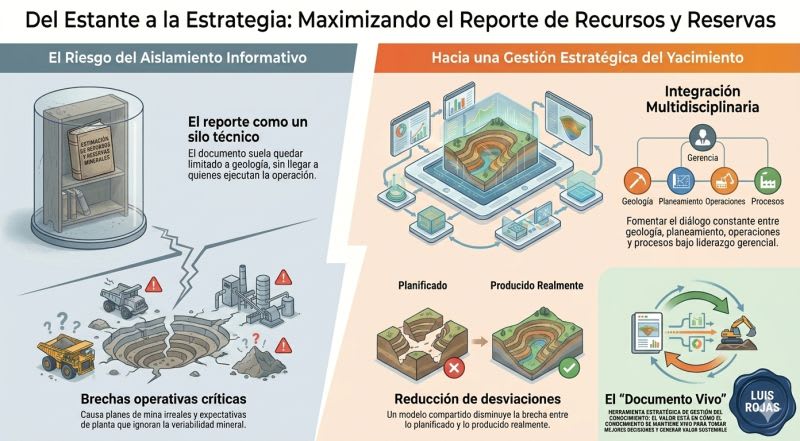
Reserves Reporting: It’s a Summary, Not a Standalone Study

Too often, Reserves reporting is misunderstood—especially by non-technical stakeholders—as a self-contained exercise. In reality, reporting Mineral Reserves in accordance with the JORC Code (2012) or KCMI is not an objective in itself. It is the formal summary of a Life-of-Mine plan that has already been developed to a sufficiently detailed level. As per JORC Clause 29: "A Mineral Reserve is... defined by studies at Pre-Feasibility or Feasibility level as appropriate that include application of Modifying Factors." In operating mines, this study is typically the Budget-level Life-of-Mine Plan—aligned with AACE Class 2 estimates under Recommended Practice 47R-11, a framework also recognised by CRIRSCO. 📌 Key Point: A Reserve cannot be declared without a supporting mine plan. Attempting to do so is not only non-compliant, it risks misleading stakeholders. ✅ The Reserves statement is the output, not the input or objective, of mine planning.

Source: Credit to Keith Whitchurch
Reserves Reporting: It’s a Summary, Not a Standalone Study
ZVENIA Mining
Corporate at ZVENIA 08/08/2025

Cut-off equivalente em depósitos polimetálicos

Resumo: Em depósitos polimetálicos, a presença de múltiplos elementos economicamente valiosos dificulta a análise comparativa e a classificação de recursos. O conceito de teor equivalente surge como uma ferramenta fundamental para integrar diferentes metais a partir de um único parâmetro de valor, facilitando a avaliação técnica e econômica. Este artigo discute os fundamentos do cálculo de teor equivalente, sua aplicação em diferentes contextos geoeconômicos, limitações práticas e exemplos reais de sua utilização na indústria mineral. 1. Introdução Depósitos polimetálicos, como os de Cu-Au-Ag, Zn-Pb-Ag ou Cu-Mo-Au, representam desafios singulares para engenheiros de minas e geólogos econômicos devido à diversidade de elementos com diferentes valores de mercado, custos de recuperação e comportamentos metalúrgicos. Para facilitar a avaliação econômica e a comparabilidade entre blocos ou domínios de um depósito, utiliza-se o conceito de teor equivalente (equivalent grade), convertendo todos os teores ao equivalente de um único metal de referência. 2. Conceito de Teor Equivalente O teor equivalente representa o teor de um único metal que geraria o mesmo valor econômico que a combinação de metais presentes. Ele permite, por exemplo, expressar teores de ouro e prata em termos de equivalente ouro (AuEq) ou cobre e molibdênio em termos de equivalente cobre (CuEq). A fórmula básica do teor equivalente é: 2.1 Tipos de Teor Equivalente A aplicação do conceito de teor equivalente pode assumir diferentes abordagens conforme o objetivo do estudo, o nível de conhecimento do depósito e a natureza dos produtos gerados. Os principais tipos de teor equivalente incluem: a) Teor Equivalente Baseado em Preço de Mercado (ou Valor Bruto) Este é o tipo mais comum e representa o valor dos diferentes metais com base nos seus preços brutos de mercado, sem considerar custos de recuperação metalúrgica, transporte ou comercialização. Embora seja útil para comparações iniciais e classificações exploratórias, tende a superestimar o valor real dos componentes do minério. b) Teor Equivalente Metalúrgico (ou Teor Equivalente com Recuperação) Neste caso, as recuperações metalúrgicas são incorporadas no cálculo, tornando o resultado mais representativo da realidade de uma futura operação. É amplamente utilizado em estudos de viabilidade, estimativas de recursos e projetos com definição de rota de processo conhecida. c) Teor Equivalente Econômico (ou Teor Eq com Receita Líquida) Este é o mais completo e acurado, considerando não apenas recuperação metalúrgica, mas também custos operacionais (tratamento, refino, transporte, royalties, penalidades). Converte todos os elementos em valor líquido recuperável em termos de um único metal, podendo ser utilizado para análise econômica de cenários e comparação entre projetos. 3. Aplicações Práticas 3.1 Avaliação Econômica Preliminar Durante estudos de scoping e pré-viabilidade, o teor equivalente fornece uma estimativa simplificada de valor de um corpo mineral, ajudando na seleção de alvos de perfuração ou na modelagem preliminar de recursos. 3.2 Seleção de Cut-off É comum definir o cut-off em termos de teor equivalente, como por exemplo: 4. Exemplo de Cálculo Considere um depósito com os seguintes parâmetros: Teor Cu: 0,5%, Recuperação Cu: 90%, Preço Cu: US$ 9.000/t Teor Au: 0,4 g/t, Recuperação Au: 80%, Preço Au: US$ 2.000/oz 1 oz = 31,1035 g Convertendo o teor de ouro para equivalente cobre: CuEq(Au) = 0.4*(0.80*2000*(1/31.1035))/(0.90*9000) = 0.254% CuEqTotal (Au) = 0.5% + 0.254% = 0.754% 5. Limitações do Método Volatilidade de preços: Alterações nos preços de mercado afetam diretamente os teores equivalentes. Recuperações distintas: Nem todos os metais têm recuperações previsíveis ou constantes. Penalidades metalúrgicas: Certos elementos podem impactar negativamente o processo ou o concentrado final. Riscos jurídicos/fiscais: A comercialização de determinados metais pode ser mais onerosa em certas jurisdições. 6. Considerações Finais O uso de teor equivalente é uma prática consolidada na engenharia de minas, sendo uma ferramenta essencial para análise de viabilidade técnica e econômica de depósitos complexos. No entanto, seu uso deve ser criterioso, sempre baseado em premissas atualizadas de preço, recuperação e fluxo de processo. Referências CRIRSCO (2019). International Reporting Template for the Public Reporting of Exploration Results, Mineral Resources and Mineral Reserves. SME (2011). Mining Engineering Handbook. AusIMM (2020). Monograph 30 - Mineral Resource and Ore Reserve Estimation. JORC Code (2012). Australasian Code for Reporting of Exploration Results, Mineral Resources and Ore Reserves. David Drumond - Engenheiro de Minas/ Doutor em Engenharia de Minas, Metalurgia e Materiais

Source: Credit to David Alvarenga Drumond
Cut-off equivalente em depósitos polimetálicos
ZVENIA Mining
Corporate at ZVENIA 08/08/2025

Erreurs fréquentes à éviter en analyse géométrique des blocs miniers

Dans l’estimation et l’exploitation des blocs miniers, certaines erreurs peuvent coûter cher. En voici quelques-unes que j’ai pu observer ou éviter : 1️⃣ Mauvais choix de dimensions de bloc : des blocs trop grands masquent les variations de teneur, ceux trop petits surchargent les calculs. 2️⃣ Ignorer la dilution : négliger la dilution géologique ou opérationnelle fausse la rentabilité réelle. 3️⃣ Sous-estimer les pertes minières : oublier les zones inaccessibles ou les chantiers non récupérables biaise le modèle. 4️⃣ Utiliser une densité générique : chaque lithologie a sa propre densité ; la précision est essentielle pour un tonnage fiable. 5️⃣ Mal définir le seuil de coupure (cut-off) : un cut-off mal calculé conduit à l’exploitation de blocs non rentables… ou au rejet de blocs riches. 6️⃣ Absence de validation terrain : sans recouper le modèle avec les données de production, on reste dans la théorie. 📌 Une bonne analyse géométrique repose sur des données solides, des hypothèses réalistes et une collaboration étroite entre géologues, ingénieurs et métallurgistes.

Source: Credit to Bernard Musafiri Pauni
Erreurs fréquentes à éviter en analyse géométrique des blocs miniers
ZVENIA Mining
Corporate at ZVENIA 27/06/2025

Mining Terms : Grade and Cut-Off Grade

In mining projects, determining the value of ore is based not only on what is extractable, but also on what is economically worth extracting. At this point, two basic concepts come into play: Grade and Cut-Off Grade. 🟢 Grade: It is the proportion of precious metal contained in an ore. This rate; In ore analysis, it is specified in grams per ton (g/t) or percentage (%). Examples: • 4 grams of gold → 4 g/t Au in 1 ton of ore • 1.8% copper → 1.8% Cu in 1 ton of ore 🟠 Cut-Off Grade: It is the minimum metal ratio that the ore must have in order to be put into operation. This value; Metal prices are calculated based on production costs, enrichment yield, and even future economic projections. 🖊️ Simply: • Grade = How much precious metal is in the ore? • Cut-Off Grade = Is that ratio valuable enough to operate? When grade and cut-off grade are evaluated together, it reveals whether the mining operation will be economically sustainable. Therefore, it is imperative that engineers who are responsible for strategic decision-making in mining systematically evaluate laboratory data together with economic parameters. In this series, I not only define technical concepts, but also cover them in plain language, along with their place in the industry. We hope to make small but solid contributions to both students and engineers working in the field...

Source: Credit to Didar K
Mining Terms : Grade and Cut-Off Grade
Siyanda Senene
Mining Engineering at Mota-engil 06/05/2025

Mining Sequence Compliance: Maximizing Open Pit NPV

Core Principle & Context Maximizing open pit Net Present Value (NPV) fundamentally depends on strict adherence to the planned temporal and spatial mining sequence. Deviations directly erode planned value. This isn't just theoretical; it's a principle rigorously championed by planning experts like Dr. Theunis Otto and validated during my operational experience as Mining Manager at Kumba Iron Ore under his technical leadership. Dr. Otto has published peer reviewed papers that demonstrate that mining sequence compliance is foundational to financial success. Impact of Non-Compliance: Value Destruction ————————————————- Short-term production gains from out-of-sequence mining are often illusory, masking deferred liabilities such as escalating future stripping costs (the "stripping bow wave") and processing inefficiencies. The long-term consequences are more severe, including resource sterilization, reduced mine life, and heightened geotechnical risks. These factors invariably lower future cash inflows and increase costs, significantly reducing the overall project NPV compared to the optimized plan. Achievability of Compliance: Kumba Case Study ——————————————————————- Restoring compliance after deviation requires focus but is demonstrably achievable. At Kumba, a dedicated effort significantly improved spatial compliance, as evidenced by the 2018 performance graph. The then General Manager, Mr. Mapi Mobwano (M.Eng/MBA), seniore mining executive in Canada’s Arcelomittal, great strides were accomplished, moving non- compliance from dismissal to heroic recovery. The graph herewith shows the 2018 Kumba Iron Ore Spatial Compliance Improvement at Sishen Mine - In-sequence tonnes increased from 56% to 92%.This real-world result underscores that recovery is possible through disciplined management. Key Takeaways ——————————————————————- Protecting and maximizing long-term asset value demands executive commitment to mining sequence compliance. This involves: - Recognizing compliance as a key value driver, not just an operational metric. - Supporting rigorous reconciliation between plan and actuals. - Enabling strategic operational adjustments to return to sequence. - Fostering a culture of execution discipline. While operational flexibility is needed, adherence to the optimal mining sequence is paramount for delivering planned NPV and ensuring sustainable mine viability.

Mining Sequence Compliance: Maximizing Open Pit NPV
Previn Pillay
Member 04/05/2025

THE GREAT MINING PROJECT LIE—AND WHY YOU MUST BURN IT TO THE GROUND

Look around. The mining industry isn’t just broken—it’s designed to fail. 🚨 80% of mining megaprojects run over budget. 🚨 The average overrun is 43%. 🚨 Billions vanish every year with the same tired excuses. (McKinsey & Co., 2016) 🔹 Carmen de Andacollo Expansion (Teck Resources)—$25M over budget. 🔹 Oyu Tolgoi (Rio Tinto)—$1.45B over, 30 months late. 🔹 Newmont’s Conga Project—$5B dead in the water from regulatory chaos. Why? Because no one has the courage to kill bad projects before they kill themselves. --- THE 5 FATAL LIES OF MINING PROJECTS 1️⃣ “We’ve Done the Risk Analysis” ❌ No, you’ve built a PowerPoint illusion of control. ❌ Your models don’t survive contact with reality. 💀 Geopolitical risk? Ask the execs whose lithium projects just got nationalized. 💀 Community engagement? Ask Pebble Mine why it’s a $6B ghost town. 👉 Real leaders put risk at the core of execution—not in a slide deck. --- 2️⃣ “We Need to Keep the Project Alive” ❌ No, you’re propping up a zombie because no one wants to pull the plug. ❌ Bad projects don’t magically improve with more time and money. 💀 If a project fails the 90-day kill test, abandon it. 💀 If leadership won’t admit failure, they’ve already failed. --- 3️⃣ “We Have a Stakeholder Plan” ❌ No, you have a PR crisis strategy, not real engagement. ❌ Communities aren’t obstacles—they decide if your project lives or dies. 💀 60% of projects stall due to local resistance. 💀 Regulatory shutdowns are the #1 killer of billion-dollar mines. (Ernst & Young, 2021) 👉 If your project doesn’t have community backing from day one, it’s already dead. --- 4️⃣ “We’re Using the Best Tech” ❌ No, you’re using 1990s processes and calling it innovation. ❌ Your competitors are deploying AI and next-gen metallurgy while you optimize spreadsheets. 💀 If your tech isn’t cutting-edge, you’re already obsolete. 💀 The future of mining is being built right now—either you lead or you die. --- 5️⃣ “This Time, We’ll Get It Right” ❌ No, you’re repeating the same cycle and expecting a miracle. 💀 We don’t need another $5B vanity project. 💀 We need projects that pivot, adapt, and actually deliver. --- THE 5 LAWS OF PROJECT SURVIVAL 🔥 1️⃣ If it can’t be prototyped in 90 days, it’s a fantasy. 🔥 2️⃣ If it doesn’t have community buy-in, it’s already dead. 🔥 3️⃣ If the risk model isn’t brutal, you’re flying blind. 🔥 4️⃣ If leadership won’t kill a failing project, replace them. 🔥 5️⃣ If you aren’t embracing cutting-edge tech, you’re digging your own grave. --- ARE YOU THE ONE WHO WILL BREAK THE CYCLE? 🚨 The industry needs ruthless realists. 🚨 The industry needs leaders who don’t tolerate incompetence. 🚨 The industry needs YOU. Are you ready to build what actually works? Or will you keep watching history repeat itself?

THE GREAT MINING PROJECT LIE—AND WHY YOU MUST BURN IT TO THE GROUND
ZVENIA Mining
Corporate at ZVENIA 06/04/2025

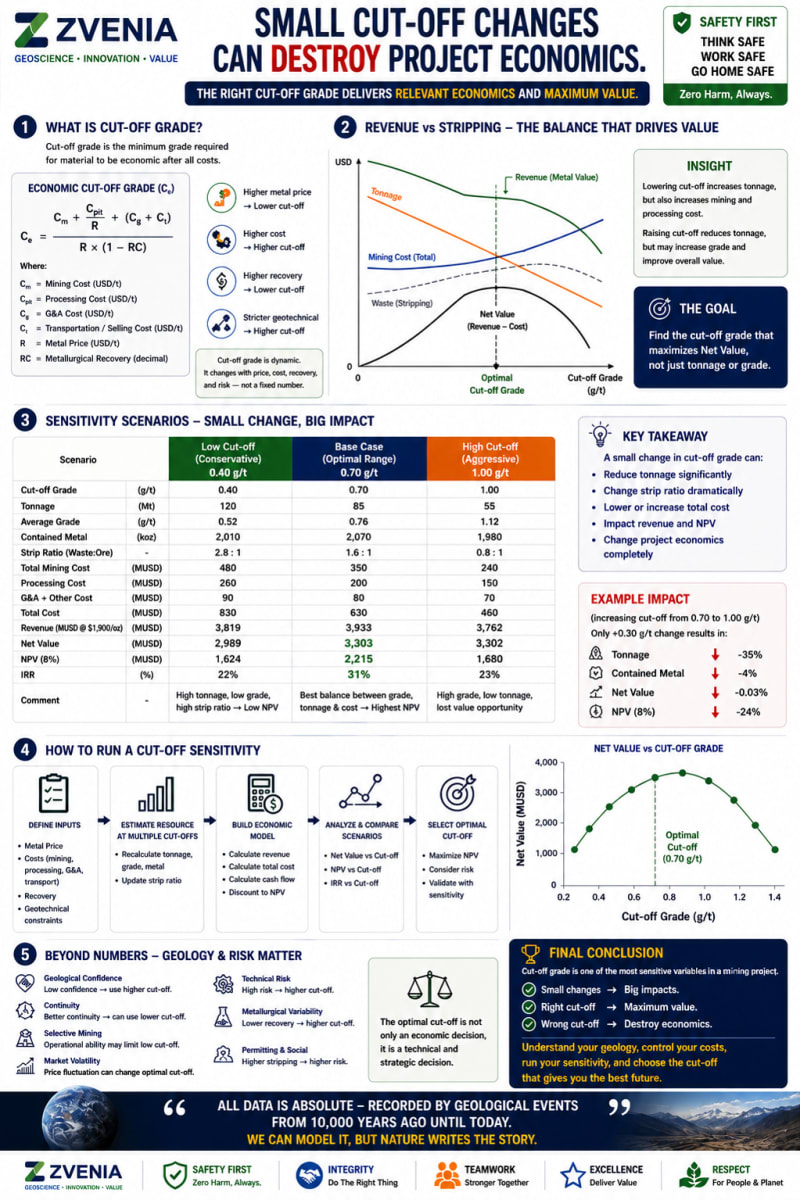
Importance of Cut-Off Grade – Maximizing Mining Profits & Sustainability (8 pages)

𝐈𝐦𝐩𝐨𝐫𝐭𝐚𝐧𝐜𝐞 𝐨𝐟 𝐂𝐮𝐭-𝐨𝐟𝐟 𝐆𝐫𝐚𝐝𝐞 𝐭𝐨 𝐌𝐚𝐱𝐢𝐦𝐢𝐬𝐞 𝐌𝐢𝐧𝐢𝐧𝐠 𝐏𝐫𝐨𝐟𝐢𝐭𝐬 & 𝐒𝐮𝐬𝐭𝐚𝐢𝐧𝐚𝐛𝐢𝐥𝐢𝐭𝐲 – 𝐇𝐨𝐰 𝐈𝐧𝐝𝐢𝐚𝐧 & 𝐆𝐥𝐨𝐛𝐚𝐥 𝐌𝐢𝐧𝐢𝐧𝐠 𝐢𝐧𝐝𝐮𝐬𝐭𝐫𝐲 𝐨𝐩𝐭𝐢𝐦𝐢𝐬𝐢𝐧𝐠 𝐢𝐭?? Cut-off Grade is the key to balancing profitability, resource utilization, and sustainability in mining. From Coal India’s opencast mines to NMDC’s iron ore strategy, setting the right cut-off grade ensures long-term success. Adjusting cut-off grades can impact NPV by ±5-16%, depending on production scale and ore type. Smart cut-off strategies mean higher revenues, lower costs, and sustainable operations. Global giants like BHP, Rio Tinto, and Newmont are using AI-driven cut-off grade optimization. Artificial Intelligence & Machine Learning are revolutionizing mining; Real-time grade control, predictive analytics, and automation can boost mine efficiency by 25% and reduce dilution losses by 18%. In Indian Mining scenario, from Hindustan Zinc Limited (HZL) to JSW Steel, mining giants are using dynamic cut-off grade adjustments to stay competitive.

Source: Credit to SHUVARTHY CHOWDHURY
ZVENIA Mining
Corporate at ZVENIA 17/03/2025

Why Cut-Off Grade is Crucial in Mining Operations

🚀 The cut-off grade is a key parameter in mining, defining the minimum concentration of a valuable mineral or metal required for material to be processed profitably. It separates Ore (economically viable material) from waste (non-viable material). Here’s why it’s so important: 1️⃣ Economic Viability 🔹 Ensures only profitable material is processed. 🔹 Balances mining, processing, and refining costs against revenue from selling the extracted commodity. 2️⃣ Resource Optimization 🔹 Maximizes the value of extracted resources by focusing on higher-grade material. 🔹 Reduces unnecessary extraction and processing of low-grade material, saving costs and resources. 3️⃣ Mine Planning & Design 🔹 Influences pit design, production scheduling, and reserve estimation. 🔹 Determines the mine’s life and total economically viable ore tonnage. 4️⃣ Profit Maximization 🔹 Adjusts based on market conditions (e.g., metal prices, processing costs). 🔹 Lower cut-off grades during high prices allow processing of lower-grade material; higher cut-off grades during low prices focus on high-grade material. 5️⃣ Environmental Impact 🔹 Minimizes waste material, reducing storage and handling needs. 🔹 Lowers energy consumption and greenhouse gas emissions by avoiding low-grade material processing. 6️⃣ Financial Reporting & Valuation 🔹 Classifies mineral resources and reserves, critical for investor and regulatory assessments. 7️⃣ Risk Management 🔹 Mitigates risks from fluctuating commodity prices, cost changes, and ore quality uncertainties. 🚀 Factors Influencing Cut-Off Grade: 🔸Commodity prices: Higher prices justify lower cut-off grades. 🔸 Processing costs: Higher costs require higher cut-off grades. 🔸 Mining costs: Deeper or complex deposits may raise cut-off grades. 🔸 Recovery rates: Efficient processing lowers cut-off grades. 🔸 Market demand: Changes in demand impact economic viability. ✅ In summary, the cut-off grade is a dynamic, essential tool in mining, balancing economic, technical, and environmental factors to ensure profitability and sustainability.

Source: Credit to Mahielden Hamid
Why Cut-Off Grade is Crucial in Mining Operations
ZVENIA Mining
Corporate at ZVENIA 06/02/2025

Factors Affecting the Cut-off Grade in Mining

The Cut-off Grade is one of the most critical factors determining whether an ore deposit is economically viable for mining. It represents the minimum metal concentration required to make extraction profitable. Several factors influence this threshold, including: 🔸 Metal Market Price: The higher the metal price, the more economically viable it becomes to mine lower-grade ore. Conversely, if prices drop, certain ore portions may become uneconomical to extract. 🔸 Extraction and Processing Costs: These include drilling, blasting, transportation, grinding, and mineral processing expenses. The higher these costs, the higher the Cut-off Grade, as a higher concentration is needed to cover expenses and generate profit. 🔸 Transportation and Storage Costs: If a mine is located in a remote area or requires costly transportation, the minimum acceptable ore grade may increase. 🔸 Available Technology: Advances in technology can reduce extraction and processing costs, allowing for a lower Cut-off Grade and making previously uneconomical ore deposits viable. 🔸 Environmental and Regulatory Factors: Government regulations and environmental restrictions can impact overall mining costs, influencing the minimum ore grade required for profitability. 🔸 Geological and Engineering Factors: These include ore composition, impurity levels, depth, and extraction difficulty, all of which affect mining feasibility and efficiency. 🔹 Key Takeaway: The Cut-off Grade is not a fixed value—it fluctuates based on economic conditions, technological advancements, and operational costs. Understanding these factors helps mining companies make informed decisions about resource extraction.

Source: Credit to Yousuf Shawky
Factors Affecting the Cut-off Grade in Mining
ZVENIA Mining
Corporate at ZVENIA 05/11/2024

Taylor´s mine life rule

In theory, it´s possible to calculate an optimum rate of extraction from an ore body, knowledge or precise assumption of the total tonnage and its sequential grades (including the effects of varying the cutoff grade), and of all cost and product prices throughout the project life is required. 💰 The maximized quantity might be total profit, total cash flow, the net present value or the internal rate of return. Thus when allowing for the practical inaccuracies of data, the calculated results cannot be considered critical. Hence, although valid, a highly mathematical approach to mine life determination is seldom of practical use. 🔍 Too low a production rate sacrifices possible economies of scale and defers possible profits too far into the future. Conversely, too high a rate may drive up the project’s capital cost beyond any ability to repay within the shortened life. Too high an output may be unsalable, while too short a life for a large enterprise may be wholly undesirable on social grounds. In real life, rates of output are strongly limited or influenced by practical problems. One of the most important of these is working space. A mine may be able to increase output as it gets older solely because its ever expanding workings offer more points of attack. 🚚 In an open pit the working space for equipment and hence maximum production rate tends to vary with the area (ft2) exposed while tonnage varies with volume (ft3). Thus one might expect the production rate for groups of more-or-less similarly shaped ore bodies to be proportional to the two-thirds power of the ore body tonnage. 🧮 The life would then be proportional to the cube root of that tonnage (F1). In this equation, it is immaterial whether short or metric tons are used. It is more convenient to use quantities expressed in millions and except for special conditions, the practical range of variation seems to lie within a factor of 1.2 above and below (F2). Taylor studied many actual projects (some operating and others only planned) involving a wide range of ore body sizes, and shapes (other than thin deposits of very large lateral extent), for which the total ore reserves were reasonably well known before major design commenced. He found that the extraction rates seemed proportional to the three quarters power of the ore tonnage rather than the two-thirds power. The designed lives were proportional to the fourth root of the tonnage. 💡 The rule provides an appropriate provisional output rate for preliminary economic appraisals and will define a range of rates for comparative valuation at the intermediate stage after which a preferred single rate can be selected for use in the feasibility study. 🖼️ The empirical formula (F2) generates the values presented in table. 📜 Reference: W. Hustrulid, M. Kuchta & R. Martin, Open pit mine planning & design Vol.1 Fundamentals, CRC Press.

Source: Credit to Alfonso Lozada Pérez
Taylor´s mine life rule
Martine Mshana
Mining Engineer at AngloGold Ashanti - Geita Gold Mine 23/08/2024

Understanding Cut-off grade in mining - Part 2 (13 pages)

Unlocking the Secrets of Cut-Off Grade Optimization in Mining. Curious about how mining projects determine which parts of a deposit are worth extracting? The answer lies in cut-off grade optimization—a critical, yet often overlooked aspect of mine planning. In my latest article, I delve into the most effective methods of cut-off grade optimization, explore lesser-known strategies, and discuss the key factors that influence these crucial decisions. Whether you’re a seasoned professional or just curious about the inner workings of mining, this piece offers valuable insights that could change how you view mining operations. Ready to dive in? 🛠️ Read the full article and discover how mastering cut-off grade optimization can transform the profitability and longevity of mining projects. 👉 Read the Article Now

ZVENIA Mining
Corporate at ZVENIA 12/08/2024

Initial Project Evaluation Manual for the Mining Industry (153 pages)

I am thrilled to announce the release of the guideline I developed, "Initial Project Evaluation Manual for the Mining Industry"! 🎉 This guide is designed to try to assist both new and existing players in the mining sector in conducting preliminary evaluations for investment decisions regarding mining projects. Why This Manual? Mining is a cornerstone of our global push towards sustainability, green energy, and net-zero initiatives. With critical minerals becoming increasingly essential in our daily lives, it is more important than ever to develop the mining industry efficiently and responsibly. What’s Inside? 🔍 Step-by-Step Guidance: From resource and reserve quality to market conditions, regulatory frameworks, community relationships, and economic viability, this manual covers all key aspects of initial project evaluation. 📊 Informed Decision-Making: Learn how to quickly determine whether a project warrants further inspection or due diligence, saving you valuable time and resources. 🌍 Global Insights: Drawing from my extensive experience across Africa, Latin America, the Caribbean, Europe, and North America, this manual incorporates lessons learned from both successful projects and those with room for improvement. 🤖 Efficiency and Innovation: By integrating traditional wisdom with innovative tools, this manual helps you navigate the complexities of the mining industry effectively. Key Benefits: ✅ Assess the economic potential and viability of mining projects ✅ Identify critical risks and challenges early ✅ Align project opportunities with your strategic objectives ✅ Make informed decisions to optimize resource allocation Who Is It For? Whether you are an industry veteran or a newcomer, this manual is designed to be user-friendly and accessible. It demystifies mining concepts, ensuring that more people from diverse backgrounds can contribute to the industry's growth. Feel free to reach out if you have any questions or need further information. Let’s make informed, impactful decisions in the mining sector!

Source: Credits to Christian Aramayo

Preview of ZVENIA Mining

Sign up to get unlimited content. No credit card needed.

Sign Up Free