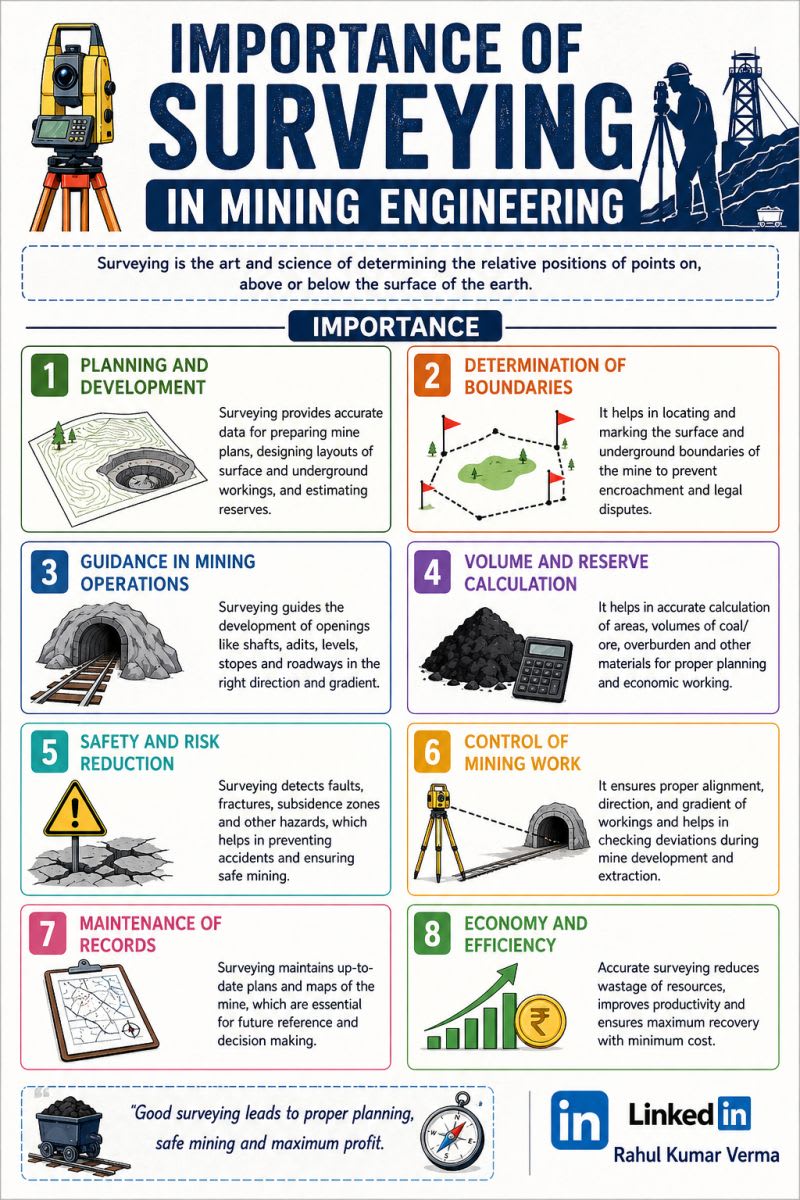




Mine surveying involves the accurate measurement and mapping of mine workings, both on the surface and underground. It is a critical function that ensures safety, supports efficient operations, and ensures legal compliance throughout the mine lifecycle: from exploration and construction to production and final closure/reclamation.
🔍 Key Responsibilities & Functions
1. Exploration & Development
· Staking Claims: Precisely demarcating the boundaries of mining leases and claims.
· Topographic Mapping: Creating detailed maps of the land surface before any mining begins.
· Drill Hole Location: Accurately positioning and surveying drill holes for resource estimation.
2. Operational & Production Phase
· Volume Calculation (Volumetrics): Measuring stockpiles of ore and waste material to calculate volumes and tonnages. This is essential for production accounting and reconciliation.
· Stakeout and Setout: Marking the location for new infrastructure, roads, ramps, and drill patterns on the ground.
· Mine Planning Integration: Providing accurate data for the Mine Planning department to design pits, underground stopes, and waste dumps.
3. Safety & Monitoring
· Stability Monitoring: Using specialized equipment to monitor highwalls, pit slopes, tailings dams workings for any movement or deformation that could lead to a collapse.
· Avoiding Breaches: Ensuring mining does not accidentally breach into adjacent properties, old workings, or hazardous zones.
· Volume of Blasts: Surveying blast holes and calculating the volume of rock to be blasted for precise explosive charging.
🛠️ Technologies Used in Mine Surveying
Modern mine surveyors use a suite of advanced technologies:
-GNSS (GPS) Provides real-time, highly accurate positioning for surface surveying, vehicle tracking, and machine guidance.
-3D Laser Scanning (LiDAR) Creates millions of data points to generate a highly detailed "point cloud" of a pit, stockpile. Ideal for volume calculations and monitoring complex geometries.
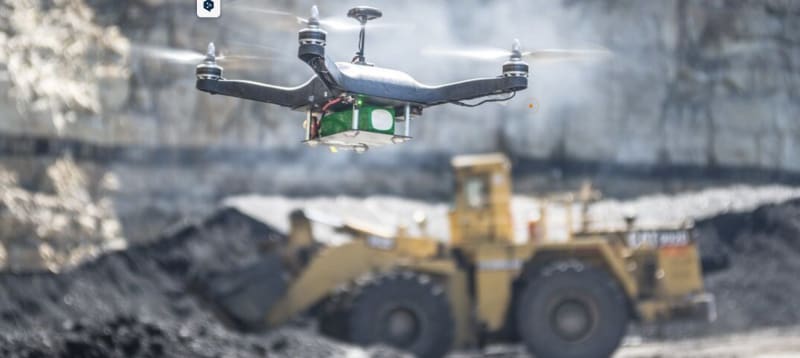
-Drones (UAVs) Equipped with cameras or LiDAR, drones can quickly and safely survey large or inaccessible areas like open pits, tailings dams, and stockpiles, generating orthomosaics and digital terrain models.
-GIS (Geographic Info Systems) The platform for managing, analyzing, and visualizing all spatial data related to the mine site.
-Survey & Monitoring Sensors Robotic total stations and radar systems for continuous, automated monitoring of critical slopes and structures.
📊 Deliverables of a Mine Surveyor
The work of a mine surveyor results in critical documents and data:
· Plans and Maps: Surface plan.
· Volume Reports: Monthly reports on ore mined, waste moved, and stockpile inventories.
· Digital Terrain Models (DTMs) & 3D Models: Digital representations of the mine's topography and geology.
· Geodetic Control Network: A network of precisely located.
La conformité au plan s'est avérée être l'un des indicateurs de performance clés (KPI) les plus
importants dans le secteur minier.
La conformité au plan consiste à suivre et à évaluer la corrélation entre ce qui est extrait de manière opérationnelle sur le terrain (données réelles) et ce qui était prévu (données planifiées) pour être extrait au cours d'une période spécifique.
Ceci est effectué principalement pour rapporter spatialement et quantitativement, le matériel qui était Planifié et Miné, Planifié et Non Miné ainsi que Miné et Non Planifié.
Le succès d'une mine dépend dans une certaine mesure des éléments clés suivants : la qualité et
l'intégration des plans en place (du long au court terme) et de l'exécution des plans définis. Il est
essentiel de structurer les plans d'exploitation et les activités à plus court terme de manière à ce
que la mine soit évidemment en mesure d'atteindre les objectifs opérationnels et financiers. Il est
encore plus important de s'assurer que les plans et activités opérationnels à court terme sont
exécutés d'une manière qui ne compromet pas la capacité de la mine à respecter le plan à long
terme défini.
Lectura esencial para quienes miden, proyectan y construyen el territorio
Me permito recomendar una obra que ha marcado generaciones de ingenieros topógrafos, constructores y proyectistas: el “Tratado de Topografía” de Raymond E. Davis, acompañado por Francis S. Foote y Joe W. Kelly. Más que un simple libro, este compendio es un pilar académico y técnico que atraviesa con rigor los fundamentos, métodos modernos e históricos, instrumentos y aplicaciones de la topografía clásica y aplicada.
📚 En su quinta edición, cuidadosamente traducida por el Dr. José María Mantero, este tratado no solo sirve como texto para estudiantes, sino como una herramienta de consulta permanente para profesionales. Su enfoque exhaustivo abarca desde el uso del teodolito y la cinta hasta los levantamientos fotogramétricos, caminos, minas, obras civiles y medición de caudales. Con ejemplos, problemas de campo, fundamentos astronómicos y prácticas de gabinete, logra un equilibrio entre teoría y experiencia.
🌍 Como docente y profesional, valoro especialmente su énfasis en la precisión, trazabilidad y responsabilidad del topógrafo frente a la sociedad. Es un recordatorio de que cada plano, cada curva de nivel y cada punto georreferenciado tienen impacto en las decisiones territoriales, ambientales y técnicas.
📐 Si trabajas en diseño de infraestructura, catastros, obras civiles, hidráulicas o minería, este tratado sigue siendo una fuente confiable y profunda para revisar conceptos, resolver problemas y formar nuevas generaciones con base sólida.
🔗 La topografía no ha pasado de moda: se ha modernizado, se ha digitalizado, pero sigue siendo el arte y la ciencia de conocer la tierra con exactitud.
Authors:
R A Y M O N D E. D A V IS
F R A N C I S S . F O O T E y J O E W . K E L L Y
Profesores de Ingeniería en la Universidad de California
Versión española de
JO SE MARIA MANTERO
Dr. Ingeniero Geógrafo
In today’s fast-evolving mining sector, drone technology is doing more than capturing beautiful aerial shots — it's transforming how we plan, operate, and monitor mining sites across Nigeria.
As a mine surveyor deeply involved in field operations, I've witnessed firsthand how high-resolution drone data is driving a new era of precision, safety, and cost-efficiency.
🔍 Here’s how drones are making a difference in Nigerian mining:
✅ Rapid Topographic Surveys: What used to take weeks can now be done in hours — reducing manpower, improving accuracy, and saving cost.
✅ Real-time Monitoring: Frequent site updates via drone data provide mine managers with actionable insights on progress, safety concerns, and environmental impact.
✅ Volume Calculations: Stockpile and overburden volumes are now measured with centimetre-level accuracy, aiding better decision-making and inventory control.
✅ Environmental Compliance: Drones assist in monitoring land disturbance, ensuring mining operations adhere to Nigeria’s environmental regulations.
✅ Improved Safety: High-risk zones can be surveyed remotely, reducing human exposure to hazardous areas.
As Nigeria continues to attract both local and international investors, integrating drone data into mining operations is no longer a luxury — it’s a necessity for sustainable, data-driven growth in the extractive sector.
At Sayech Mineral and Mining Limited, we’re committed to harnessing these technologies to reshape the future of mining in Nigeria.
📡 Interested in exploring drone solutions for your mining site? Let’s connect and discuss how drone intelligence can power your operations.
A Total Station is a surveying instrument that combines an electronic theodolite (for measuring horizontal and vertical angles) and an Electronic Distance Measurement (EDM) device. It measures angles and distances and converts them into coordinates using geometric equations.
1. Conversion from Polar to Cartesian Coordinates (XYZ)
When the instrument measures:
Horizontal angle (θ),
Vertical angle or elevation angle (α),
Slope distance (S),
It calculates the coordinates of the unknown point using the following equations:
X = X₀ + S × cos(α) × sin(θ)
Y = Y₀ + S × cos(α) × cos(θ)
Z = Z₀ + S × sin(α)
Where:
(X₀, Y₀, Z₀) are the coordinates of the instrument (station),
θ is the horizontal angle (from a reference direction),
α is the vertical angle (from the horizontal plane),
S is the slope distance to the point.
2. Horizontal Distance and Vertical Difference
Horizontal distance (H) = S × cos(α)
Vertical difference (ΔZ) = S × sin(α)
3. Angle Calculation Using the Cosine Rule
To find angles in a triangle between three points:
cos(θ) = (a² + b² - c²) / (2ab)
4. 3D Distance Between Two Points
To calculate the spatial distance between two points:
D = √[(X₂ - X₁)² + (Y₂ - Y₁)² + (Z₂ - Z₁)²]
1. Con Puntos de Control en Tierra (GCPs).
Precisión: Alta precisión absoluta (centimétrica).
Uso de GPS RTK/PPK: Complementa o refuerza la precisión.
Aplicaciones: Topografía, Catastros, Obras Civiles, Ingeniería.
Ventajas: Mayor confianza en la georreferenciación y mejores resultados.
Desventajas: Requiere más tiempo en campo y equipo GNSS.
2. Sin Puntos de control en Tierra (Solo GPS del dron)
Precisión: Relativa aceptable, pero baja precisión absoluta.
Uso del GPS del dron: Dependencia total del GPS embarcado, es decir sin correcciones.
Aplicaciones: Agricultura, monitoreo visual, inspecciones rápidas.
Ventajas: Más rápido menos equipamiento en campo.
Desventajas: Error absoluto puede ser de varios metros depende del GPS del dron.
¿ Por qué es importante esta diferencia?
* Proyectos de ingeniería necesitan precisión absoluta para posicionar estructuras con exactitud.
* En monitoreo periódico si no hay GPS, los modelos pueden no coincidir espacialmente entre campañas.
* El uso del GCPs reduce el error en el procesamiento fotogramétrico (RMS), especialmente en zonas con más señal GNSS.
Navigating Precision in Drone Mapping 🌐✈️
Embarking on a mapping mission? 🗺️ Let's explore the pros and cons of three pivotal technologies: Ground Control Points (GCP), Real-Time Kinematics (RTK), and Post-Processed Kinematics (PPK). 🛰️💡
Ground Control Points (GCP):
Pros:
1-Absolute Accuracy: GCPs provide a benchmark for absolute accuracy, ensuring reliable georeferencing.
2-Versatility: Suitable for various mapping applications and projects of different scales.
3-Cost-Effective: Initial setup costs might be lower compared to some RTK/PPK solutions.
Cons:
1-Time-Consuming: Manual placement and surveying of GCPs can be time-intensive.
2-Logistical Challenges: Accessibility to GCP locations may pose logistical challenges in remote or rugged terrains.
3-Dependency on Surveyor Expertise: Accuracy heavily depends on the surveyor's expertise in placing GCPs.
Real-Time Kinematics (RTK):
Pros:
1-Real-Time Corrections: Provides real-time, centimeter-level accuracy during drone flights.
2-Reduced Ground Control Needs: Decreases the dependency on a dense network of GCPs.
3-Time Efficiency: Accelerates data collection with instant corrections.
Cons:
1-Limited Range: RTK requires a continuous connection to a base station, limiting operational range.
2-Signal Interference: Can be susceptible to signal interruptions in urban canyons or areas with dense vegetation.
3-Cost: RTK-enabled equipment tends to be more expensive than traditional setups.
Post-Processed Kinematics (PPK):
Pros:
1-Flexibility: Eliminates the need for real-time communication, allowing more flexibility in mission planning.
2-Centimeter-Level Accuracy: Achieves high accuracy through post-processing, comparable to RTK.
3-Reduced Dependency on GCPs: Minimizes the necessity for an extensive GCP network.
Cons:
1-Post-Processing Time: Requires additional time for post-processing, impacting real-time decision-making.
2-Equipment Cost: PPK-enabled drones and software may have a higher upfront cost.
3-Learning Curve: Mastery of post-processing workflows may be needed for optimal results.
Image credit: ageagle.com
You can explore more about world wide RTK services at: RTKdata.com
In the dynamic landscape of drone mapping, each technology has its role. Choose wisely based on project requirements, terrain, and budget. Let's elevate our mapping game! 🌐✨
RTK (Real-Time Kinematic ) is a GPS correction technique that provides centimeter-level accuracy by using real-time satellite corrections, transmitted from a base station to a rover (the receiver on your survey tool, drone, or tractor). Here’s how RTK is reshaping industries:
Precision Surveying 📏
From boundary marking to infrastructure layout, RTK enables surveyors to establish points with pinpoint accuracy, minimizing rework and ensuring projects stay on track.
Construction & Urban Development 🏗️
In construction, RTK is invaluable for mapping and ensuring that every detail matches the design plan, speeding up timelines and lowering costs.
💡 Why Centimeters Matter
The difference between a few centimeters might seem trivial, but in fields like surveying, it’s the difference between efficiency and costly mistakes. RTK delivers that crucial accuracy, turning projects from “good enough” into flawlessly executed.
As we move toward an era of smart cities and autonomous machines, RTK is the backbone that will keep everything in sync. Thinking about adding RTK to your workflow? Now’s the time. 🔥
Image credit: Emlid
A conversation last week sparked a question that’s been nagging at me: why do some view Key Performance Indicators (KPIs) as meaningless paper exercises? For mine surveyors, whose work underpins the safety, efficiency, and profitability of mining operations, this perception feels particularly off-base. The tasks surveyors perform—measuring excavations, ensuring compliance, and maintaining precise records—have tangible value, yet quantifying their impact through KPIs often falls short. This article explores the critical contributions of surveyors, drawing on their day-to-day responsibilities, and proposes a fresh perspective on how KPIs can better reflect their role in mining’s bottom line.
=> The Heart of Mine Surveying
Surveyors are the custodians of spatial accuracy in mining. Their work ensures that every dig, blast, and haul aligns with the mine’s design, directly affecting costs, safety, and regulatory compliance. Let’s break down their key responsibilities and why they matter.
=> Timely End-of-Month Reports
End-of-month (EOM) survey measurements are a cornerstone of operational reporting. A late EOM report can ripple through an operation, inflating labor costs as finance teams scramble to catch up, eroding management’s trust in data, and delaying decisions that could save millions. In some contracts, late reporting even triggers financial penalties, squeezing cash flow. Surveyors using tools like Datamine Studio ensure timely, accurate EOM reports, providing the data backbone for strategic decisions.
=> Drive Compliance
Mining without a design is illegal in most jurisdictions, and surveyors ensure excavations stay within specified parameters. Non-compliant drives—whether overbroken or underbroken—carry steep costs. Overbreak increases material movement, hauling, and support expenses, while diluting ore with waste rock. It can also destabilize pillars in room-and-pillar operations, risking collapses, or enlarge voids, spiking ventilation costs. Surveyors’ compliance analytics pinpoint these issues, saving costs and enhancing safety by aligning excavations with geotechnical recommendations.
=> Shotcrete Measurement
Shotcrete, a sprayed concrete used for support, demands precise measurement to verify coverage and thickness. Surveyors’ detailed surveys—using total stations or point clouds—enable accurate surface models, optimizing material use and reducing waste. This precision ensures contractors are paid fairly, supports quality control, and prevents structural failures, all while providing as-built records for future maintenance. The result? Cost efficiency and safer underground environments.
=> Record Keeping
Mine plans, built from meticulous surveyor data, are high-value assets. Peg coordinates, observation logs, and development records form a cohesive picture of the mine’s progress. Accurate plans enhance safety by identifying hazards, like undercutting risks in SLOS retreats, and ensure compliance with regulators like South Africa’s DMR or Zambia’s MSD. They also streamline resource planning, from equipment to manpower, boosting operational efficiency and stakeholder confidence.
=> Spatial Control
Surveyors provide the visual references—via survey notes or memos—that guide miners to execute designs accurately. These instructions, generated quickly with tools like Datamine, minimize downtime and ensure precise dimensions, dips, and directions. Efficient memos reduce overbreak, lower material costs, and enable surveyors to cover more headings, directly boosting productivity.
=> Volumetric Measurements
Whether it’s ore, waste, or access tunnels, surveyors measure the volumes moved across the mining value chain. These measurements feed accounting inventories, optimize resource allocation, and ensure environmental compliance by tracking waste generation. Accurate volumetric reports also flag safety risks, like unstable slopes, and support reclamation planning, preventing costly miscalculations down the line.
=> Quality Control in Open Pits
In open-pit mining, surveyors ensure the pit shell matches the design, adhering to geotechnical limits and repose angles. By collecting spatial data to build digital terrain models, they highlight deviations, enabling early interventions to prevent slope failures or regulatory violations. Real-time monitoring optimizes operations, cuts downtime, and protects the environment by keeping excavations within limits.
=> Subsidence Monitoring
Surveyors support geotechnical engineers by tracking ground movement, measuring points over time to calculate velocity and predict subsidence risks. This data protects miners, nearby infrastructure, and ecosystems, while improving subsidence prediction models. Timely monitoring allows operations to implement preventive measures, safeguarding both people and profits.
=> The KPI Conundrum
Each of these tasks delivers clear value, but translating them into KPIs is tricky. Some contributions, like drive compliance analytics, have a direct line to profitability—reducing overbreak can save millions in material costs. Others, like Weisbach triangle quality or gyro base establishment, are less understood outside surveying circles, making their value harder to quantify. Yet, these “esoteric” tasks ensure the precision that prevents costly errors or safety incidents.
The skepticism about KPIs often stems from a disconnect: metrics that don’t reflect the core business. If a surveyor’s KPI is tied to the number of memos or survey notes issued, it misses the bigger picture—how those memos reduce overbreak or downtime. A better approach is to align KPIs with mining outcomes:
1- Accuracy: Percentage of excavations within design tolerances, reflecting compliance and cost savings.
2- Timeliness: Delivery of EOM reports within deadlines, ensuring operational continuity.
3- Safety: Number of hazards identified through monitoring, like subsidence or slope risks.
4- Efficiency: Reduction in material waste or downtime due to precise spatial control.
5- Compliance: Adherence to regulatory standards, avoiding fines and building stakeholder trust.
=> A Call for Clarity
Surveyors are not just measuring points—they’re enabling smarter, safer, and more profitable mining. Yet, their value is often underappreciated because KPIs fail to capture the full scope of their impact. By rethinking KPIs to focus on outcomes—cost savings, safety, compliance—mines can better recognize surveyors’ contributions. Tools like Datamine Studio amplify this impact, streamlining data collection and reporting, but the real shift lies in how we measure success. Let’s move beyond paper exercises and craft KPIs that reflect the true worth of surveyors’ work. After all, in mining, precision isn’t just a task—it’s the foundation of progress.
Mine Surveying Notes are crucial for maintaining accurate records of mine workings, essential for safety, efficiency, and profitability, encompassing measurements, calculations, and mapping of the mine's layout
Here's a breakdown of what mine survey notes entail:
=>Purpose of Mine Survey Notes:
Safety:
Identifying potential hazards, ensuring safe passage and ventilation, and supporting emergency planning.
Efficiency:
Optimizing mining operations, planning new workings, and ensuring efficient ore extraction.
Profitability:
Accurate mapping and resource estimation contribute to better planning and resource utilization, ultimately increasing profitability.
Legal Compliance:
Providing documentation for regulatory bodies and demonstrating adherence to safety standards.
Technical Support:
Providing data for mine planning, design, and production(mining), as well as for monitoring and maintenance.
=>Key Elements of Mine Survey Notes:
- Measurements: Recording distances, elevations, and angles within the mine workings.
- Calculations: Determining coordinates, areas, and volumes based on measurements.
- Mapping: Creating detailed plans and maps of the mine layout, both underground and surface.
- Reporting: Compiling and presenting survey data in a clear and organized manner.
- Documentation: Maintaining a comprehensive record of all survey activities, including dates, personnel, and methods used.
=> Specific Example of Mine Survey Notes:
Tunnel Survey: Measuring the length, width, and height of tunnels, as well as their alignment and position.
Sources:
Merrete surveys
ResearchGate
Check out this project where our LiDAR team at HMaRA GIS performed high-precision stockpile volume calculations using UAV LiDAR scanning. We processed a point cloud with an average density of 485.2 points/m² to generate detailed contour lines and calculate a total volume of 6,788.4 m³ across 19 stockpiles.
Scope of Work:
- Classified the point cloud to separate ground and non-ground points
- Generated minor contour lines at 0.25 m intervals and major contour lines at 1 m intervals
- Created a Digital Terrain Model (DTM) for the entire territory
- Developed volumetric models for each stockpile, using the DTM as the base layer
- Applied elevation-based color coding to clearly define stockpile boundaries
- Calculated individual stockpile volumes and exported the data into vector formats
- Added annotations and labels for clarity
- Conducted a quality check to ensure accuracy and refined volume boundaries as needed
This project showcases how cutting-edge LiDAR technology delivers accurate, efficient, and cost-effective solutions for stockpile volume calculation, which is critical for infrastructure projects, resource management, and construction planning.
If you want to know more or get a quote, please write to Vladyslav Poda:
https://www.linkedin.com/in/vladyslav-poda/
👉 Explore the full case study here:
https://hmaragis.com/cases/
• Behind the scenes, RTK relies on a network of GNSS satellites that transmit signals to both the base station and the mobile receiver. The base station, positioned at a stable, fixed location with visibility to satellite constellations and within radio range of the rover, continuously calculates the discrepancies between its precise coordinates and the coordinates obtained from GNSS signals. These discrepancies, or errors, include factors such as 𝘀𝗮𝘁𝗲𝗹𝗹𝗶𝘁𝗲 𝗼𝗿𝗯𝗶𝘁 𝗲𝗿𝗿𝗼𝗿𝘀, 𝗮𝘁𝗺𝗼𝘀𝗽𝗵𝗲𝗿𝗶𝗰 𝗱𝗲𝗹𝗮𝘆𝘀, 𝗮𝗻𝗱 𝗺𝘂𝗹𝘁𝗶𝗽𝗮𝘁𝗵 𝗲𝗳𝗳𝗲𝗰𝘁𝘀, which occur when signals reflect off surfaces before reaching the receiver.
• The base station sends real-time correction data to the mobile receiver, which applies these corrections to its own measurements. This process involves several key steps:
𝟭. 𝗗𝗶𝗳𝗳𝗲𝗿𝗲𝗻𝘁𝗶𝗮𝗹 𝗖𝗼𝗿𝗿𝗲𝗰𝘁𝗶𝗼𝗻𝘀 – The base station calculates the difference between the observed GNSS measurements and the true position, generating differential corrections.
𝟮. 𝗥𝗲𝗮𝗹-𝗧𝗶𝗺𝗲 𝗧𝗿𝗮𝗻𝘀𝗺𝗶𝘀𝘀𝗶𝗼𝗻 – These corrections are transmitted to the mobile receiver via radio signals, enabling immediate adjustments.
𝟯. 𝗣𝗼𝘀𝗶𝘁𝗶𝗼𝗻 𝗥𝗲𝗳𝗶𝗻𝗲𝗺𝗲𝗻𝘁 – The mobile receiver applies the corrections to refine its position estimates, resulting in highly accurate coordinates.
• To maintain optimal performance, it is crucial that the error in RTK positioning remains minimal—typically within a few centimeters. If the error exceeds this acceptable range, adjustments or recalibrations may be necessary to ensure measurement accuracy.
Also Check:
▪️"𝗥𝗧𝗞 𝗣𝗼𝘀𝗶𝘁𝗶𝗼𝗻𝗶𝗻𝗴 𝗘𝘅𝗽𝗹𝗮𝗶𝗻𝗲𝗱"
----https://lnkd.in/d9K2bxsC
▪️"𝗥𝗧𝗞 🆚 𝗣𝗣𝗞"
----https://lnkd.in/d9rWPcgK
🔻𝗦𝗵𝗮𝗿𝗲 𝘆𝗼𝘂𝗿 𝗽𝗲𝗿𝘀𝗽𝗲𝗰𝘁𝗶𝘃𝗲 👇🏾
🔻Follow 👉🏾: Gensre Engineering & Research
Video Credit 🎥: Geospatial World & SatLab
In underground mining, precise surveying is essential for operational safety and efficiency. However, deviations and errors can occur, often due to methods like resection and forwarding control points. Let’s explore why these errors happen and how survey loops can help ensure accuracy.
Why Do Errors Occur?
🔸 Resection Method
The resection method involves using known control points to establish new survey positions. Small errors in setting up instruments or identifying control points can lead to misalignments, which propagate through the system.
🔸 Forwarding Control Points
When new control points are set based on previous ones, even minor discrepancies can compound, leading to larger alignment issues in the mine.
🔸 Environmental & Instrumental Factors
Factors such as rough terrain, temperature variations, and vibrations can also cause inaccuracies in measurements, making survey loops essential for error detection.
How Survey Loops Help
Survey loops act as a safeguard by closing the loop on the measurements, allowing surveyors to check for discrepancies and errors. If a loop doesn’t "close" properly, it’s a clear sign of error that needs to be corrected.
🔸 Error Detection & Correction
Survey loops help identify discrepancies, ensuring that measurements align correctly with the original control points, preventing misalignment in tunnels, shafts, or stopes.
🔸 Improved Accuracy & Safety
Accurate surveys ensure structural integrity and safe operations. Survey loops help catch small errors early before they become bigger problems that affect safety or mine layout.
🔸 Preventing Misaligned Ramps
Without survey loops, misaligned ramps or tunnels could become a significant issue, requiring costly rework and causing operational delays.
Conclusion:
In underground mining, accuracy is paramount. Survey loops are a critical tool for detecting and correcting errors, ensuring that operations remain efficient, safe, and on track.
🔍 Resection in Surface Environments:
In surface work environments, performing instrument setup using the resection technique is often relatively straightforward. The available space for positioning the instrument is usually abundant, allowing for easier alignment with reference points. By carefully considering all the factors that contribute to the accuracy of the setup, such as the use of three reference points, maintaining proper distances, angles, and instrument placement, we can achieve highly accurate results. Recommended angles between reference points typically range from 60° to 90° to ensure the stability and accuracy of the resection process.
Challenges of Resection in Underground Mining:
In underground mining, we face numerous obstacles that make the resection process far more challenging. These include but not limited to:
1️⃣ Limited Space:
The tight spaces and confined areas in underground environments severely restrict the options for instrument placement.
2️⃣ Collinear Reference Points:
Reference points in underground settings are often aligned or too close to each other, which negatively impacts the geometry of the setup and reduces the stability of the measurements.
3️⃣ Limited Visibility:
In many underground mines, visibility is a significant concern, making it more difficult to take accurate readings and manage instrument placement.
4️⃣ Use of Only Two Reference Points:
In most cases, we are forced to work with just two reference points, which limits the geometric stability and accuracy of the resection process.
How to Overcome These Challenges:
Maximize Available Space:
Although space is limited underground, selecting the best possible location for the instrument and ensuring it is securely mounted is essential to reduce errors.
Optimize Reference Point Distribution:
Whenever possible, choose two reference points that are as far apart as feasible to minimize inaccuracies. If the available space doesn’t allow for the ideal setup, consider using additional methods to cross-check results.
Recommended Angles:
In underground environments, angles between reference points should be at least 60°, ideally approaching 90°. In scenarios where only two reference points are used, try to place them at opposite ends of the available area to maximize the effective angle.
Ensure Consistent Measurements:
Repeating measurements and triangulating results as much as possible can improve the reliability of resection in these challenging environments.
In summary, while resection is an effective and reliable technique for instrument setup in surface environments, underground mining presents unique challenges that require additional planning, careful execution, and innovative approaches to ensure accurate results.
#Resection hashtag#UndergroundMining hashtag#SurveyingChallenges hashtag#MiningSurveying hashtag#PrecisionSurveying hashtag#SurfaceVsUnderground hashtag#MiningOperations hashtag#SurveyingAngles
Accurate and stable control points are the backbone of underground mining operations. Here’s a comprehensive guide to setting up a reliable traverse network:
🔍 Steps to Follow
1️⃣ Determine the Number of Points:
Typically, 4 to 8 main points are required, depending on the size and complexity of the site.
2️⃣ Preliminary Planning:
Select points in stable and secure locations to ensure long-term usability.
Maintain an optimal angle between points (60°-120°) for network stability.
Plan for visibility and accessibility to all points.
3️⃣ Assigning Coordinates Using GPS:
Use precise GPS systems (e.g., RTK) to assign coordinates to reference points.
Ensure optimal satellite signal for accuracy, especially in open areas.
4️⃣ Network Closure with Total Station:
Use a total station to measure and close the traverse network.
Leverage applications like Sets of Angles to refine angles and distances.
Ensure closure accuracy with an error ratio of at least 1:10,000 or better.
5️⃣ Quality Check:
Verify the network’s accuracy by checking angles, distances, and closures.
Remeasure if discrepancies are detected.
6️⃣ Securing Points:
Use permanent markers like concrete columns or metal markers in stable locations.
This enhances durability and protects the points for long-term use.
7️⃣ Documentation:
Create a detailed report with coordinates, measurements, and error corrections.
Share the data with relevant teams for future underground operations.
💡 Key Recommendations:
Distances between points should range from 100m to 500m, depending on terrain.
Always measure angles and distances in both directions for accuracy.
Construct concrete pillars for reference points in critical areas.
After GPS setup, always verify and close the network using a total station.
Regularly monitor the network to ensure its accuracy. Mining operations or ground displacement may affect the stability of the network, requiring adjustments or updates.
By following these steps and recommendations, you’ll create a robust and reliable network that serves as the foundation for underground mining operations. 🛠️
Source: Credit to Moataz Abdelrady
Loading more posts...
09 Topography
Addresses mine surveying and measurement using GPS, drones, scanning, and traditional methods for volume and tonnage calculations.
Training sessions on surveying tools, drones, and mine measurement technologies.
No events scheduled
09 Topography
Addresses mine surveying and measurement using GPS, drones, scanning, and traditional methods for volume and tonnage calculations.
Surveyors share real-world applications and technological advances.