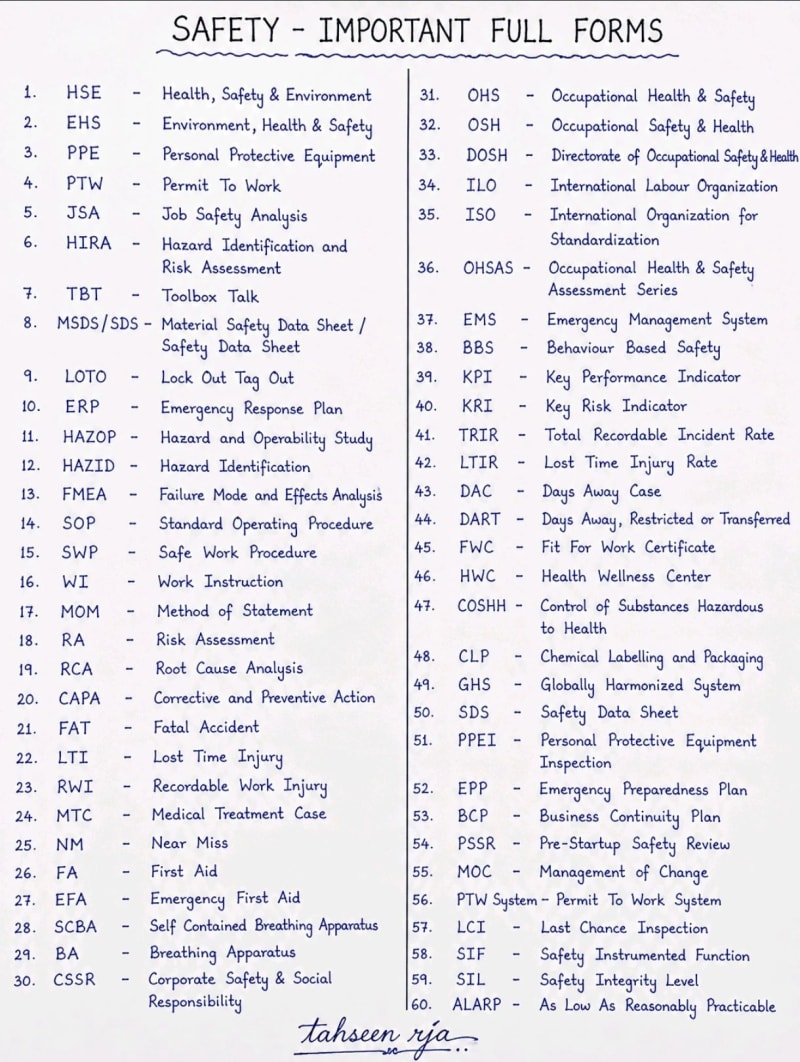
In the safety profession, understanding important safety terms and abbreviations is essential for effective communication and workplace safety. Here is a handwritten collection of key safety full forms that are commonly used in HSE, construction, and industrial environments. Continuous learning helps us become better safety professionals.
"Safety is not expensive, it's priceless."
An Internal HSE Audit is a powerful tool to evaluate safety performance, ensure compliance, and identify opportunities for improvement. It helps organizations move from reactive to proactive safety management by continuously monitoring and enhancing their HSE systems.
📋 Key Elements of an Internal HSE Audit:
• Compliance Verification: Ensuring alignment with regulations, standards, and company policies 📘
• Hazard Identification: Detecting unsafe conditions and practices before incidents occur 🔍
• System Effectiveness: Evaluating the performance of the HSE management system 🛠️
• Corrective Actions: Developing and tracking actions to address non-conformities ✅
• Continuous Improvement: Using audit findings to enhance overall safety performance 🚀
💡 Tip: Treat audits as opportunities, not inspections—focus on improvement, not blame.
📊 A strong internal audit process builds transparency, strengthens compliance, and drives a culture of continuous safety improvement.
Every crew has one.
The operator who can move material faster than anyone else.
The foreman who always finds a way to keep production moving.
The ironworker who can handle the toughest tasks without hesitation.
They’re experienced.
They’re respected.
They get the job done.
And sometimes… they’re also the highest risk on the project.
Not because they don’t care about safety.
But because confidence and capability can slowly erode caution.
In heavy civil construction, high performers often operate closer to the edge.
They’ve done the lift before.
They know how the machine responds.
They’ve worked around hazards long enough that the risk feels manageable.
And when something works repeatedly, the brain starts telling a dangerous story:
“I know what I’m doing.”
But here’s the problem — hazards don’t care about experience.
Ground conditions don’t respect reputation.
Gravity doesn’t recognize seniority.
Equipment doesn’t adjust because someone is “good at their job.”
In fact, some of the most serious incidents happen when high-skill meets high-confidence under production pressure.
Here’s where leaders must pay attention:
1. Skill Can Mask Exposure
When someone is efficient, it’s easy to overlook how close they’re working to the hazard. Productivity can unintentionally normalize risk.
2. Crews Rarely Challenge the Expert
Less experienced workers often hesitate to question the person who “knows the job best.” That silence can allow unsafe practices to continue unchecked.
3. Reputation Can Override Procedure
When someone has years of experience, teams sometimes assume the rules apply differently to them. But procedures exist because physics and human limitations are universal.
4. Confidence Can Replace Verification
Experienced workers may rely on instinct rather than confirmation — skipping the pause that catches a hazard before it becomes an incident.
5. Leaders Must Protect Experts from Themselves
Good leaders don’t just coach the inexperienced. They also challenge the veterans who might be drifting closer to the line.
The goal isn’t to slow down your best people.
It’s to remind them that experience should increase discipline — not reduce it.
The safest professionals in heavy civil construction aren’t the ones who take the biggest risks.
They’re the ones who never stop respecting the hazard — even after 20 years on the job.
Before the next task starts, ask this question during your safety briefing:
“Are we relying on skill today… or are we relying on controls?”
Because skill can fail.
Controls protect everyone.
💬 I’m curious about the industry’s perspective:
Have you ever seen a highly skilled worker unintentionally drift into higher risk because they were so good at their job?
Or have you seen a veteran leader who never let experience turn into complacency?
Protect the people who build our infrastructure.
— Safety Jake
The academic paper “Metalliferous Mine Dust: Human Health Impacts and the Potential Determinants of Disease in Mining Communities” explains how dust produced in metal mining areas can seriously affect human health. This dust often contains heavy metals such as lead, arsenic, cadmium, and nickel. When miners breathe in this dust, very small particles go deep into their lungs and can enter the bloodstream. Over time, these metals can cause serious health problems like lung disease, cancer, heart and kidney problems, or damage to the nervous system.
For HSE and QHSE professionals, this study clearly shows that miners need strong protection. It is not enough to only improve ventilation or use water to control dust. Workers must also use personal wearable protection to stay safe. This includes respirators or masks (like N95, P100, or powered air-purifying respirators) that block fine dust and toxic metal particles. Protective suits, gloves, and sealed goggles stop the metals from touching the skin or eyes. Smart wearables such as dust-monitoring badges, gas detectors, or helmets with built-in sensors can help workers and supervisors see when air quality becomes dangerous. These devices give real-time information and make it easier to prevent exposure before harm occurs.
If miners do not use these wearable protections, the results can be very harmful. Dust with heavy metals can slowly damage their lungs and other organs. Continuous exposure may lead to chronic diseases, breathing problems, and in severe cases, death. Without smart wearable devices, workers may not even notice the danger in the air around them until it is too late.
The message from the paper is clear: metalliferous mine dust is a silent but serious threat, and wearing the right protection saves lives. In HSE and QHSE work, promoting the correct use of masks, wearables, and protective equipment is not only a rule—it is a responsibility to protect every worker underground.
Personal Protective Equipment Saves Lives : Leadership and Safety in Action - SHE Part VI
🚨Every year, approximately 2.3 million women and men worldwide DIE from work-related accidents or illnesses a figure reported by the International Labour Organization (ILO).
🚨This tragically equates to more than 6,300 deaths every single day around the globe.
🚨The ILO further estimates there are over 374 million non-fatal work-related injuries annually, many of which could be prevented through consistent use of PPEs
🚨Studies also show that only about 64% of workers globally use PPE properly, highlighting a critical gap in safety culture and training, especially in developing regions.
Personal Protective Equipment (PPE) is more than just a set of tools; it’s the frontline defense against workplace hazards. From construction to healthcare, PPE protects employees from physical, chemical, and biological risks, ensuring that everyone leaves work as healthy as they arrived.
Essential Types & Proper Usage
⛑️ Head Protection: Helmets prevent head injuries from falling objects.
🥽 Eye and Face Protection: Safety glasses and face shields block hazardous particles and chemicals.
🎧 Hearing Protection: Earplugs protect against damaging noise.
😷 Respiratory Protection: Masks and respirators filter out harmful substances.
🧤 Hand Protection: Gloves safeguard against cuts, burns, and exposure.
🥾 Foot Protection: Safety boots reduce risks of impact or punctures
👷♂️ Body Protection: Work clothes for body parts and vests protect body parts
🎽 Fall Arrest: Protective vests, belts and hooks protects fall injuries because of working in height
Why PPE Matters
✅ Minimizes exposure to hazards, preventing serious workplace injuries and occupational illnesses
✅ Safeguards workers from long-term health risks, such as chemical exposure or hearing damage
✅ Supports business continuity by reducing absenteeism, medical costs, and downtime from accidents
Always ensure PPE is well-fitted, undamaged, and used as instructed. Regular usage and awareness Trainings, Safety Walks, Checks and Behavioral Observation Programs are key!
Benefits Beyond Safety
👍 Boosts employee confidence and morale, knowing their wellbeing is prioritized
👍 Meets legal and regulatory requirements, avoiding fines and legal complications
👍 Demonstrates a proactive safety culture that values every worker.
By prioritizing PPE, companies build a foundation for operational excellence and show real leadership in workplace safety.
The paper by T. J. Bauerle – “Mineworker Fatigue: A Review of What We Know and Future Directions” gives a focused look at how fatigue affects workers in the mining industry. It explains that fatigue is not just about feeling tired – it is a measurable condition that can be tracked through self-reports, sleep diaries, and technologies like actigraphy that monitor rest and activity levels.
The review shows that fatigue is highly common in mining because of factors such as shift work, long working hours, irregular schedules, poor lighting, noise, heat, and underground conditions with limited natural time cues. These factors disturb natural sleep patterns and recovery, leaving workers physically and mentally exhausted.
From a QHSE perspective, this is critical because fatigue directly impacts attention, reaction time, and decision-making, leading to higher risks of injuries, machinery accidents, and environmental incidents. The paper highlights that fatigue is a systemic issue, not only an individual one, meaning companies need strong management strategies such as better scheduling, fatigue monitoring, training, and rest policies.
Finally, the review points out that more research is needed on long-term health effects, the role of culture and leadership in managing fatigue, and practical interventions that balance production demands with worker safety. For mining, this means treating fatigue the same way we treat other hazards—as a safety risk that must be identified, measured, and controlled within QHSE systems.
Source: https://stacks.cdc.gov/view/cdc/55670
Tailings management is one of the most serious and sensitive issues in the mining industry. It connects directly to the safety of people, the protection of the environment, and the long-term sustainability of mining operations. Tailings are what remain after valuable minerals are separated from the ore. These leftover materials are usually stored in large containment areas called tailings storage facilities or tailings dams. If these structures fail, the results can be catastrophic—causing loss of life, environmental pollution, and the loss of public trust in mining. Because of this, responsible companies and organizations like the International Council on Mining and Metals (ICMM) have created strong principles and guidance to make sure tailings are managed safely, respectfully, and transparently.
ICMM’s “Mining with Principles” framework includes Tailings Management as a key commitment. Its goal is to make sure that all mining companies design, construct, operate, and close tailings storage facilities in a way that protects communities and the environment throughout their entire life cycle. The framework is built around respect—for people, for nature, and for the future. It focuses on continuous improvement, risk management, and learning from past failures. One of its major principles is that safety must never be compromised for profit or convenience. Every tailings dam, no matter its size or location, must be managed to the highest possible standard.
The first important part of ICMM’s tailings approach is governance. This means that responsibility for tailings safety starts at the highest level of a company—the board and senior management. ICMM encourages companies to have clear accountability and decision-making systems for tailings facilities. The principle says that tailings risks must be treated with the same seriousness as other major business risks. This ensures that executives are aware of the conditions of every tailings facility and that safety decisions are based on sound engineering and data, not just cost or production pressure. The ICMM also asks companies to use independent reviews, audits, and qualified engineers to check the stability and performance of every facility regularly.
Another essential part is risk-based design and operation. Tailings facilities are not all the same. Some are very large, holding hundreds of millions of tonnes of waste; others are small and located in remote areas. The risk level depends on factors such as the height of the dam, the amount of water it contains, the type of materials used for construction, the climate, and the local geology. ICMM recommends that every facility be designed and operated based on a detailed understanding of these risks. For example, in areas with heavy rainfall or earthquakes, engineers must plan for extreme events. They must use conservative safety factors and have clear emergency response plans.
ICMM’s principles also require continuous monitoring and the use of new technology. Many companies are now using drones, satellite images, and sensors to monitor tailings dams in real time. This makes it possible to detect early signs of movement, seepage, or pressure changes before they become serious. For example, many modern mines use piezometers—small instruments that measure water pressure inside the dam walls—to monitor how water is behaving. If the pressure increases, it might indicate that the dam is under stress. Early detection allows the company to take quick actions such as lowering water levels or reinforcing the dam wall before any danger develops.
Transparency and community engagement are also key elements of ICMM’s tailings management principle. In the past, many communities living near mines were not informed about the risks of tailings dams. When disasters happened, they often had no warning or knowledge about what to do. The ICMM has emphasized that this is not acceptable. Mining companies must be open with local people and regulators about the design, monitoring results, and risk level of each tailings facility. They must also involve the community in emergency planning. This builds trust and ensures that everyone knows how to act in case of an incident. Many ICMM members now publish detailed reports on their tailings facilities, including location, type, construction method, and risk level.
One of the strongest outcomes of ICMM’s commitment to tailings safety was the development of the Global Industry Standard on Tailings Management (GISTM). This standard was launched in 2020 by ICMM together with the United Nations Environment Programme (UNEP) and the Principles for Responsible Investment (PRI). The GISTM sets a very high bar for safety, requiring zero harm to people and the environment. It includes 15 principles covering the entire life cycle of tailings—from design to closure. Every ICMM member company has committed to implement this standard across all tailings facilities, starting with those that have the highest risk. The implementation deadline for high-risk facilities was August 2023, and for all others by August 2025.
The GISTM goes beyond technical rules. It requires a culture of safety and ethics. It says that companies must develop organizational culture where workers, engineers, and managers feel empowered to report concerns without fear. It encourages leadership that listens and learns, not just manages. It also calls for “independent review boards” for high-risk facilities—groups of external experts who can give honest advice and oversight. This is a big step forward compared to the past when many tailings facilities were designed and managed without external supervision.
Learning from past disasters is another area where ICMM’s principles play a role. Tragic tailings dam failures in Brazil (Samarco in 2015 and Brumadinho in 2019) and Canada (Mount Polley in 2014) showed what happens when safety, design, and governance fail. These disasters caused deaths, destroyed ecosystems, and left deep scars in communities. They also taught the mining world that safety systems must be proactive, not reactive. ICMM’s work since those events has aimed to make sure that such tragedies never happen again. By applying lessons from those cases—like the importance of dry stacking, proper drainage, and independent oversight—the industry is moving toward safer and more sustainable practices.
Dry stacking is one of the modern technologies encouraged by ICMM. Instead of keeping tailings as liquid slurry behind a dam, they are filtered to remove most of the water and then stacked in a dense, dry form. This method reduces the risk of catastrophic failure because there is little or no free water that could cause a collapse. It also makes closure and reclamation easier. However, it requires investment and space, which not all mines have. Still, ICMM and other organizations encourage its adoption whenever practical because it represents a safer and more responsible approach to waste management.
Environmental protection during and after mine operation is also part of responsible tailings management. When a mine closes, the tailings facility must be safely sealed, covered, and monitored for many years to ensure that contaminants do not enter rivers, groundwater, or soil. ICMM promotes integrated mine closure planning from the start of the project—not waiting until the end. The goal is to restore the land so it can be safely used again, maybe as a natural habitat, forest, or even for other economic purposes. This long-term view is part of what makes tailings management sustainable.
In addition to technical and environmental safety, ICMM recognizes the social aspect of tailings. Communities near mines have the right to live without fear of dam failure or contamination. Respect for human rights, fair communication, and cooperation with local authorities are key. Many ICMM companies are now conducting social impact assessments, public consultations, and transparent risk communication meetings to ensure that people are fully informed and part of the decision-making process.
Financial assurance is another element tied to responsible tailings management. The ICMM believes that companies must be financially prepared to maintain and close their facilities properly, even if the mine stops operating. This prevents situations where abandoned sites become public hazards. Governments also have a role in setting and enforcing strong regulations. Cooperation between companies, regulators, and communities creates a safer and more stable system.
The ICMM “Mining with Principles” approach transforms tailings from a technical challenge into a moral responsibility. It reminds everyone that safety, transparency, and respect must guide all decisions. The future of mining depends not only on how much metal we produce but on how responsibly we manage what we leave behind. With the application of ICMM’s principles and the Global Industry Standard on Tailings Management, the mining sector is moving toward a culture of zero harm, continuous improvement, and global trust.
In simple words, good tailings management means more than just building a strong dam. It means caring for people, respecting the land, and making sure that the mistakes of the past are never repeated. It is about using science, technology, and ethics together. It means that every engineer, operator, and manager has a duty to protect life and nature. When mining companies follow ICMM’s tailings management principles, they show that mining can be both productive and responsible. This is the true meaning of sustainable mining—producing resources that the world needs, while protecting the planet and its people for future generations.
Rock bolt is one of the most important safety systems used in underground mining. It is a long steel bar that is inserted into holes drilled in the rock to support the roof and walls of tunnels and mine openings. The main purpose of a rock bolt is to make the rock mass stable and prevent the roof or walls from falling. In underground mining, where workers are always surrounded by heavy rock layers, this support system is essential for protecting human life and keeping the workplace safe.
Rock bolts were first used in underground mining around the 1940s, and they quickly became a standard method for rock support because they were much faster and more effective than using wood or steel frames. Today, almost every underground mine in the world uses rock bolts as part of its ground control system. According to international mining data, more than 80% of underground tunnels and excavations use rock bolts for stability and safety.
A rock bolt works by anchoring itself into the rock mass and holding together weak layers or cracks. When the rock starts to move or deform due to stress or pressure, the rock bolt resists this movement and keeps the rock in place. The bolts are usually made of steel and installed using mechanical anchors, resin, or cement grouting. The selection depends on rock type, depth, and stress conditions.
Measuring the performance of rock bolts is very important for safety monitoring. Engineers measure the load, stress, and deformation of each bolt using special sensors or strain gauges. Deformation is the small amount of stretching or bending that happens when the rock moves. If the deformation becomes too high, it means the rock bolt is reaching its limit and may fail, so it needs to be replaced or reinforced.
During installation, miners must follow strict QHSE (Quality, Health, Safety, and Environment) procedures. Workers must wear helmets, gloves, and eye protection because drilling and inserting bolts can release dust, small rock pieces, and noise. Bolts must be installed at the correct angle and depth, using safe drilling machines. Before starting, the roof must be checked for cracks or loose rocks. If we do not follow these steps, the rock could fall and cause serious injury or death. Rock bolts help save us because they hold the rock layers tightly, preventing sudden collapses or rock falls that can trap workers.
In recent years, technology has brought a big improvement: smart rock bolts. These are modern types of bolts that include sensors and wireless transmitters. They can detect stress, vibration, or deformation in real time and send safety warnings to the control room or directly to workers’ handheld devices. When the rock begins to move dangerously, the smart rock bolt sends a signal or message, giving early warning before a collapse happens. This allows miners to evacuate or take action immediately.
Smart rock bolts use wireless communication and sometimes low-power Bluetooth or radio signals to transmit data. Some systems also connect to cloud platforms where engineers can monitor many bolts at once. The sensors measure tension, strain, and temperature changes, and the data is automatically recorded for safety reports. These systems are a big step forward for QHSE management because they reduce the need for manual inspection and give continuous, real-time monitoring of underground conditions.
In conclusion, rock bolts are the backbone of underground mine safety. From the first use in the 1940s to today’s smart wireless bolts, they continue to protect workers and maintain the stability of mine tunnels. They help reduce accidents, support heavy rock layers, and create a safer working environment. As technology advances, smart rock bolts will play an even bigger role in ensuring that underground mining remains safe, efficient, and well controlled.
OSHA provides a comprehensive framework of exposure limits, design standards, and operational guidelines to minimize risk in workplaces across industries.
From permissible noise levels (90 dB(A) over 8 hrs), to chemical exposure limits (e.g., Silica – 50 µg/m³ TWA), and safe oxygen ranges (19.5%–23.5%), these limits are non-negotiable foundations of workplace safety.
📊 Adhering to OSHA's safety parameters ensures:
✔️ Reduced occupational health risks
✔️ Legal compliance and audit readiness
✔️ Safer, more productive work environments
Source: Credit to Nirdosh Kumar
21 QHSE
Covers health, safety, quality, and environmental management in mining operations.
QHSE trainings, certifications, and awareness events.