Mining looks chaotic from the outside—massive machines, explosions, mountains of rock moving around. Under the hood, though, it follows a surprisingly elegant chain of steps. Think of it as a carefully choreographed industrial dance where geology, engineering, and logistics work together to turn buried rock into valuable minerals.
Here’s a simplified look at the mining workflow illustrated in the image:
🔵 Overburden Removal (if existing)
• Removing the topsoil and waste rock that sit above the ore body.
• This step exposes the valuable mineral layer and prepares the site for extraction.
🟠 Waste Drilling & Blasting
• Holes are drilled into the waste rock and explosives are placed.
• Controlled blasting breaks the rock into manageable fragments.
🟡 Hauling Waste
• Large haul trucks transport the blasted waste material away from the mining zone.
🟤 Dumping Waste
• Waste rock is dumped in designated areas while wall monitoring systems ensure pit stability and safety.
🟢 Ore Drilling
• Once the ore body is exposed, precision drilling begins to prepare it for extraction.
🔴 Ore Blasting
• Controlled blasts fragment the ore so it can be efficiently loaded and transported.
🟣 Hauling Ore
• Heavy trucks move the ore from the pit to stockpiles or directly to the processing plant.
🔷 Stockpiling (Grade Control)
• Ore is sorted into high-grade, medium-grade, and low-grade stockpiles to optimize processing and recovery.
⚫ Primary Crushing
• Crushers (such as jaw or cone crushers) reduce large rocks into smaller pieces suitable for processing.
🟧 Grinding & Processing
• The crushed ore enters the mill, where grinding and flotation/separation extract valuable minerals.
🟦 Mineral Concentrate Production
• The valuable mineral is separated and collected as concentrate.
🟩 Tailings Management
• Waste slurry is sent to a Tailings Storage Facility (TSF) where water is recycled and environmental safety is maintained.
Mining is not just about digging rock—it’s a system of geology, engineering, data, and environmental management working together to transform raw earth into usable resources.
I find it fascinating that an industry capable of extracting value from kilometers beneath the earth's surface still relies on radio calls and walking around to locate a missing loader, and that this reality is so normalized that nobody seems particularly bothered by it.
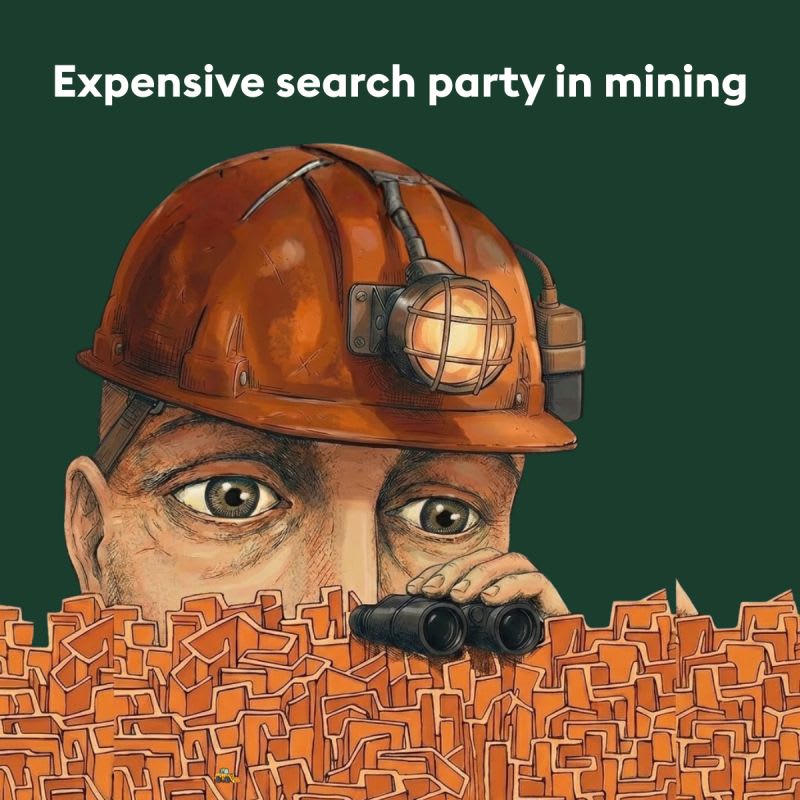
Supervisors at underground operations still hunt for equipment the same way they did thirty years ago. When something isn't where it's supposed to be, the search begins. Radio calls go out and often go unanswered or get garbled in the interference that plagues underground communications. Someone gets dispatched to check the last known location. Another person checks the workshop. The whole process can easily consume 30 minutes or more.
What strikes me most about this isn't the time lost to the search itself. The real cost is everything that stops moving while one person tries to figure out where one piece of equipment has gone.
There is no line item anywhere in any report that captures "time spent figuring out where things are." It gets absorbed into shift variances, attributed to operational complexity, or simply accepted as how underground mining works. The cost is real but invisible.
Most of the time, the information exists somewhere in the system. The operator knows where the loader is. But that knowledge lives in people's heads, and the moment those people leave site, the institutional memory disappears.
So the next supervisor, on the next shift, facing the same missing equipment problem, starts the search from scratch.
I'm curious how many operations have ever actually measured how much of their shift productivity disappears into the gap between where equipment should be and where it actually is.
My suspicion is that most haven't, because the answer would be uncomfortable.
The technology to solve this problem has existed for years. Real-time location systems are nothing new in logistics, warehousing, and manufacturing. Outside of mining, hybrid RTLS technologies are projected to exceed 55% adoption as companies recognise the operational intelligence that comes from knowing where everything is at all times.
Yet mining remains hesitant, and when you dig into why, you find objections that have less to do with technology and more to do with culture and legacy infrastructure.
Connecting RTLS with legacy dispatch systems, ventilation controls, and task management platforms that were never designed to talk to each other requires patience and investment that many operations struggle to justify when the benefits remain invisible in current reporting.
At IRH, we see this differently. The integration problem is solved by building platforms that were designed from the beginning to unify data streams and integrate with any legacy system. This is why we've built location intelligence into the core of our operating system rather than treating it as another standalone module that needs to be connected later.
When we analyzed shift efficiency patterns for internal research, we discovered that many mining sites lose millions in productive time.
This finding points to a structural problem: mining operations generate extensive operational data but lack systems to translate that data into actionable time utilization insights. Most managers track equipment hours and tonnage without understanding the relationship between these metrics and actual productive capacity.
Our field studies revealed consistent measurement gaps across operations. A mine we researched reported 56-64% effective working time, with variance tied to blast and shift configurations. The real insight wasn't the efficiency range but rather the absence of systematic approaches to understand variance drivers. Time Utilisation Model (TUM) codes capture some activities while equipment resets and haulage queuing remain untracked. This selective visibility creates optimization bias: teams improve measured activities while unmeasured bottlenecks expand.
The incentive structure analysis uncovered predictable but overlooked dynamics. Tonnage-based rewards drive short-term production at the expense of equipment utilization and maintenance windows.
This creates cascading effects: increased wear rates lead to unplanned downtime, which compresses maintenance schedules, which further reduces equipment reliability. Standard shift designs assume static operating conditions, but actual mining environments require dynamic response capabilities. Supervisors receive performance data after shifts end, preventing real-time adjustments that could prevent minor delays from becoming production losses.
The competitive analysis shows widening performance gaps between integrated and traditional planning approaches. Companies with modern planning systems capture 10-15% productivity gains through dynamic scheduling and bottleneck prediction. Legacy operators face both immediate cost disadvantages and reduced learning rates from limited operational feedback.
In commodity markets where margins compress during downturns, operational efficiency differences determine which companies maintain positive cash flow.
The shift planning problem isn't about time management but about building systems that convert operational data into sustained competitive advantage.
El Futuro de la Minería a Cielo Abierto: Inteligencia Artificial y Equipos Autónomos como Claves de la Eficiencia
La industria minera está atravesando una transformación impulsada por la inteligencia artificial (IA) y la automatización, tecnologías que están redefiniendo la forma en que operan las minas a cielo abierto. Estas innovaciones no solo buscan incrementar la productividad, sino también minimizar errores humanos, reducir costos operativos y mejorar las condiciones de seguridad.
1. Optimización de la Producción con Inteligencia Artificial
Los algoritmos de IA son capaces de analizar grandes volúmenes de datos geológicos, topográficos, operacionales y climáticos en tiempo real. Esta capacidad de procesamiento permite:
• Optimizar los planes de minado, ajustando los diseños según la ley del mineral, los costos de extracción y las condiciones del terreno.
• Predecir el comportamiento de los equipos, reduciendo paradas no programadas gracias al mantenimiento predictivo.
• Tomar decisiones automatizadas, priorizando zonas de mayor rentabilidad sin intervención humana directa.
Esto reduce los tiempos de respuesta ante cualquier cambio en el entorno operativo, haciendo más dinámico y eficiente el ciclo minero.
2. Camiones de acarreo autónomos
Los camiones sin conductor operan con precisión milimétrica, siguiendo rutas programadas que evitan accidentes, reducen el desgaste de las vías y maximizan la eficiencia del transporte. Entre los beneficios destacan:
• Disminución del error humano, especialmente en tareas repetitivas o de largas jornadas.
• Operación continua 24/7 sin fatiga.
• Consumo de combustible más eficiente debido a patrones de conducción optimizados.
3. Perforadoras autónomas
Las perforadoras automatizadas aseguran precisión en la ubicación, profundidad y orientación de cada barreno. Esto tiene efectos directos en:
• Mejor fragmentación del material, lo que reduce los costos de tronadura y acarreo.
• Mayor seguridad, ya que se evita la exposición del personal a zonas de alto riesgo.
• Estandarización del proceso, reduciendo las variaciones de calidad.
4. Drones para topografía y monitoreo
Los drones equipados con cámaras de alta resolución y sensores LIDAR o multiespectrales permiten realizar:
• Mapeos rápidos y actualizados de la mina, mejorando el control volumétrico y el seguimiento del avance.
• Inspecciones en zonas peligrosas o de difícil acceso sin exponer al personal.
• Monitoreo ambiental y de estabilidad de taludes, previniendo deslizamientos o eventos geotécnicos.
5. Beneficios generales para cualquier mina a cielo abierto
• Reducción de costos operativos y de capital al disminuir la necesidad de intervención humana y errores asociados.
• Mayor seguridad en todas las operaciones, especialmente en entornos remotos o extremos.
• Mejor control de los indicadores de producción, al tener datos en tiempo real.
• Menor huella ambiental, gracias a decisiones más precisas en la planificación y ejecución.
I want to share determination formula & calculation one of mining rate on common mining contract, especially for my friends who don't have a chance to know it, learn it and be a part of the mining team.
Hope you can always do the best for your career.
It wasn’t too long ago when you used to be able to walk into a mine survey office, go over to a plan cabinet, and inspect the mine plans (drawings) which showed excavations of the mine and the parts of the ore body mined out. These plans and sections depicted some of the hazards and proximity of mine workings.
Surveyors used to spend are large portion of their time preparing these, with many adding their personal touch of artistry to an ornate North arrow.
Computer systems with the various mining software or CAD packages have now taken over from the hand drawing of plans.
Go to a survey office today though, and too often you will not be able to see a mine plan of the excavations. Instead, it is more likely the data will be brought up on a screen display, and then be presented with a screen dump or plan depicting a specific area. However, this can only occur if you know where all the relevant data is stored on the computer system and be able to drive the software or, wait until a person such as the Mine Surveyor is available to do this for you.
Having plans readily available is not only useful for planning purposes but is especially important for use in emergency situations.
Deficiencies in mine plans have also been reported as factors in some mining disasters of the past. For example, Gretley Colliery in NSW in 1996.
Even when there is legislation in place, still too often mine plans are not compiled.
Is this from a conscious decision to ignore the requirements or a misinterpretation of them?
A case in point is the West Australian legislation: The ‘Mines Safety and Inspection Regulations 1995’ stipulate the particulars required in mine plans and when they are to be submitted. However, many fail to read the Regulations in conjunction with the ‘Mines Safety and Inspection Act 1994’ which states that accurate plans of the mine are to be kept up to date. It is worth noting that the onus of procuring and keeping mine plans falls on the manager of the mine.
The cost of having in-house or an outsourced compilation of mine plans is not a huge add on to costs already incurred in survey staffing and equipment.
So why is it that so many times I see a site that doesn’t have accurate and up to date mine plans?
I encourage all Mining Inspectors, Managers and Surveyors to audit this fundamental safety item and act on the proper compilation of mine plans.
For helpful reference links regarding this, please see http://www.handebook.com.au/publications/Act%20on%20Mine%20Plans.pdf
25 Aug. 2014
The mining industry, one of the cornerstones of modern civilization, is undergoing a transformative shift as it embraces the power of Artificial Intelligence (AI). This revolutionary technology is poised to revolutionize every aspect of the mining sector, from exploration and extraction to supply chain optimization and worker safety. In this comprehensive introduction, we will delve into the profound impact of AI on the mining industry, uncovering the challenges, opportunities, and cutting-edge applications that are shaping the future of this vital sector.
Source : Ali Abou El fadl Mohamed
One of my favorite quotes, "The future is already here — it's just not very evenly distributed" by William Gibson, reflects the idea that advancements and innovations that will shape the future are already present in certain regions, industries, or sectors. However, the distribution and accessibility of these advancements are uneven. A prime example of such innovation is Artificial Intelligence (AI).
AI involves developing computer systems capable of tasks that typically require human intelligence. These include learning, reasoning, problem-solving, perception, linguistic understanding, and creativity.
AI encompasses a broad range of methodologies, technologies, and subfields. In mining and mineral exploration, we have been applying Machine Learning (ML) and other AI algorithms since the 90s. Recent advancements in Deep Learning and Natural Language Processing have allowed the development of AI models that can not only enhance efficiency and safety but also pave the way for innovative practices that will redefine the sector.
This article delves into the current and future applications of AI in mining, spotlighting innovations that, while not universally adopted, have the potential to reshape the industry.
Current Applications
AI is revolutionizing the mining industry by enhancing operational efficiency, improving safety, and reducing environmental impacts. Below are some of the transformative applications currently being deployed:
Geometallurgy: The application of ML in geometallurgy, one of AI's earliest uses in mining, involves analyzing complex relationships between ore attributes and processing plant performance. These relationships are then used to improve decision-making and optimize processing operations. More recently, some companies are using ML-based systems to adjust processing plant parameters in real-time, based on characteristics of the ore being mined. This leads to better recovery and throughput, enhanced supply chain efficiencies, and reduced energy consumption.
Exploration Targeting: AI algorithms can process vast amounts of geological data, outperforming traditional methods in speed and accuracy. ML algorithms are being used to generate exploration targets, assess their potential value, and optimize exploration strategies. This approach not only increases the chances of discovering new deposits but also reduces the environmental impact of exploration activities.
Core Logging: Using hyperspectral imaging for automatic core logging has been considered for decades. Over the last decade, some mining companies have spent millions on core scanning, storing vast amounts of data. However, these efforts often fell short of producing meaningful interpretations for effective geological modeling. Recent advances in deep learning have allowed this technology to start delivering on its promise.
Grade Control: Modern grade control optimizers apply AI algorithms for dig-line optimization. This is perhaps the lowest hanging fruit for the use of AI in a mining operation. The advantages of such approach have been documented for many years, but unfortunately the uptake of the technology has been slow. Software developers are starting to catch up, with new offerings now available by the major mining software providers.
Predictive Maintenance: Another existing application of AI in mining is predictive maintenance. By using ML algorithms to analyze equipment data, mining companies have been able to predict failures before they occur, minimizing downtime and extending the lifespan of fixed and mobile assets. This approach not only cuts costs but also boosts safety by lowering the risk of equipment-related incidents.
Automation and Robotics: The mining industry increasingly employs autonomous vehicles, robots and drones. These technologies, guided by AI, can operate in hazardous environments, performing tasks such as topographic surveys, drilling and transporting materials without human intervention. This not only improves safety, by reducing human exposure to dangerous conditions, but also enhances operational efficiency.
Data Mining: Commercial and company-owned AI platforms have been used to digest vast quantities of technical reports, financial disclosures, and press releases as well as mining news and technical articles. This creates an extensive knowledge base that can be consulted using natural language and advanced analytics. The most common users of such platforms are investors, analysts, deal makers, and exploration teams.
Stochastic Mine Planning: AI was applied in the early 2000s to develop the first stochastic mine planning method for open pit scheduling. Since then, a couple of decades of R&D sponsored by major mining companies, have developed a more sophisticated solution able to optimize whole mining complexes, from mine to market. The method can take a myriad of uncertainties into account. This method, in broad terms, uses a combination of stochastic optimization and AI techniques to obtain the optimal solution for the mine scheduling problem.
Worker Safety and Health Monitoring: AI-trained wearable devices are being used to monitor the health and safety of miners in real-time, detecting signs of fatigue, exposure to harmful substances, or physical stress. These systems can alert workers and managers to potential health and safety risks, significantly improving workplace safety.
Looking Ahead
The future of AI in mining is bright, with potential applications set to further transform the industry, making it safer, more efficient, and sustainable. Here's a glimpse into what the future holds:
Resource modeling: Resource modeling is a process where typically 80% of the time is spent processing data, while the remaining 20% is used to analyze and refine the results. Soon, autonomous systems, guided by AI algorithms, will be able to flip these statistics around. This will allow geologists to spend considerably more time stress testing models and refining estimates, resulting in higher confidence estimates and models that can be updated seamlessly as additional information becomes available.
Digital Twins: Before the end of this decade, we will see the proliferation of AI-based systems to create and run digital twins of mining assets and even whole company portfolios. These digital models will allow us to model and simulate the behavior and performance of entire mining complexes. Embedded with stochastic planning capabilities, these digital twins will help us optimize operations, predict failures, and test different scenarios for improved decision making. Importantly, it will break the infamous mine planning cycle, that mines go through every year, and allow for near-real-time updates that respond to the ever-changing conditions of a mining operation.
Mine Design: Developing mine designs is a laborious and time-consuming task, which requires considering multiple parameters such as resource models, mining methods, equipment selection, infrastructure, capital costs, operating costs, and many others. Generative AI models will enable more efficient design creation and allow for the evaluation of hundreds or thousands of scenarios with ease. This ability is key in determining the more efficient and cost-effective mine design for a given orebody in a timely fashion.
Environmental Monitoring and Sustainability: The future of AI in mining includes advanced systems for environmental monitoring and sustainability. AI can be used to monitor the impact of mining activities on ecosystems, predict environmental risks, and develop strategies to mitigate negative effects. These applications of AI are going to help achieve sustainable mining practices and adhering to increasingly stringent environmental regulations.
Integration with Renewable Energy Sources: AI can optimize the integration of renewable energy sources into mining operations. By predicting energy consumption patterns and coordinating with renewable energy availability, mining operations can reduce their carbon footprint and energy costs.
Collaborative Robots: Future advancements may see the rise of co-bots in mining – robots designed to work alongside humans. These AI-driven robots could undertake tasks that are unsafe or unsuitable for humans, while humans focus on supervisory and decision-making roles, creating a synergistic workforce.
In conclusion, the application of AI in the mining industry is not just a trend but a fundamental shift towards safer, more efficient, and sustainable operations. As technology advances, the potential for AI to transform the sector grows, offering promising prospects for the future.
This evolution requires ongoing investment, as well as a commitment to training and upskilling the workforce to adapt to an ever-changing technological landscape. Embracing AI is not merely an option but a critical step forward for the mining industry, ensuring its growth, sustainability, and resilience in the years to come.