HR is evolving beyond just hiring; it’s now about measuring impact. Relying on intuition alone places you at a disadvantage.
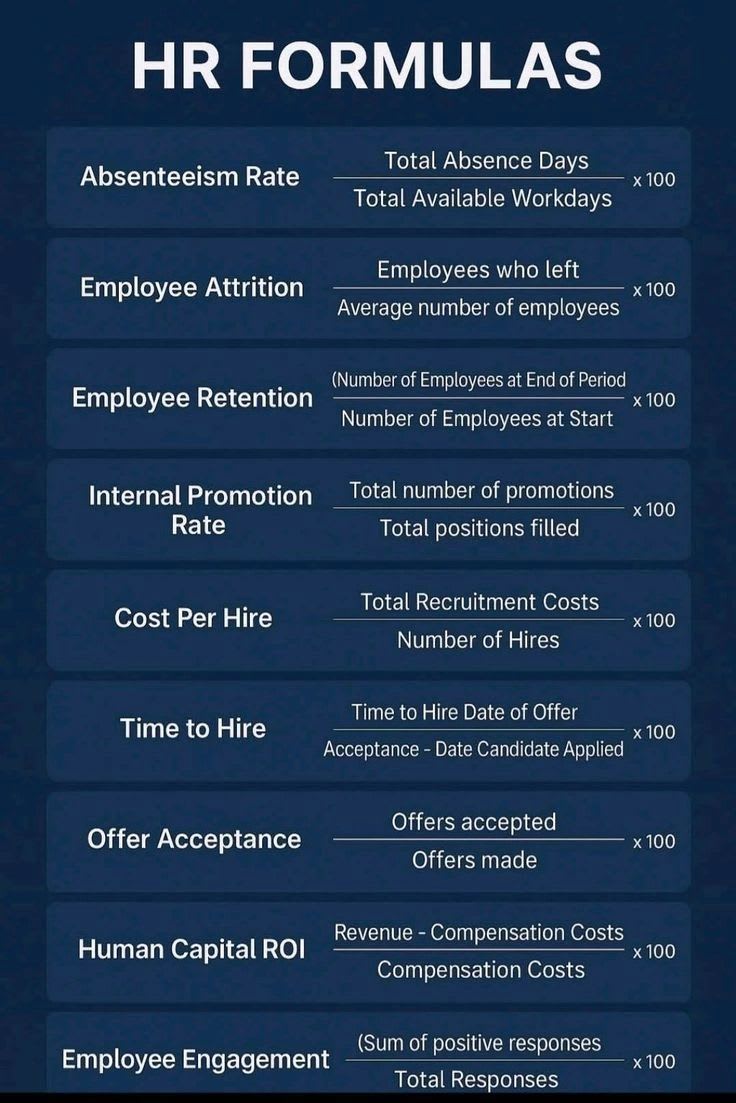
Leading companies today utilize data-driven HR metrics to make informed decisions swiftly. Here are the essential HR formulas every business leader should be familiar with:
✔️ Absenteeism Rate
✔️ Employee Attrition
✔️ Employee Retention
✔️ Internal Promotion Rate
✔️ Cost Per Hire
✔️ Time to Hire
✔️ Offer Acceptance Rate
✔️ Human Capital ROI
✔️ Employee Engagement
These metrics are not merely numbers; they significantly influence:
• Productivity
• Hiring efficiency
• Employee satisfaction
• Business profitability
The fundamental truth is: what you don’t measure, you can’t improve. Organizations that consistently track these metrics can:
→ Reduce hiring costs
→ Improve retention
→ Build stronger teams
→ Scale faster
A practical tip: Begin with just three metrics—Attrition, Cost per Hire, and Engagement—and you’ll gain immediate insights.
Which HR metric do you track the most in your organization
I used to pride myself on being busy.
Back-to-back meetings.
Overflowing inbox.
Working late.
Until my mentor asked me one question that
changed everything:
"Are you actually getting anything done?"
That hit hard.
I was busy.
But I wasn't productive.
I was working on everything.
But accomplishing nothing important.
That's when I learned the secret:
The best leaders don't work harder.
They guard their time
Focus on high-impact work
Eliminate nearly everything else
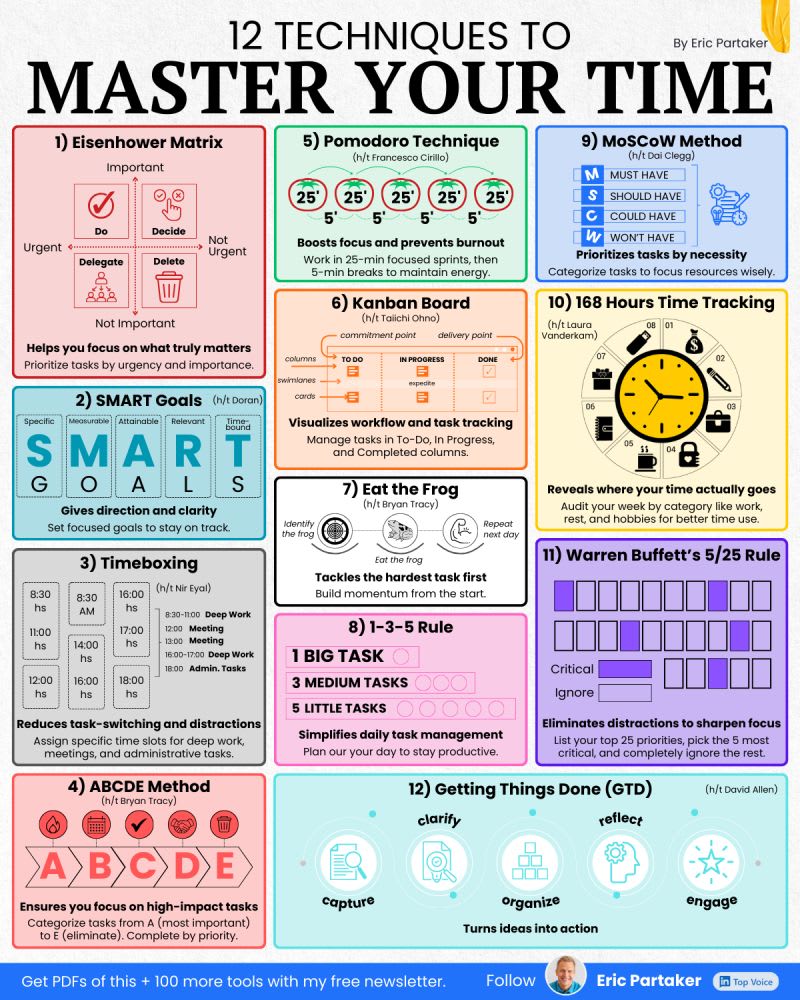
12 proven techniques to master your time
like a Fortune 500 CEO:
1. Eisenhower Matrix
↳ Always busy but not productive?
↳ Separate urgent from important (and stop confusing the two)
2. SMART Goals
↳ Big dreams mean nothing without a plan.
↳ Get specific, set a deadline, and track progress.
3. Timeboxing
↳ Multitasking kills focus.
↳ Block time for deep work, and watch your productivity skyrocket.
4. ABCDE Method
↳ If everything is a priority, nothing is.
↳ Rank tasks A to E, and never waste time on the bottom.
5. Pomodoro Technique
↳ Losing steam at midday?
↳ Work in focused 25-minute sprints with breaks to stay sharp.
6. Kanban Board
↳ Feeling overwhelmed?
↳ A simple "To-Do, In Progress, Done" board clears mental clutter fast.
7. Eat the Frog
↳ Procrastinating that tough task?
↳ Do it first. The rest of your day will feel effortless.
8. 1-3-5 Rule
↳ Stop overloading your to-do list.
↳ Win the day: 1 big task, 3 medium, 5 small.
9. MoSCoW Method
↳ Not sure where to focus?
↳ Label tasks as Must, Should, Could, or Won't to cut the clutter.
10. 168 Hours Time Tracking
↳ Think you're always running out of time?
↳ Track a full week. You'll find gaps you never knew existed.
11. Warren Buffett's 5/25 Rule
↳ Success isn't about doing more.
↳ List 25 goals, focus on 5, ignore the rest completely.
12. Getting Things Done (GTD)
↳ Too many ideas but not enough action?
↳ Capture everything, organize by priority, and execute systematically.
You can't scale your impact if you're drowning in busywork.
The good news? You don't need all 12 of these.
Start with one. Build from there.
Small shifts in how you spend your hours
create massive changes in your results.
The bad news is time flies.
The good news? You're the pilot.
👇 What's your favorite tool for time management?
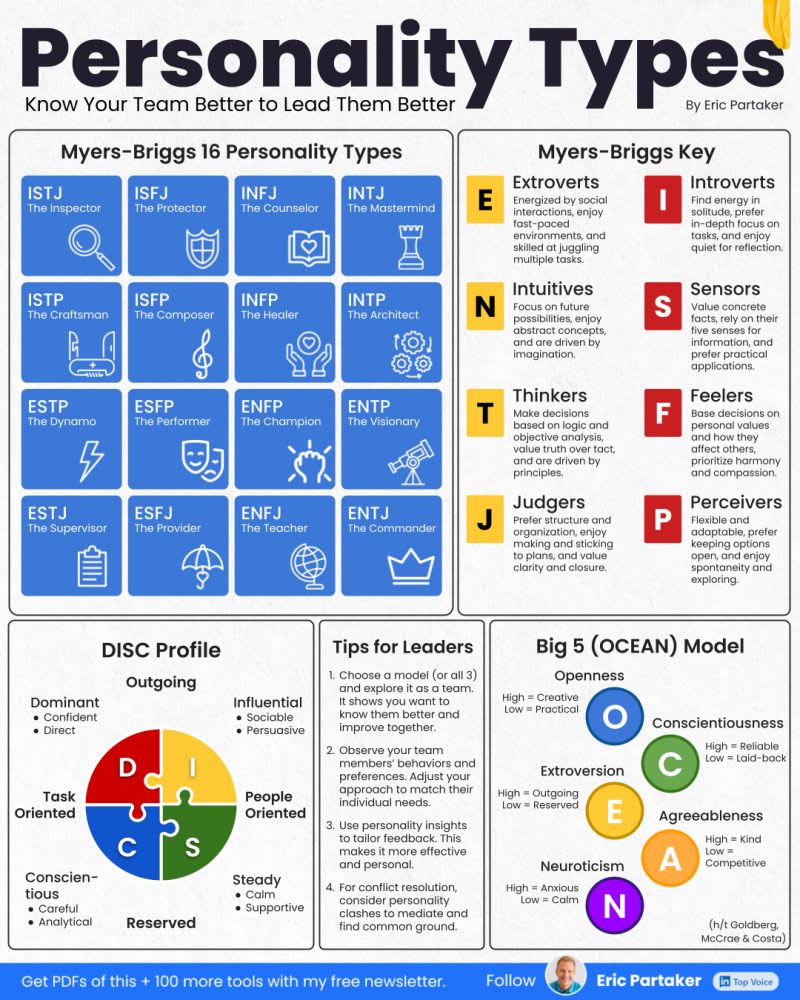
For your team
• Richer brainstorming sessions
• Smoother conflict resolution
• Personalized development
• Fewer misunderstandings
• Improved communication
• Creative problem-solving
• Stronger team cohesion
• Efficient work allocation
• Reduced stress levels
• Greater engagement
For you:
• Greater resilience
• More adaptability
• Stronger influence
• Enhanced empathy
• Deeper connections
• Heightened intuition
• Increased confidence
• Better self-awareness
• Clearer communication
• Sharper decision-making
Every great leader knows:
Understanding your team is the first step to success.
Why this matters?
It reveals how each team member:
➟ Thinks and processes information
➟ Interacts and communicates
➟ Responds to stress and conflict
Armed with this knowledge, you can:
➟ Tailor your leadership style
➟ Enhance team synergy
➟ Boost overall productivity
Save this sheet.
Share it with your team.
Use it as your daily reference.
P.S. Which personality model do you find most useful?
📌 Want a PDF of my Personality Types cheat sheet + 100 more leadership resources?
Get them free: https://ericpartaker.com/
El verdadero seniority no se demuestra solo hablando: se demuestra antes, durante y después de la reunión.
La mayoría de líderes creen que su presencia ejecutiva se construye solo “cuando hablan”.
Pero la verdad es que el 70% de lo que proyectas ya estaba decidido antes de pronunciar la primera palabra.
Lo veo todos los días.
▫️Gente que llega a reuniones críticas sin una intención clara.
▫️Profesionales senior que aún hablan desde la defensa y no desde la claridad.
▫️Líderes con experiencia que hacen preguntas “tácticas” cuando deberían formular preguntas que revelen visión.
Y no es falta de conocimiento.
Es falta de presencia estratégica.
Porque una reunión de alto nivel no se improvisa.
Se prepara como un atleta prepara una final: con intención, foco y energía emocional alineada.
Cuando entras así, todo cambia:
✔️ Tu mensaje deja de ser disperso y se vuelve memorable.
✔️ Tus pausas proyectan seguridad, no dudas.
✔️ Tu lenguaje corporal respalda tu voz (no compite con ella).
✔️ Y al cerrar, no suenas “amable”: suenas senior.
Y ahí está el secreto de los líderes que avanzan más rápido:
No hablan más fuerte.
Hablan mejor.
Con propósito.
Con límites.
Con presencia.
Piensa en tu última reunión importante:
¿Entraste con intención o reaccionaste a la situación?
¿Qué vas a cambiar en la próxima reunión?
Today, key human resources indicators (KPIs) have become more sophisticated because they no longer only measure administrative efficiency, but also the strategic impact on the business.
Here are 5 big blocks with examples:
1. Attraction and recruitment
• Time to Fill: average days to fill a vacancy.
• Time to Hire: from the time the candidate is contacted until they accept the offer.
• Cost per hire: sum of investment in recruitment divided by the number of hires.
• Quality of hiring: performance and permanence of the talent hired.
2. Performance and productivity
• Productivity per employee: revenue or results generated / number of employees.
• Compliance with performance objectives (individual OKRs/KPIs): % of goals achieved.
• Absenteeism rate: absences vs. scheduled working hours.
• Overtime worked: indicator of overload or poor planning.
3. Retention and Turnover
• Voluntary and involuntary turnover rate: % of employees who leave the company.
• Retention of key talent: permanence of critical profiles for the business.
• Average tenure: average seniority of employees.
• Turnover cost: expense associated with replacing an employee (recruitment + training + loss of productivity).
4. Development and training
• Investment in training per employee: annual amount invested.
• Training hours per capita: average number of training hours per employee.
• Applicability index of the training: % of skills learned applied on the job.
• Internal mobility: percentage of vacancies filled with internal talent.
5. Organizational climate and commitment
• Employee Engagement Index: level of commitment and job satisfaction.
• eNPS (Employee Net Promoter Score): willingness to recommend the company as a place to work.
• Well-being index: perception of work-life balance, physical and mental health.
• Level of diversity and inclusion: % of women, generations, multicultural profiles in key positions.
The most current HR KPIs go beyond payroll and turnover: today they focus on employee experience, productivity, development, and strategic value for the business.
At HRA Talent we can help you prepare an analysis with solution proposals so that your company is profitable and recovers an exceptional service culture!
I’m sharing some of the knowledge I’ve recently gained from my studies at Wits Business School in the Strategy module. Mining is one of the most complex industries, where technical precision must align with strong leadership to achieve sustainable outcomes.
The framework of Strategic Leadership, built on four pillars; Strategy, Culture, Operations, and People, offers a powerful way to think about leadership in mining (Timothy Tiryaki’s 4 Focus Areas of Strategic Leadership). For mine planning engineers, these pillars provide a guide for turning designs into practical results.
Strategy: Shaping the Mine’s Future
For mine planning engineers, strategy means more than hitting monthly tonnage. It’s about aligning short-term schedules with the mine’s long-term vision. For example, sequencing blocks today must not only feed the plant consistently but also create space for future drilling and development.
Culture: The Glue That Holds It Together
As my lecture Mzoxolo Gulwa like to say: “Culture will eat strategy for breakfast.” In mining, culture defines how teams respond when conditions change. A planning engineer who fosters collaboration between geologists, drill & blast teams, geotechnical engineers and operators ensures challenges are tackled collectively, maintaining both safety and production momentum.
Operations: Turning Plans into Action
A great plan means nothing without disciplined execution. Operations leadership for a planner is about ensuring schedule compliance, monitoring equipment utilization, and optimizing designs for efficiency. For example, when longer haul distances slow down trucks, redesigning routes or adjusting cut layouts or even running Load and Haul Simulations that ensure effective truck allocation and route selection can immediately restore productivity and reduce costs.
People: Building the Workforce of Tomorrow
Mining is powered by people, not machines. Strategic leaders invest in developing their teams. A planner who mentors juniors in software like Deswik, Datamine or Alastri builds capability that strengthens not just today’s schedule, but the mine’s long-term resilience and talent pipeline.
The North Star in Mining
The intersection of these four pillars is the North Star, the balance between thinking and feeling, macro and micro perspectives. A mine planning engineer who applies this balance doesn’t just deliver schedules; they create value, foster innovation, and ensure the mine thrives sustainably.
Definir correctamente tus Objetivos y KPIs en RRHH, es clave para impulsar los Objetivos de tu Negocio.
Pir lo general deberás superar, al menos estos 11 Obstáculos y Errores Comunes para Definir y Medir Objetivos y KPIs en RRHH.
1. Falta de alineación estratégica:
Dificultad para vincular los objetivos de RRHH con los objetivos del Negocio. Poco dominio de las palancas que generan ingresos y gastos en el Negocio
2. Falta de una metodología práctica y coherente:
Tanto para definir Objetivos y KPIs, como para medirlos y hacer análisis posteriores.
Te recomiendo mi Método JUANCA, que incluye 4 componentes: Preguntas Claves a Clientes Internos, Conversión de Quejas en Objetivos, Benchmarking y Menú Predeterminado con más de 600 Objetivos y KPIs en RRHH para que puedas escoger y adaptar a tu situación específica.
3. Datos insuficientes o poco fiables:
Escasez de información precisa para medir el desempeño o establecer KPIs relevantes.
4. Resistencia al cambio:
Empleados o líderes que se oponen a nuevos KPIs o procesos de evaluación.
5. Objetivos poco claros o ambiguos:
Definir metas vagas que no son medibles ni alcanzables.
6. Falta de tecnología adecuada:
Sistemas obsoletos que dificultan la recolección y análisis de datos.
Te recomiendo mi MetroKPI, un software simple, directo, práctico, económico, que te ayuda desde la definición de tus Objetivos y KPIs en RRHH, hasta medirlos, evaluarlos, diseñar Programas Estratégicos de Mejoras, a medir el ROI Esperado y Real de los mismos, a hacer Reportes Analíticos que muevan a la acción….
7. Prioridades cambiantes:
Cambios frecuentes en la estrategia organizacional que desactualizan los KPIs.
8. Escasez de habilidades analíticas:
Falta de personal capacitado en RRHH para diseñar e interpretar KPIs.
9. Cultura organizacional débil:
No se fomenta la rendición de cuentas o el seguimiento de objetivos.
10. Enfoque excesivo en métricas de procesos:
Ignoran KPIs financieros y de ROI.
11. Falta de comunicación interna:
Desconexión entre departamentos que impide establecer KPIs colaborativos.
Te puedo ayudar.
¿Qué obstáculo se te hace difícil superar?
¿Qué otros obstáculos estás enfrentando?
Love this Periodic Table of Mining Careers - shows the diverse opportunities available to those that pursue a career in mining.
Once again, we are proud to have our Next Generation Student program at Resourcing Tomorrow. If you are a student and would like to attend on a complimentary basis, or are a lecturer on course that has a relationship to mining (earth sciences, engineering, physical sciences, computer sciences, health & safety, finance, environment, social impact etc etc) please drop me a message or see the link below for more details
https://resourcingtomorrow.com/nextgen