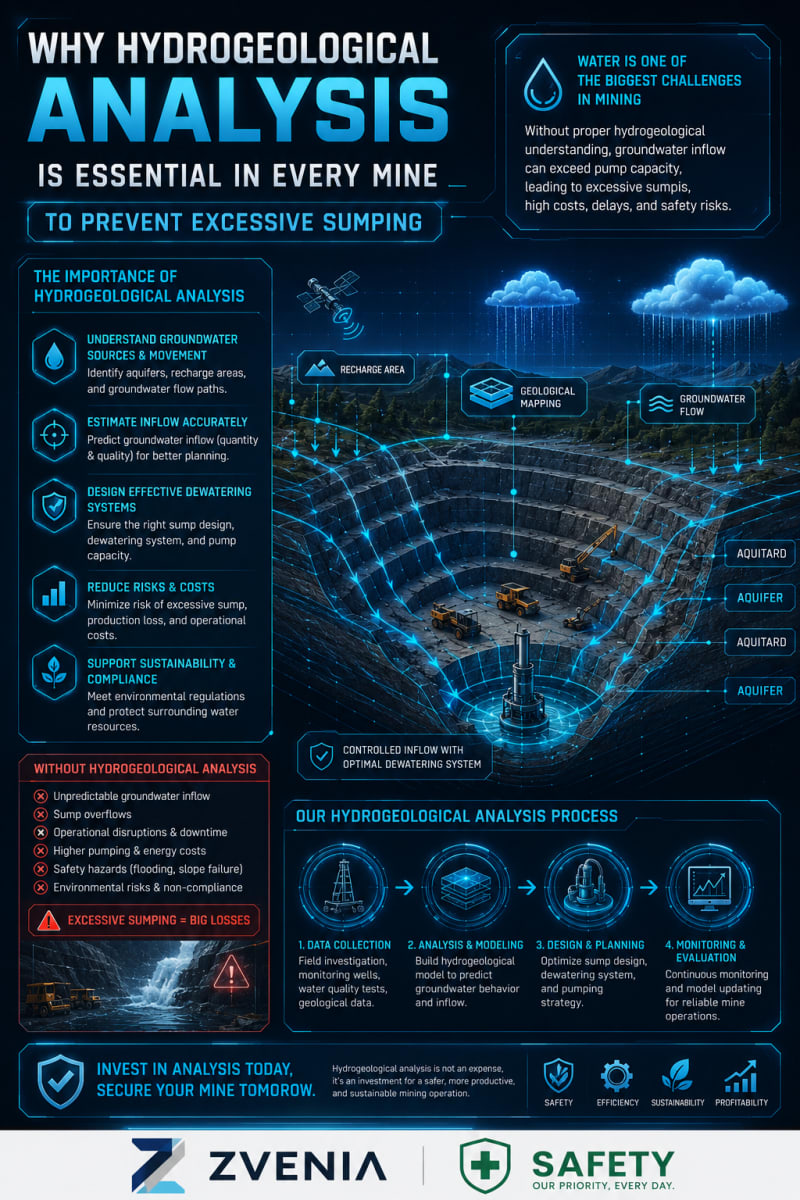
“Water is often underestimated in mining & until it stops, the entire operation.”
A mine without proper hydrogeological analysis is like digging blind beneath groundwater pressure. Uncontrolled inflow can slowly turn a productive pit into an operational hazard — excessive sump capacity, flooded working areas, unstable slopes, rising pumping costs, and lost production time.
Hydrogeological analysis may look simple on paper, but understanding groundwater flow, recharge zones, aquifers, and inflow prediction can be the difference between:
✔ Controlled dewatering
✔ Stable operations
✔ Efficient pumping systems
✔ Sustainable mining
Or
❌ Constant flooding
❌ Operational downtime
❌ Unsafe working conditions
❌ Millions lost in preventable issues
In mining, small analyses often prevent massive disasters.
Hydrogeology seems simple… but it can save your mine from drowning.
#Hydrogeology #MiningEngineering #Groundwater #OpenPitMining #Dewatering #Geotechnical #MinePlanning #NickelMining #MiningOperation #SafetyFirst #Zvenia #MiningIndustry
This video demonstrates the process of applying shotcrete for underground mining support. Shotcrete is a sprayed concrete that strengthens rock surfaces, prevents loose rock from falling, and enhances the overall stability of tunnels and excavations. You will see step-by-step how shotcrete is applied, including proper techniques, sequence, and safety measures. The video also highlights its effectiveness in controlling rock movement and protecting workers during underground operations.
This study focuses on the performance of reinforced shotcrete, a special type of sprayed concrete that often includes fibers or mesh to make it stronger. Shotcrete is widely used in underground mining, tunneling, and construction to support rock surfaces, prevent rock falls, and increase the overall stability of underground spaces. One of the key factors influencing how well shotcrete works is the sequence in which ground support elements are installed. These elements typically include rock bolts, wire mesh, and the shotcrete layer itself.
The research shows that the installation sequence matters a lot. If the supports are installed in the correct order, the surrounding rock becomes much more stable, cracks and spalling are reduced, and the risk of accidents decreases. Using reinforced shotcrete, especially with steel fibers, creates a strong, protective layer that holds loose rock fragments together and resists surface damage. The study also highlights that timing is critical: applying shotcrete too early or too late can reduce its effectiveness.
The findings provide practical, easy-to-follow guidelines for engineers and mining professionals. They explain how to choose the right type of shotcrete, decide on the thickness, select reinforcement methods, and determine the optimal installation order based on specific rock conditions. By following these guidelines, mining and tunneling teams can improve safety, save time and resources, and increase the efficiency of underground operations.
This study is particularly useful for mining engineers, tunnel designers, and safety specialists, as it combines practical experience with research-backed evidence. It shows that careful planning of support installation, along with the right use of reinforced shotcrete, can prevent rock failures, protect workers, and extend the life of tunnels and underground excavations.
In short, reinforced shotcrete is not just a material—it is a critical part of underground safety and stability, and understanding its performance in combination with installation sequence can make a huge difference in modern mining and tunneling operations.
Source: credit to Martin LA, Pakalnis R, Raffaldi MJ, Sandbak LA, Stepan MA, Warren SN
More and more people are discussing what constitutes a deep mine. Logically, many focus on depth below ground surface. But depth is just one aspect to consider and, as a surprise to many, not the dominant factor. Two of the more important aspects to consider are:
(1) in situ stress state which varies globally ranging from conditions where the major principal stress is vertical to where the major principal stress is horizontal and multiples in magnitude of the vertical stress. For example, stresses in and around Pennsylvania can have horizontal to vertical stress ratios >4.
a. Example 4000m depth where the major principal stress is vertical (e.g., deepest UG mine in South Africa is ~4000m) would have a Sigma 1 ~108MPa.
b. Example 2000m depth where the major principal stress is horizontal and 2 times the vertical would also have a Sigma 1 ~108MPa. Both cases assuming 0.027MPa/m for vertical stress gradient.
(2) If you couple the in situ stress state (for which depth is a variable) with intact rock strength, you have the makings of a parameter (the Stress Level Index, e.g., Kaiser et al 2000) that is valuable for defining deep mining conditions.
The stress Level Index (SLI) relates the induced maximum stress (σmax) around an equivalent circular excavation in elastic rock to the rock’s intact compressive strength (σc), where σmax = 3σ1 – σ3 (with σ1 and σ3 representing the major and minor principal stress in the vicinity of the tunnel in the plane perpendicular to the tunnel axis). By benchmarking the SLI to real conditions (from these and more…Wilson 1971, Barton et al. 1974, Wiseman 1978; 1979, Hoek and Brown 1980a, Stacey and Page 1984, Jager et al. 1990, Kaiser et al. 1996, Board and Brummer 1997, Brummer 1998, and Martin et al. 1999, amongst others) you find:
- Spalling initiates at σmax/σc= 0.3-0.5 (which corresponds with the unconfined rock mass strength near the excavation wall)
- Notch formation with deep spalling (>20% of tunnel radius) and potentially minor strainbursting (spitting and popping) is to be expected for σmax/σc>0.5 to 0.6
- Moderate strainbursting and-or deep spalling at σmax/σc>0.6 to 0.8
- Major strainbursting and-or deep spalling at σmax/σc>0.8
This allows for a meaningful relative assessment of stressed ground challenges. In Figure 1, I have plotted my operating mine and project experience for cases available in the public domain to show the value of looking at SLI vs depth. One can quickly see that depth is not the driving factor and that it is a combination of in situ stress and intact rock strength. These plots are for the in situ stress before mining but induced stress at different times of mining can be used to assess SLI as well and see how it changes over a mine’s life.
Furthermore, in the past, Sigma 1 / UCS was used as a stressed ground indicator. I argue that SLI is more valuable. When the same data is plotted with S1/UCS (Figure 2), there is limited range in the results reducing decision making potential. One of the reasons for this is the importance of the other principal stresses in assessing when deep mining challenges could be expected.
How We Protect Tunnels and Mines
1-Rock Bolts
Steel rods inserted into the rock to bind layers together and prevent separation.
2-Wire Mesh
Used with rock bolts to hold small rock fragments and prevent falls.
3-Shotcrete
A thin layer of sprayed concrete applied to tunnel walls to strengthen and stabilize them.
4-Steel Sets / Arches
Used in areas with weak rock or high stresses to provide strong support.
5-Hydraulic Props
Adjustable columns used to temporarily support the roof during operations
🛡️ Why Ground Support Matters:
- Protects workers and equipment
- Prevents tunnel collapses and production stoppages
- Reduces accidents and repair costs
Choosing the right support type depends on careful assessment of rock conditions, stress levels, and mine environment.
Proper ground support design is essential for the success and sustainability of underground mining.
Slope stability is a critical consideration in the design, operation, and long-term sustainability of surface mining projects.
The mechanical behavior of slopes significantly influences operational safety, mine productivity, and economic performance.
The accompanying diagram delineates three principal components in the context of slope stability analysis:
𝟏. 𝐒𝐥𝐨𝐩𝐞 𝐌𝐚𝐬𝐬: The volume of overburden or rock material subject to potential movement due to gravitational and stress-induced forces.
𝟐. 𝐈𝐧𝐭𝐞𝐫𝐟𝐚𝐜𝐞: The potential failure surface, often defined by zones of weakness, discontinuities, or adverse geological structures along which shear displacement may occur.
𝟑. 𝐒𝐥𝐨𝐩𝐞 𝐁𝐚𝐬𝐞: The competent substratum that provides geomechanical support to the overlying slope mass.
✅ From a geotechnical standpoint, failure mechanisms are governed by a combination of factors including material strength parameters (cohesion, internal friction angle), groundwater conditions, slope geometry, and external loads.
✅The mobilization of shear stresses along the interface can lead to translational or rotational failure modes, particularly in heterogeneous or anisotropic materials.
📈 To mitigate the risk of slope failure, contemporary mining practices integrate a multidisciplinary approach encompassing:
- Site-specific geotechnical investigations.
- Laboratory and in-situ testing (e.g., triaxial, direct shear, borehole logging).
- Hydrogeological modeling and pore pressure monitoring.
- Numerical simulations (e.g., Limit Equilibrium, Finite Element Analysis).
- Real-time monitoring systems (inclinometers, piezometers, radar systems).
➡️ Preventive and remedial measures such as slope reinforcement, dewatering systems, and geometry optimization are implemented based on comprehensive stability assessments.
➡️In conclusion, the integrity of mine slopes is not merely a geotechnical constraint but a central component of responsible mine planning and risk management.
➡️Continuous monitoring, coupled with rigorous analysis, remains essential for ensuring both operational continuity and the safety of personnel and assets.
It's not just luck or concrete — it's rock mass classification, and the Q-System is one of the most trusted tools for it in mining and tunneling.
Developed in 1974, the Q-System helps engineers evaluate the quality of rock masses using 6 key parameters:
1️⃣ RQD – Rock Quality Designation
2️⃣ Jn – Joint set number
3️⃣ Jr – Joint roughness
4️⃣ Ja – Joint alteration
5️⃣ Jw – Water inflow
6️⃣ SRF – Stress reduction factor
The result? A numerical Q-value that tells you exactly how strong or weak your ground is — and what support it needs.
🔩 Based on this, you can determine:
Type of rock support (e.g., bolts, mesh, shotcrete)
Support spacing
Tunnel stability
Q-System = turning geology into engineering decisions.
Rock Bolting in Underground Mining: Enhancing Stability & Safety
Rock bolting is a critical ground support method in underground mining, designed to reinforce rock masses and prevent failures. The selection of bolt type and installation depends on rock mass quality, assessed using Rock Mass Rating (RMR) and Geological Strength Index (GSI), as well as excavation size and mining method.
🔹 Rock Types & Classification:
• Good Rock (RMR: 61-80, GSI: 60-80) – Minimal support required, standard bolting.
• Fair Rock (RMR: 41-60, GSI: 40-60) – Systematic bolting with grouted rebar.
• Poor Rock (RMR: 21-40, GSI: 20-40) – Reinforced bolting with mesh and shotcrete.
• Very Poor Rock (RMR <20, GSI <20) – Cable bolts, shotcrete, and systematic reinforcement.
🔹 Bolt Types & Applications:
• Mechanical Bolts (Split Set, Expansion Shell) – Quick support in competent rock.
• Resin-Grouted Bolts (Rebar, Dowel) – Strong anchorage for weak rock.
• Cable Bolts – Deep anchorage for poor rock conditions and large spans.
• Self-Drilling Bolts (SDA) – Ideal for fractured rock, grouted during installation.
• Friction Bolts (Swellex, Split Set) – Fast installation for dynamic conditions.
• Super Bolts – High-capacity, long bolts (6m+) for deep-seated failures.
🔹 Bolt Dimensions & Spacing:
• Diameter: 16mm – 39mm (common sizes: 22mm – 32mm).
• Length: 1.2m – 6m (cable bolts may exceed 6m).
• Spacing: Typically 1m – 1.5m apart, depending on ground conditions.
🔹 Geotechnical Inspection & Monitoring:
• Pull Testing for load verification.
• Displacement Monitoring (extensometers, convergence meters).
• Ultrasonic & Acoustic Testing for bolt integrity.
• Numerical Modeling (FLAC3D, RS2, Map3D) to predict stability.
Proper bolt selection, systematic reinforcement, and geotechnical monitoring are key to safe and efficient underground operations. What bolting strategies do you use in your operations?
Tunnel failure catalogue is a valuable resource for engineers and anyone involved in tunnel construction case histories of tunnel failures around the world by studying these failures, engineers can learn from their mistakes and improve their own tunneling practices.
Source: Syed Shah
Source: Credits to Civil Engineering and Development Department
El magazine internacional se imprime nuevamente 𝗲𝗻 𝗹𝗮 𝟭𝗿𝗮 𝘀𝗲𝗺𝗮𝗻𝗮 𝗱𝗲 𝗼𝗰𝘁𝘂𝗯𝗿𝗲 𝗰𝗼𝗻 la entrevista 2024 a 𝗡𝗶𝗰𝗸 𝗕𝗮𝗿𝘁𝗼𝗻, 𝘁𝗿𝗮𝗯𝗮𝗷𝗼𝘀 𝘁𝗲́𝗰𝗻𝗶𝗰𝗼𝘀 del Congreso TM2024 realizado del 3-5 de julio en Lima, 𝗽𝗿𝗼𝘆𝗲𝗰𝘁𝗼𝘀 𝗲𝗻 𝗔𝗿𝗴𝗲𝗻𝘁𝗶𝗻𝗮, 𝗖𝗼𝗹𝗼𝗺𝗯𝗶𝗮, 𝗖𝗵𝗶𝗹𝗲, 𝗣𝗲𝗿𝘂́, 𝗠𝗲́𝘅𝗶𝗰𝗼, y un especial de los eventos: XIX Seminario Andino de Túneles en Armenia y de las XIV Jornadas en Argentina.
Source:Elí Torres Lugo
Source: Credits to ELITEMIN
07 Ground support
Focuses on supporting rock and soil to ensure safety and stability in underground and surface mining operations.
Technical events on ground support technologies and best practices.
No events scheduled
07 Ground support
Focuses on supporting rock and soil to ensure safety and stability in underground and surface mining operations.
Expert conversations on rock support challenges and solutions.