Iran’s mining sector represents a substantial and diverse opportunity landscape across metallic and non-metallic minerals, exploration projects, operating mines, processing opportunities and mining-related investments.
As ZVENIA Country Manager for Iran, I am developing ZVENIA’s presence within the Iranian mining ecosystem while supporting greater visibility and connectivity between the local mining industry and the international mining community.
For international investors and mining companies interested in understanding the Iranian market, preliminary work can begin well before any final investment decision. This includes:
• Identification of potential mining investment opportunities
• Initial project and asset screening
• Preliminary technical and commercial assessment
• Mining market intelligence
• Understanding local industry structure and key stakeholders
• Identification of suitable companies, contractors, consultants and potential partners
Through my professional activities in Iran’s mining sector, I have developed a strong database of mining opportunities across different commodities and stages of development. This provides a practical starting point for investors wishing to monitor the market, evaluate potential projects and prepare for possible future participation.
The objective is not simply to identify assets, but to help interested parties build an informed understanding of the Iranian mining landscape and focus their attention on credible opportunities.
All potential activities and investment considerations must, of course, be assessed in accordance with applicable legal, regulatory, sanctions, compliance and investment requirements.
For initial discussions regarding Iran’s mining market and available opportunities:
Shahou Rezaei
Country Manager – Iran | ZVENIA
Email: shahou44@gmail.com
WhatsApp: +989129675238
Y es mucho más fácil convertirla en una reserva económica que la misma tonelada descubierta en medio de la nada.
En primer lugar, el riesgo geológico es menor. Si ya existe un yacimiento de cobre en producción, se sabe que el sistema mineralizante existe. Se cuenta con años de perforación, modelos geológicos, interpretación estructural, geofísica, geoquímica y datos reales de la operación minera. La exploración puede centrarse en extender la mineralización conocida en profundidad, a lo largo del rumbo, o en encontrar depósitos satélite cercanos.
En segundo lugar, la infraestructura ya existe. Un descubrimiento junto a una mina en operación puede aprovechar la planta de procesamiento existente, energía, carreteras, infraestructura hídrica, instalaciones de relaves, fuerza laboral y cadena de suministro.
A medida que una mayor proporción del capital destinado a la exploración de cobre se dirige hacia minas existentes, encontrar mineralización adicional es solo una parte del desafío. Los operadores todavía necesitan determinar cuánta perforación se requiere realmente para convertir esas toneladas de Recursos Inferidos a Indicados y Medidos.
Tradicionalmente, el equipo debe tomar decisiones como: ¿Cuántos sondajes adicionales necesitamos? ¿Dónde exactamente deberían ubicarse? ¿Necesitamos otros 10.000 metros o 30.000 metros de perforación?
Lo que no puede verse con claridad de antemano es la relación entre la perforación adicional y la conversión de recursos que esta producirá.
No somos capaces de producir para el mismo volumen una tabla como esta:
10.000 m de perforación → 35% del recurso objetivo convertido a Indicado
15.000 m → 58% convertido
20.000 m → 73% convertido
25.000 m → 77% convertido
Si esta relación se conociera antes de perforar, la decisión sería muy diferente. Los últimos 5.000 metros de este ejemplo hipotético aportan solo cuatro puntos porcentuales adicionales de conversión. Quizás ese capital podría generar más valor en otro lugar.
Y no se trata únicamente de cuánto perforar. También importa dónde colocar esos metros. Dos programas de perforación de 20.000 m pueden producir niveles muy diferentes de conversión de recursos dependiendo de la ubicación de los sondajes.
La exploración brownfield es atractiva, en parte, porque se supone que ofrece una ruta eficiente hacia reservas adicionales. Pero si la perforación de definición de recursos entre el descubrimiento y alcanzar un nivel de confianza utilizable en el recurso no está optimizada, parte de esa ventaja en eficiencia puede perderse.
Show translation
Mining operations run on a chain of decisions that must be visible long after a purchase order is raised. A site may need drilling consumables, equipment maintenance, laboratory work, freight, fuel, engineering support, or a contractor mobilisation at short notice. When the supplier, contractor, operating site, and treasury team are in different countries, a payment is not merely an instruction to move money. It is a controlled operating event that needs an owner, evidence, and a clear completion rule.
Digital payment systems can improve the recordkeeping and handoffs around that event. They do not remove the need for local banking arrangements, procurement approvals, sanctions screening, tax treatment, contract controls, or finance review. Their value lies in making the payment process easier to define, track, reconcile, and audit.
## Cross-border payment challenges in mining
The cross-border payment problem in mining is often an information problem before it becomes a settlement problem. A procurement team may approve a supplier invoice in one currency, a site manager may confirm delivery in another location, and treasury may release funds under a separate authority matrix. If the payment reference is vague, the parties may spend time matching bank confirmations, emails, and invoices after the fact.
International payments also pass through different payment infrastructures, operating hours, intermediary arrangements, and data requirements. The Bank for International Settlements identifies fragmentation and friction in cross-border payments as a global issue, with work focused on improving speed, cost, transparency, and access rather than assuming there is one universal rail.
For a mine operator, the practical response is to define a payment workflow before a payment becomes urgent. The workflow should state who can create an instruction, which document establishes the obligation, what constitutes proof of goods or services, who may amend beneficiary details, and what status allows the payment to be treated as complete. This applies equally to a recurring equipment supplier, a one-off geotechnical contractor, and a logistics provider.
## Payment instructions and transaction records
Every cross-border payment should begin with a structured instruction, not a free-form email. For a mining operation, that instruction can connect the purchase order to a specific site, project or cost centre, supplier or contractor, invoice, currency or asset, amount, destination details, expected payment date, and approval trail. This is particularly useful when the same supplier supports several sites or when a contractor is mobilised for a specific project phase.
## Monitoring and confirmation
A transaction should not become “paid” merely because a user submitted an instruction or a transfer appears in a wallet or portal. Operations need a status model that separates initiated, pending, payment detected, confirming, completed, rejected, expired, and under review. The exact labels may differ, but the meaning of each should be agreed across procurement, site operations, treasury, and finance.
For example, a contractor should not be told that a mobilisation payment is final until the organisation’s defined confirmation condition has been met and the record can be matched to the approved instruction. If a payment is detected but the asset, network, amount, or destination differs from the original request, it should move to an exception queue rather than silently close the invoice.
Monitoring is therefore both a technical and operational task. A system can observe transaction state, while staff decide how an exception affects delivery, work authorisation, or the next approval. The distinction matters: evidence that a transfer exists is not automatically evidence that a contractual payment obligation has been correctly settled.
## Reconciliation
Reconciliation is where the payment record meets the accounting and operational record. A useful daily reconciliation file links the purchase order, invoice, payment instruction, transaction or bank reference, currency or asset, expected amount, actual amount, status, approvers, and any adjustment or refund record.
This structure makes exceptions visible. Finance can identify an invoice that has been approved but not settled, a settlement that cannot be matched to an invoice, a payment that was sent twice, or a contractor payment that requires a withholding or other internal review. It also gives site teams a reliable answer when a supplier asks for payment status.
The control objective is traceability, not paperwork for its own sake. COSO’s internal-control framework is designed to help organisations address operating and reporting objectives; a payment process should make it possible to trace an individual transaction through those objectives. In mining, the same record may later support a procurement review, a project-cost analysis, a vendor query, or an audit request.
## Settlement and treasury
Settlement should be designed as a separate step from transaction initiation. Treasury needs to know what has been authorised, what has actually settled, what remains pending, and where the resulting balance sits. This is particularly relevant when a group treasury function funds a site or when suppliers operate across several jurisdictions.
A mining group may also need to distinguish between corporate treasury, a local operating entity, and a project-level cost centre. Without that separation, a correctly executed payment can still become difficult to allocate internally.
Digital payment systems can support this by giving treasury a common transaction ledger and defined status events. They should not be treated as a substitute for liquidity planning, bank-account governance, beneficiary validation, or the company’s own policies for foreign-exchange and cash management.
Stablecoins may be considered in some payment flows as a digital settlement instrument rather than an investment product. If a company evaluates that option, it should define the specific asset, network, permitted counterparties, custody arrangement, redemption path, transaction limits, and records required for reconciliation. The proposed use should also fit the relevant contract, jurisdiction, and internal policy. The Financial Stability Board's recommendations on global stablecoins highlight the regulatory and oversight considerations involved, reinforcing the need for governance alongside the technology.
No payment instrument resolves a supplier dispute, validates an invoice, or replaces a site’s procurement controls. The settlement method has to fit the organisation’s approved treasury process.
## Operational controls
The control framework should concentrate on points where a payment can be misdirected, duplicated, or wrongly treated as final. Useful controls include a maker-checker approval flow; independent verification of changes to beneficiary details; restricted roles for instruction creation, approval, and settlement release; documented exception handling; and retained evidence for each status change.
Systems integrations need similar care. An API can create a payment instruction from an approved procurement workflow and send status events back to the enterprise system. The receiving system should authenticate those events, match them to the intended instruction, handle retries safely, and prevent one event from generating duplicate downstream actions. A customer-facing redirect, an emailed screenshot, or an unverified message should not become the system of record.
Access control is also an operational concern at remote sites. Teams should decide who can view supplier payment details, who can initiate a change, who can approve it, and who can export records. Those decisions should be documented alongside the payment workflow, not left to informal local practice.
## Practical recommendations
Start with a small, defined payment lane rather than attempting to redesign every supplier process. Map one recurring workflow, such as critical-spares payments or a contractor mobilisation, from requisition through settlement. Identify the documents, status transitions, approvers, exception paths, and records that each team needs.
Then standardise the reference data. The purchase order, invoice, payment instruction, and transaction reference should be connected by stable identifiers. Agree in advance what will happen when amounts differ, beneficiary data changes, a transaction remains pending, or a supplier disputes completion.
Finally, test the workflow with procurement, site operations, treasury, and finance together. The aim is not simply to make payment initiation faster. It is to create a process in which each team can see the same payment state and knows what to do next. It is a process in which each team can see the same payment state and knows what to do next. Payment infrastructure such as [Cryptoway](https://cryptoway.com/) can bring checkout, invoices, transaction monitoring, API integration, and settlement into one operating path; the operating model still needs to define approvals, exceptions, and records around it.
## Conclusion
Cross-border payments in mining work better when they are managed as controlled operational records, not isolated transfers. Clear instructions connect funds to a business purpose. Status monitoring separates an initiated transaction from a confirmed one. Reconciliation ties treasury activity back to procurement and accounting. Stablecoins, where permitted and appropriate for a defined process, require the same attention to counterparties, records, controls, and governance as any other settlement method.
The durable outcome is not a new payment rail. It is a workflow that allows a mine operator to explain what was paid, why it was paid, who approved it, what evidence confirms it, and how it was settled.
The latest production data shows that global nuclear fuel supply is increasingly concentrated in a handful of countries. 60% of uranium comes from just 3 countries.
1. Kazakhstan dominates the market. Producing over 23,000 tonnes in 2024, Kazakhstan supplies more than one-third of the world's uranium. No other country comes close.
2. Canada remains the clear number two. With more than 14,000 tonnes produced, Canada's high-grade deposits continue to make it one of the most important and reliable suppliers to the global nuclear fleet.
3. Namibia's rise is one of the biggest stories. Production has more than doubled over the past decade, moving Namibia into third place globally and reinforcing Africa's growing role in the nuclear fuel supply chain.
4. Australia's production has declined despite having the world's largest uranium resources.
5. The United States remains heavily import dependent. Despite renewed focus on energy security and domestic supply chains, U.S. uranium production remains a fraction of what it was historically.
But the most important takeaway may be this: the nuclear build-out isn't only about building reactors. It also requires uranium mines, conversion facilities, enrichment capacity, fuel fabrication plants, and long-term investment across the entire fuel cycle.
As countries pursue energy security, AI-driven electricity demand, and nuclear expansion, attention is increasingly shifting from reactors to the supply chains that make them possible.
The question is no longer whether the world wants more nuclear power. It's whether the fuel cycle can scale fast enough to support it.
The enclosed visualization tells a powerful story: while traditional minerals like copper, iron ore, and bauxite still dominate by volume, the fastest growth is now in energy transition minerals.
data source:
https://ourworldindata.org/grapher/global-mine-production-minerals
Lithium has surged from near-zero in 1960 to ~240Kt today.
Rare Earths are approaching ~390Kt, driven by magnets, EVs, and electronics.
Nickel, graphite, and cobalt are all accelerating alongside battery demand.
This is more than a commodity cycle. It's a structural shift. Electrification, AI infrastructure, and decarbonization are fundamentally reshaping demand patterns. Yet the challenge is not resource scarcity, it's how we produce:
Lower-grade deposits
Higher capital and energy intensity
Increasing environmental scrutiny
The future of mining will hinge on balancing growth, sustainability, and supply chain resilience. Much like oil in the 20th century, critical minerals are rapidly becoming a cornerstone of economic competitiveness and energy security.
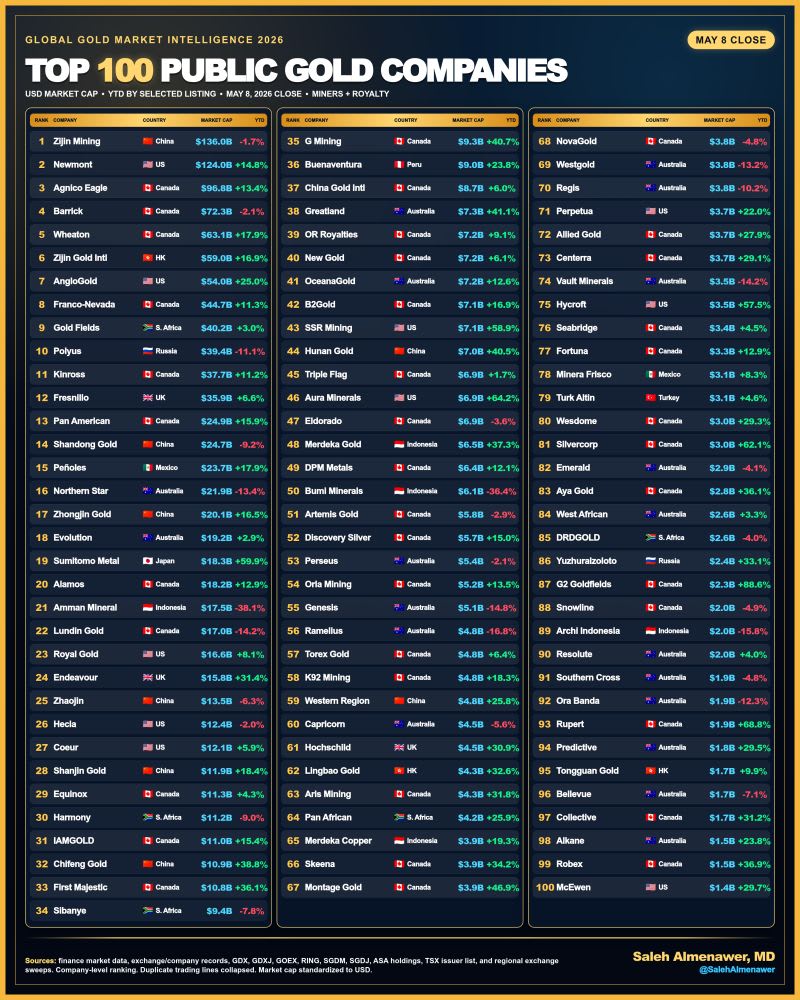
The top 100 public gold companies are now worth $1.44T.
And the company ranked #100 is still worth $1.4B.
That is the part I think the market still underprices.
Gold gets the headline.
Gold miners give you the operating torque behind the headline.
The leaderboard is bigger than most people realize:
1. The top 10 control 50.7% of the entire ranking
2. Canada has 40 names on the board
3. China + Hong Kong now have 11 names worth $294B
4. Every royalty/streaming name on the list is green
5. Even after the run, 29 of the top 100 are still red YTD
That last point is not bearish to me.
It is the opportunity.
A strong gold tape does not lift every miner equally.
It separates the market into tiers.
The giants attract institutional capital.
The royalty names collect cleaner exposure.
The explorers give you discovery and construction torque.
The beaten-up operators become the debate.
This is why I love gold miners more than gold itself.
Gold moves.
Miners can multiply the move.
Not always.
Not evenly.
But when the cycle is real, the equity market starts hunting for torque.
And this table shows how deep that hunting ground has become.
If gold stays strong, where does the next wave of capital go?
Mega-cap producers?
Royalty names?
Explorers?
Or the punished operators everyone gave up on too early?
A complete guide to the CFA Level 1
• Quantative medhods
• Economics
• Financial Statement Analysis
• Corporate Issuers
• Fixed Income
• Time Value of Money
And more!
En minería, los números lindos en un PowerPoint no garantizan que un proyecto sea viable. Lo que define si una mina existe o no, está en los detalles técnicos que muchas veces se pasan por alto.
Estos conceptos son la base para evaluar si un proyecto es sólido o si solo tiene potencial geológico sin sustento económico real. Entenderlos te permite reducir riesgos, hacer mejores preguntas y tomar decisiones con información técnica, no solo con promesas.
📌 Resumen clave (checklist para inversores):
✅ Preguntá por reservas, no solo recursos.
✅ Entendé la ley de corte y cómo cambia con precios/costos.
✅ Exigí modelos con dilución y recuperación realistas.
✅ Evaluá CAPEX con contingencias y OPEX con benchmarks.
✅ Verificá experiencia del equipo en ese tipo de depósito.
✅ Validá que haya un QP independiente certificado revisando el proyecto.
¿Cuál de estos conceptos te resultó más útil? ¿Hay alguno que agregarías?
Si estás evaluando un proyecto minero y necesitás una segunda opinión técnica independiente (NI 43-101, due diligence, CPR), escribime. Puedo ayudarte a separar proyectos sólidos de presentaciones de PowerPoint.
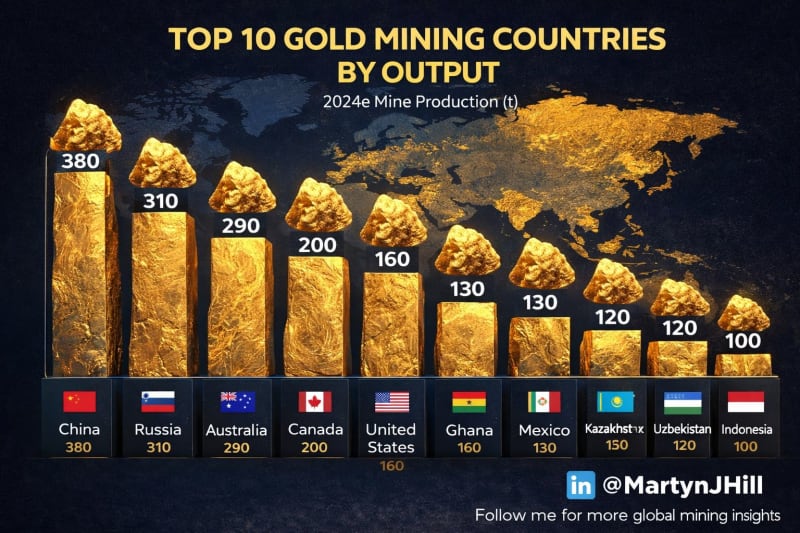
Global gold production continues to consolidate around a handful of dominant jurisdictions, but the real story sits beneath the rankings.
This latest infographic highlights the Top 10 gold producing regions by 2024 estimated mine output, and the numbers reveal more than just tonnes. They reflect geology, investment cycles, political strategy and the evolving direction of the global mining sector.
China retains the number one position, supported by a large domestic industry and consistent state-backed development. Russia and Australia remain close behind, demonstrating the strength of established gold provinces and the scale that long-term infrastructure investment can deliver. Canada and the United States round out the traditional Tier 1 mining jurisdictions, where stable regulation and access to capital continue to underpin production.
What stands out is the growing presence of emerging and frontier regions. Ghana maintains its position as a cornerstone of West African gold output, while Mexico reinforces Latin America’s contribution through a mix of underground and open pit operations. Kazakhstan and Uzbekistan continue to rise as Central Asian producers, supported by large-scale deposits and ongoing investment into modern mining methods.
Indonesia deserves particular attention. While ranked tenth by total output in this dataset, its influence on global gold supply is outsized thanks to the world-class hashtag#Grasberg operation. Grasberg is not only one of the largest gold deposits globally, it represents a shift toward large-scale underground block cave mining following decades of open pit production. Its scale, copper by-product credits and continued investment into underground infrastructure position Indonesia as a long-term powerhouse within the gold sector, not just a mid-table producer.
From a broader industry perspective, this distribution highlights three key trends. First, production leadership is becoming more geographically diverse, reducing reliance on a single dominant region. Second, established mining nations are balancing mature operations with new project pipelines to sustain output. Third, emerging producers are gaining momentum as exploration success meets improving infrastructure and international investment.
For those of us working across mining, workforce planning and project delivery, understanding where production is concentrated matters. Capital flows toward production hubs.
Gold remains one of the few commodities that bridges traditional mining and global economic sentiment. Whether driven by investment demand, currency hedging or industrial use, its production footprint offers a clear lens into where the sector is heading next.
Click the 🔔 on my profile to follow me for more global mining insights.
#Mining #GoldMining #GlobalMining #Resources #MiningIndustry #Commodities #MiningCareers #MartynJHill
Mining thrives not only on geology and technology but also on finance and market dynamics. In today’s interconnected world, access to capital and understanding of market behavior determine whether a mining venture succeeds or collapses.
1. The Power of Financial Strategy
Every mine begins as an investment idea a balance of risk, reward, and resource. Financial planning ensures that exploration, development, and production are backed by sustainable funding.
Sources of financing range from equity investments, joint ventures, and private equity, to government-backed mineral development funds. A well-structured financial model helps companies secure investor confidence and long-term viability.
2. Market Dynamics and Price Volatility
Commodity prices fluctuate with global demand, technological shifts, and geopolitical events. Gold rises during economic uncertainty, while base metals like copper and nickel respond to industrial growth and green energy transitions.
Understanding these market cycles allows miners to hedge risks, adjust production strategies, and time their sales for maximum profitability.
3. Investment Trends in the Green Economy
The push for renewable energy and electric mobility is reshaping mining finance. Investors are channeling funds toward critical minerals such as lithium, cobalt, and rare earth elements materials vital for batteries and clean energy technologies.
This shift is encouraging new financial partnerships between governments, investors, and exploration firms to secure ethical and sustainable mineral sources.
4. Challenges in Mining Finance
Rising exploration costs, uncertain regulatory environments, and ESG (Environmental, Social, and Governance) compliance requirements can limit access to capital.
Today’s investors demand transparency not only in profits but in social responsibility. Therefore, mining companies must build trust through data disclosure, responsible practices, and community engagement.
5. The Future Market Outlook
Digital transformation is introducing blockchain-based mineral trading, improved traceability, and more efficient commodity exchanges. These innovations will redefine how minerals are priced, traded, and financed ensuring fairer and more secure transactions across borders.
1
17 Finances and markets
Explores commodity markets, price evolution, and financial performance of mining companies.
Market outlook events and financial forums.
No events scheduled
17 Finances and markets
Explores commodity markets, price evolution, and financial performance of mining companies.
Discussions on commodities, speculation, and market dynamics.