



Hydraulic Accumulators – The Hidden Power Behind System Reliability
In every hydraulic system, there’s an unsung hero that ensures smooth performance, energy efficiency, and safety — the hydraulic accumulator.
Whether it’s storing energy, absorbing shocks, or providing emergency power, accumulators play a crucial role in keeping systems stable and responsive.
There are three main types:
⚙️ Weight-loaded – delivers constant pressure but is bulky.
⚙️ Spring-loaded – simple but limited by spring elasticity.
⚙️ Gas-charged (Piston, Bladder, Diaphragm) – the most widely used for their compactness, quick response, and efficiency.
💡 Applications go far beyond energy storage:
• Safety systems in aircraft and railways ✈️🚆
• Energy saving in injection molding machines
• Suspension and vibration damping in heavy vehicles 🚜
• Pressure stabilization in pumps and hydraulic circuits
By using accumulators smartly, engineers can reduce pump load, save energy, and extend equipment life — all while maintaining system stability.
🔹 Small component, massive impact on system performance.
Maintenance teams and management must stop treating every notification as an emergency. Prioritizing work based on risk is critical for efficient operations. Here's a simple framework to assess the "likelihood", "severity", and "impact" to Safety, Health, Environment (SHE) and Business/Production if a maintenance job/task remains incomplete within 2, 7, 30, 90, 180, or 365 days:
🚧 2 Days:
- Likelihood: SHE: Low | Business/Production: Low
- Severity: SHE: Minor | Business/Production: Minor
- Impact: Slight safety or environmental risk; minimal operational hiccups.
🚧 7 Days:
- Likelihood: SHE: Moderate | Business/Production: Moderate
- Severity: SHE: Moderate | Business/Production: Moderate
- Impact: Possible safety incidents; noticeable production delays.
🚨 30 Days:
- Likelihood: SHE: High | Business/Production: High
- Severity: SHE: Serious | Business/Production: Serious
- Impact: Significant safety or environmental hazards; major workflow disruptions.
🚨 90 Days:
- Likelihood: SHE: High | Business/Production: High
- Severity: SHE: Severe | Business/Production: Severe
- Impact: Critical safety or environmental violations; substantial production losses.
🚨 180 Days:
- Likelihood: SHE: Very High | Business/Production: Very High
- Severity: SHE: Critical | Business/Production: Critical
- Impact: Severe safety or environmental damage; extended operational downtime.
🚨 365 Days:
- Likelihood: SHE: Very High | Business/Production: Very High
- Severity: SHE: Catastrophic | Business/Production: Catastrophic
- Impact: Devastating safety or environmental harm; massive financial and operational setbacks.
Set correct End Dates in the notifications so work order backlog is easily managed.
Also having a risk category applied/configured in the notification can help with Planning, Scheduling and Execution stages where the IW38/IW37N report can have a column for the risk category.
Planners and schedulers can filter by End Dates, Risk category and streamline their activities to ensure the execution teams have the right jobs in the weekly schedule.
💡Takeaway: Implement a risk-based approach to prioritize maintenance notifications. This ensures resources are allocated effectively, protecting SHE and minimizing business disruptions.
Let’s work smarter, not harder!
Problem Statement:
A batch of parts was rejected due to an oversized hole diameter.
5-Why Analysis:
1.Why was the batch rejected?→ Because the hole diameter was larger than the specified tolerance.
2.Why was the hole diameter too large?→ Because the drilling machine was not properly adjusted.
3.Why was the machine not properly adjusted?→ Because the operator used an outdated setup sheet.
4.Why did the operator use an outdated setup sheet?→ Because the latest revision was not available at the machine.
5.Why was the latest revision not available at the machine?→ Because there is no system in place to ensure controlled document distribution.
Root Cause:
No document control system for distributing updated setup sheets.
Corrective Actions:
•Introduce a document control procedure to issue and display the latest revision only.
•Restrict access to outdated setup sheets by removing old versions from machines.
•Train machine operators and line leaders on verifying document revision before setup.
Preventive Measures:
•Digitize all setup sheets with access through a centralized network folder or MES (Manufacturing Execution System).
•Implement revision control logs with sign-off for updates and acknowledgments by operators.
•Conduct regular audits on setup documents at workstations.
•Establish standard work that includes a revision check step before every job setup.
•Integrate barcode or QR code scanning to verify correct document versions at machines.
L'article d'aujourd'hui c'est la maintenance premier niveau (maintenance niveau zéro).
🌟Qu’est-ce que ? 🛠️
C'est la maintenance de première ligne
Les opérateurs🧑🔧 où les conducteurs 🧑🔧🧑🔧des lignes qui utilisent les machines quotidiennement , sont formés et responsabilisés pour effectuer des tâches de maintenance simples telques :
🔸🔹L'Inspection visuelle👁️ : Vérifier l’état général de la machine, repérer des fuites...
🔸🔹 Nettoyage des machines🧴🧹 : Éliminer la poussière, la saleté ou les débris qui peuvent affecter le fonctionnement des équipements.
🔸🔹Lubrification🛢️ : Appliquer les lubrifiants appropriés aux endroits indiqués, en respectant les fréquences d’intervention.
🔸🔹 Vérification des fixations🔩 : S’assurer que les boulons et autres fixations mécaniques sont bien serrés.
🔸🔹Communication des anomalies📣 : Transmettre aux équipes de maintenance les informations sur les dysfonctionnements identifiés, pour permettre une intervention rapide et efficace.
🌟 Quel est son rôle ?
Elle consiste à impliquer directement les opérateurs dans l’entretien de base des machines.
🌟 Pour Quoi ?
🔸 Réduire📉 les temps d'arrêt.
🔸 Impliquer et responsabiliser les opérateurs dans chaîne de production .
🔸 Réduire le coût📉 de la maintenance.
🔸 Améliorer la sécurité 🚨des équipements.
La maintenance de première ligne, une approche gagnante 🏆
El KPI olvidado que podría transformar la estrategia de mantenimiento: IM (Índice de Intensidad de Mantenimiento)
Dentro de mis años de experiencia sólo una vez escuché sobre este indicador y no precisamente estaba dentro de las métricas de medición de la compañía. En la industria hablamos constantemente de MTBF, MTTR, backlog o disponibilidad. Son indicadores esenciales en mantenimiento, sin duda. Pero hay uno que suele quedar en la sombra y que, bien interpretado, puede revelar verdades profundas sobre nuestra gestión: el Índice de Intensidad de Mantenimiento (IM).
¿Qué es el IM?
El IM se calcula como:
IM = Horas de mantenimiento / Horas de operación
Este indicador refleja cuánto esfuerzo real en mantenimiento (en horas-hombre o de máquina) requiere un activo para mantenerse operativo. Es decir, cuánta "intensidad" debemos aplicar para que el sistema funcione.
¿Por qué es tan valioso?
Hace visible lo invisible: Muchos equipos parecen confiables porque no fallan, pero requieren constantes ajustes, limpiezas, calibraciones o intervenciones menores. El IM captura ese esfuerzo que no siempre se refleja en las fallas.
Detecta desgaste encubierto: Si un activo aumenta su IM sin fallar más, probablemente está envejeciendo o está siendo sobrecargado silenciosamente.
Permite comparaciones más justas: No basta con saber si algo falla o no. Dos líneas de producción pueden tener el mismo MTBF, pero una requiere el doble de horas de mantenimiento. ¿Cuál es más eficiente realmente?
¿Por qué casi nadie lo usa?
Porque exige registros detallados y sistemáticos de horas de mantenimiento, algo que no todas las empresas hacen bien.
Porque no es glamoroso ni fácil de interpretar si no se contextualiza.
Porque aún priorizamos la reacción por sobre la comprensión estructural de los activos.
A lo que quiero llegar es que el IM no reemplaza a los grandes KPIs, pero los puede complementar con una mirada crítica y estructural. En un entorno donde buscamos eficiencia, sostenibilidad y optimización, no podemos darnos el lujo de ignorar cuánta intensidad estamos aplicando para mantener nuestro sistema en marcha.
Quizás es hora de poner este KPI olvidado en el centro de la conversación. Los escucho.
En la industria minera, es fundamental calcular diversos indicadores para optimizar la gestión y el rendimiento de los equipos. Estos indicadores permiten tomar decisiones informadas, mejorar la eficiencia operativa y reducir costos asociados a fallas y tiempos de inactividad.
Por ejemplo, uno de los indicadores clave es la Disponibilidad, que nos ayuda a determinar qué porcentaje del tiempo los equipos están operativos y listos para su uso. Esto facilita identificar oportunidades para mejorar la eficiencia y reducir los periodos en los que los equipos permanecen inactivos.
Otro indicador importante es el Tiempo fuera de servicio (TFS), que mide cuánto tiempo permanecen los equipos inactivos debido a mantenimiento, fallas o reparaciones. Con esta información, se puede planificar mejor las actividades de mantenimiento y reducir las paradas no programadas, optimizando así la producción.
Asimismo, para evaluar la efectividad de las acciones de mantenimiento, calculamos el Porcentaje de Mantenimiento Preventivo. Este indicador nos permite conocer qué proporción del mantenimiento realizado es preventivo, con el objetivo de reducir fallas inesperadas y prolongar la vida útil de los equipos.
Por último, para entender mejor las causas de las fallas, es útil clasificar los tipos de fallas mediante diagramas de dispersión logarítmica. Esto nos permite graficar los equipos junto con sus fallas, ya sea leves, agudas, críticas o crónicas, facilitando así el enfoque en acciones correctivas y preventivas más efectivas.
Parte de estos conceptos y herramientas se abordarán en un curso especialmente diseñado, donde se presentará un reporte de indicadores de mantenimiento utilizando Power BI aplicado a equipos mineros. La metodología será sencilla y accesible, con la intención de que la herramienta sea fácil de entender y aprovechar, ya que Power BI es muy amigable y poderoso para la visualización de datos.
Te comparto más información en el video adjunto.
Saludos cordiales,
Ingeniero Luis Bastidas
Director de EduIntelligence Academy
WhatsApp: +584125375083
Email: info@eduintelligenceacademy.com
El mantenimiento reactivo y el mantenimiento proactivo, no son tipos de mantenimiento.
Entonces ¿Que son?
En el siguiente artículo podrás encontrar la respuesta.
El artículo es tomado de mi libro "PLANIFICACIÓN, PROGRAMACIÓN Y COSTOS DEL MANTENIMIENTO" que podrás adquirir en:
https://www.bookdelivery.com/fr-en/books/search?q=Jos%C3%A9+Contreras+M%C3%A1rquez
Evolution of Maintenance Best Practices and System Reliability
Timeline graph illustrating the evolution of maintenance best practices over time, from 1930 to 2000. The x-axis represents time, while the y-axis represents system availability and reliability, showing a positive upward trend in maintenance sophistication and effectiveness.
(1) *Early Maintenance Approaches (1930 - 1950):
a. Run to Failure: The initial approach where maintenance was only performed after a failure.
b. Inspection: Introduction of basic inspection practices.
(2) *Preventive Maintenance and Failure Analysis (1950 - 1970)
a. Preventive Maintenance: Scheduled maintenance routines to prevent failures.
b. Failure Analysis: Analyzing failures to prevent recurrence.
(3) *Reliability-Centered Maintenance (1970 - 1990)
a. Reliability-Centered Maintenance (RCM): Emphasis on identifying maintenance strategies to improve reliability.
b. Computerized Maintenance Management Systems (CMMS): Integration of technology in maintenance.
c. Condition-Based Maintenance (CBM): Monitoring conditions to predict failures.
(4) *Advanced Maintenance Strategies (1990 - 2000)
a. RCM Best Practice: Refinement of RCM approaches.
b. Total Productive Maintenance (TPM): Involvement of all employees in maintenance.
c. Asset Integrity Management: Ensuring assets function as intended throughout their lifecycle.
Source: Society of Automotive Engineer SAE Standard JA1011/JA1012
I recently carried out a thesis on 2 projects, stimulation and modeling of the asset management process in the mining industry and an assessment of asset management in the mobile plant operation, and the findings were amazing.
Now, let's dive into the topic above and how organizations can inculcate them into the business world.
A strategic, sustainable asset and maintenance management process involves a long-term, data-driven approach to optimize asset lifespans, maximizing return on investment while addressing environmental, social, and governance (ESG) objectives.
Here's a breakdown of key elements:
1. Strategic Planning & Asset Lifecycle Management:
# Strategic Asset Management Plan (SAMP):
This document links organizational objectives to asset management goals and outlines high-level, strategic actions to achieve those goals.
# Asset Lifecycle Management:
This involves overseeing an asset from acquisition to disposal, ensuring maximum value throughout its lifecycle. Key stages include;
*Planning: Identifying needs and requirements for new or existing assets.
*Acquisition: Procuring the necessary assets.
*Operation: Ensuring assets are used effectively and safely.
*Maintenance: Implementing proactive and reactive maintenance strategies to extend asset lifespan and minimize downtime.
*Disposal: Planning for the responsible disposal or retirement of assets.
*Asset Identification and Tagging:
Ensuring assets are easily identifiable and linked to the overall asset plan and maintenance schedule.
*Asset Prioritization:
Assessing the criticality of assets to business operations to focus resources on the most important assets.
*Condition Assessment:
Regularly evaluating the physical condition of assets to inform maintenance and replacement decisions.
*Asset Utilization:
Ensuring assets are used effectively and efficiently and providing necessary information to workers and maintenance teams.
2. Sustainable Practices:
ESG Considerations: Incorporating environmental, social, and governance factors into asset management decisions.
*Upcycling and Recycling: Implementing programs to extend the lifespan of assets and reduce waste.
*Responsible Disposal: Ensuring assets are disposed of in an environmentally responsible manner.
*Environmental Friendliness: Utilizing environmentally friendly materials and processes throughout the asset lifecycle.
*Energy Efficiency: Implementing measures to reduce energy consumption and improve asset performance.
3. Maintenance Management:
Preventive Maintenance:
Implementing regular maintenance activities to prevent failures and extend asset lifespan.
Corrective Maintenance:
Addressing issues that arise during asset operation to minimize downtime and repair costs.
Predictive Maintenance:
Using data and technology to predict potential failures and schedule maintenance proactively.
1️⃣ Definition
🔷 OEE: Assesses how well equipment performs during scheduled production time
🔷 TEEP: It shows how effectively equipment is utilized relative to its full capacity.
2️⃣ Objectives
🔷 OEE: Identify and eliminate losses during scheduled production time (availability, performance, quality) to Improve equipment efficiency and reliability.
🔷 TEEP: Maximize equipment utilization over its theoretical full capacity and highlight opportunities to increase production by reducing downtime or extending operational hours.
3️⃣ Formula for Calculations
🔷 OEE = Availability × Performance × Quality
Availability = (Uptime ÷ Scheduled Production Time)
Performance = (Actual Output ÷ Ideal Output)
Quality = (Good Units ÷ Total Units Produced)
🔷 TEEP = OEE × Utilization
Utilization = (Scheduled Time ÷ Total Time Available)
4️⃣ Example to Illustrate OEE and TEEP
🔸 🔦 A factory operates a machine that is capable of running 24 hours a day, 7 days a week (168 hours per week).
🔸 Scheduled Production Time: The machine is scheduled to run for 100 hours per week.
🔸 Actual Run Time: The machine runs for 90 hours during the scheduled 100 hours (10 hours lost due to breakdowns).
🔸 Performance Loss: During the 90 hours of actual run time, the machine runs at 80% efficiency due to minor stoppages or slowdowns.
🔸 Quality Loss: Out of 10,000 units produced, 9,500 units are good (5% defect rate).
➡️ Step 1: Calculate OEE:
1. Availability = Uptime / Planned Production Time = 90 / 100 = 0.90 (90%)
2. Performance = Actual Output / deal Output = 0.80 (80%)
3. Quality = Good Units / Total Units Produced = 9500 / 10000 = 0.95 (95%)
✔️ OEE= Availability × Performance × Quality = 0.90 × 0.80 × 0.95 = (68.4%)
➡️ Step 2: Calculate TEEP:
1. Utilization = Planned Production / Time Total Time Available = 100 / 168 = 0.595 (59.5%)
✔️ TEEP = OEE × Utilization = 0.684 × 0.595 = 0.407 (40.7%)
5️⃣ Explanation of Results:
🔷 OEE (68.4%): Indicates that the machine is performing at 68.4% effectiveness during the scheduled 100 hours. This highlights the losses during scheduled time (availability, performance, and quality).
🔷 TEEP (40.7%): Reflects that the machine is utilized at only 40.7% of its full potential (168 hours per week). This emphasizes the opportunity to increase production by either extending operational hours or addressing unscheduled downtime.
What is Predictive Maintenance?
Predictive maintenance refers to the use of data analysis tools and techniques to detect anomalies in equipment and predict potential failures before they occur. This approach leverages data from sensors and machines to anticipate maintenance needs, thereby preventing costly downtime and extending the lifespan of machinery.
Current State of Predictive Maintenance:
According to IoT Analytics, the predictive maintenance market is growing fast, hitting $5.5 billion in 2022, and is expected to grow by 17% annually until 2028. This growth is driven by industries with heavy assets like oil and gas, where downtime is costly. The market has evolved to include three main types of predictive maintenance: indirect failure prediction, anomaly detection, and remaining useful life (RUL). Most companies adopting predictive maintenance report a positive ROI, with 95% seeing benefits and 27% recouping costs within a year. Successful vendors often specialize in specific industries or assets, and software tools in this space share common features like data collection, analytics, and third-party integration. As the market matures, integration into broader maintenance workflows and asset management systems is becoming increasingly important.
Why is it a Big Deal?
The power of predictive maintenance lies in its ability to ensure operational efficiency and save substantial costs in the long run. By preventing unexpected equipment failures, companies can reduce downtime, enhance safety, and optimize spare parts handling, making operations smoother and more cost-effective.
The Challenge: Two Worlds Colliding
However, integrating predictive maintenance into business operations isn't without its hurdles. One significant challenge is the cultural and knowledge gap between maintenance teams and AI experts. Maintenance professionals may lack a deep understanding of AI and data analytics, while AI specialists often do not possess firsthand knowledge of the intricate realities of day-to-day maintenance. This disparity can lead to miscommunications and inefficiencies in implementing predictive maintenance solutions.
Analytics Considerations for Successful Predictive Maintenance Initiatives
Predictive maintenance fundamentally redefines traditional maintenance practices by integrating sophisticated analytics into its core processes. Unlike condition monitoring, which primarily focuses on using alarms to signal deviations from expected performance thresholds, predictive maintenance leverages in-depth analytics to foresee and mitigate potential failures before they manifest. According to IoT Analytics, the accuracy of many predictive maintenance solutions is lower than 50%. This low accuracy can erode trust and create frustration as maintenance teams spend time chasing false alarms. As a result, this approach necessitates a different set of considerations, many of which are novel for maintenance teams accustomed to conventional methods.
Consideration 1: Data Sources
The use of diverse inputs such as operational data, sensor outputs, and historical maintenance records is vital. These sources enrich predictive models by providing a comprehensive view of equipment performance and behavior over time. Are you capturing a wide range of data types to maximize your predictive accuracy? For example, have you considered integrating temperature and vibration data from sensors with operational logs to enhance failure prediction?
Knowledge-based: Utilizes pre-built models, first principles data, and subject-matter expertise. This information is crucial as it provides a theoretical and expert-backed foundation for predictive models.
User-based: Maintenance logs and feedback from operators are critical as they contain real-world insights and historical records of equipment performance, helping to refine predictive accuracy.
Hardware-based: Asset data, retrofitted sensor data, controller data, and gateway data are key inputs, providing live and historical operational data that can reveal trends and patterns indicative of potential failures.
External/other data: This includes external data sources that can enhance predictions, like environmental conditions or industry benchmarks.
Consideration 2: Types of Analytics
Employing a range of analytical methods—descriptive, diagnostic, predictive, and prescriptive—ensures a thorough understanding of both current conditions and future risks. This multifaceted approach allows for more nuanced decision-making and strategic planning. What mix of analytics does your organization currently use, and how can these be optimized to improve maintenance predictions? For example, could you implement diagnostic analytics to pinpoint the specific causes of equipment anomalies detected by your sensors?
Descriptive Analytics: Offers a summary of historical data, helping to understand past equipment behavior and identify patterns.
Diagnostic Analytics: Delves into the reasons behind observed equipment failures, aiding in understanding root causes.
Predictive Analytics: Foresees potential future failures based on trends and historical data, allowing proactive maintenance.
Prescriptive Analytics: Provides actionable recommendations on how to prevent failures or optimize performance, moving beyond predictions to decision support and automation.
Consideration 3: Class Imbalances
Addressing the imbalance where failure events are significantly outnumbered by normal operation data is crucial for model accuracy. Techniques such as synthetic data generation or advanced sampling methods can help models learn to recognize rare but critical failure patterns. How does your predictive maintenance system handle class imbalances, and what methods could be implemented to improve this? As a specific instance, have you considered using SMOTE (Synthetic Minority Over-sampling Technique) to artificially enhance your dataset with synthesized examples of rare but critical failures?
Data Level: Involves sampling techniques like oversampling, undersampling, or using hybrid methods like SMOTE to balance the dataset and improve model training.
Algorithm Level: Includes strategies like cost-sensitive learning, which penalizes the model more heavily for missing failure events, ensuring these critical events are accurately predicted.
Ensemble Learning: Combines multiple models to enhance prediction accuracy, particularly in cases of rare events.
Consideration 4: Data Quality
Ensuring data is accurate, complete, and timely is critical for effective predictive maintenance. High-quality data leads to more reliable predictions, fewer false alarms or missed failures, and higher overall uptime. How does your organization validate and clean its data, and what improvements could be made? For instance, what steps are taken to check sensor accuracy and recalibrate them if necessary to maintain data quality?
Accuracy: Ensures that data correctly reflects the true state of the equipment. Calibration of sensors and regular validation checks are necessary to maintain this accuracy.
Completeness: This involves ensuring that all relevant data points are captured without gaps, which could otherwise lead to misleading predictions.
Timeliness: Data must be up-to-date, as delayed data can lead to missed predictions and increased downtime.
Consideration 5: Model Evaluation
Regularly assessing the performance of predictive models through metrics such as accuracy, precision, and recall ensures they remain effective even as conditions change. Continuous model evaluation is key to adapting predictive maintenance strategies to new data and operational shifts. What evaluation schedule and metrics are most appropriate for your models, and how often should retraining occur? Could you use a confusion matrix to more clearly understand where your model's predictions go wrong?
Model Diagnostics: Includes techniques like ROC curve and AUC analysis to assess the true performance of the models.
Performance Methods: These methods evaluate how well the models perform in predicting failures versus non-failures.
Interpretability & Insights: Ensures that models are not just black boxes but provide actionable insights that can be understood by maintenance teams.
Error & Statistical Analysis: Regular analysis of errors helps in refining models and reducing false positives or negatives.
Consideration 6: Modeling Strategy
Selecting the appropriate modeling strategy involves deciding whether to focus on anomaly detection, failure prediction, or life expectancy estimation, among other options. This choice should align with the organization's specific maintenance goals and operational needs. How do you choose the right modeling strategy for your operations, and could this approach be refined? For example, if reducing downtime is a priority, how might focusing on real-time anomaly detection improve operational efficiency?
Remaining Useful Life (RUL): Focuses on estimating how long equipment will function before failure, which is critical for planning maintenance schedules.
Probability of Failure within a Time Window: Helps in understanding the likelihood of failure in the near future, allowing for targeted maintenance interventions.
Anomaly Detection: Identifies unusual patterns that could indicate potential failures, often serving as an early warning system.
Survival Analysis: A statistical method that estimates the time until an event, such as failure, occurs, helping in long-term maintenance planning.
Consideration 7: Model Deployment
The deployment of predictive models, whether in the cloud, on-premise, or in a hybrid environment, significantly impacts the timeliness and effectiveness of maintenance actions. Each deployment strategy offers different benefits and challenges related to scalability, speed, and security. What is the most effective deployment strategy for your organization's needs, and how can it enhance predictive maintenance performance? Specifically, how might moving to a cloud-based platform improve your ability to scale predictive maintenance efforts across multiple facilities?
Cloud Implementation: Offers scalability and centralized management, ideal for organizations with multiple facilities or those seeking to leverage advanced cloud-based analytics.
Edge Implementation: Provides real-time analytics at the point of data generation, which is crucial for scenarios where immediate action is required.
Hybrid Implementation: Combines the best of cloud and edge, balancing the need for real-time insights with broader scalability and data management.
Source: https://www.jeffwinterinsights.com/insights/analytics-considerations-when-implementing-predictive-maintenance
Source: Credit to Jeff Winter, jeffwinterinsights.com
La GMAO (Gestion de la Maintenance Assistée par Ordinateur) est un outil essentiel pour optimiser la gestion de la maintenance industrielle et tertiaire.
Voici pourquoi elle est importante :
1. Amélioration de la disponibilité des équipements
Réduction des pannes grâce à la maintenance préventive et conditionnelle
Optimisation des plans de maintenance
2. Réduction des coûts
Moins d’arrêts non planifiés et de réparations d’urgence
Gestion efficace des stocks de pièces de rechange
Suivi des coûts de maintenance en temps réel
3. Meilleure organisation des interventions
Planification des tâches de maintenance
Suivi des interventions et de l’historique des équipements
Gestion des équipes de maintenance et affectation des ressources
4. Amélioration de la traçabilité et conformité
Archivage des interventions pour audit et analyse
Respect des normes de sécurité et réglementations
Suivi des indicateurs de performance (MTTR, MTBF, taux de disponibilité)
5. Aide à la prise de décision
Analyse des pannes pour anticiper les défaillances
Optimisation des stratégies de maintenance
Gestion des budgets et des ressources
En résumé, la GMAO permet d’avoir une maintenance plus efficace, proactive et rentable, ce qui améliore la performance globale d’une entreprise.
Purpose: A problem-solving method used to identify the root cause of an issue by repeatedly asking "Why?" until the fundamental cause is discovered.
Steps:
1. Ask "Why?" for the problem or symptom.
2. Ask "Why?" again for each answer until the root cause is identified.
Example:
Problem: Defective products on the assembly line.
Why: Machine issues.
Why: Machine not calibrated.
Why: Calibration schedule missed.
Why: No reminder sent to maintenance.
Why: Reminder system down.
Root Cause: Reminder system failure caused missed calibration, leading to defects.
Outcome: Fix the reminder system to ensure timely calibration and prevent defects.
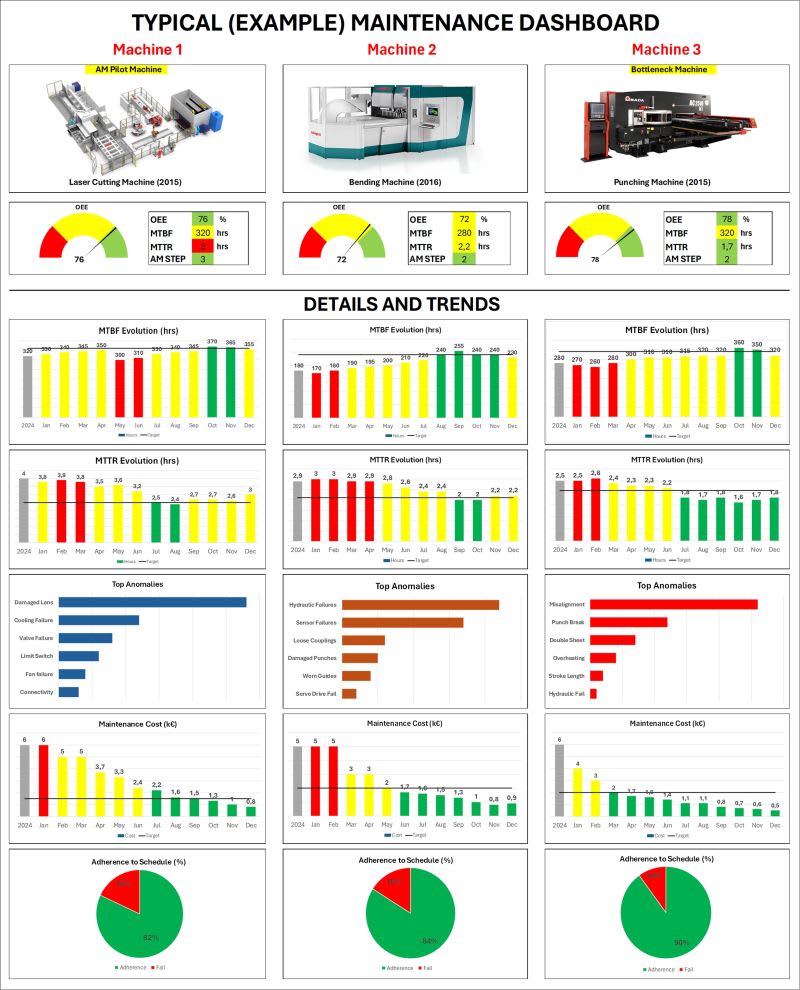
Regularly reviewing and analyzing these KPIs will help you maintain effective and efficient maintenance operations, ultimately leading to improved equipment performance and reduced costs.
1. Reduce Breakdowns: Decrease the number of equipment failures.
2. Zero Failure Machine: Ensure that key machines operate without any failures.
3. Abnormality Correction: Address and fix abnormalities immediately.
4. MTBF (Mean Time Between Failures): Work to increase the time between equipment failures.
5. MTTR (Mean Time to Repair): Shorten the time required to repair broken equipment.
6. MTTF (Mean Time to Failure): Aim to lengthen the average duration a part lasts before failure.
7. Failure Rate: Lower the frequency at which equipment fails.
8. Reliability: Improve the chances that equipment will function correctly without malfunctioning.
9. Minimum Spares: Maintain only the necessary spare parts to prevent operational downtime.
10. PM Schedule (Preventive Maintenance): Adhere to a regular maintenance schedule to avert problems.
11. TBM (Time-Based Maintenance): Carry out maintenance based on a fixed time interval rather than only when issues arise.
12. CBM (Condition-Based Maintenance): Perform maintenance according to the actual condition of the equipment.
13. MP Sheet / Know-why / Know-How: Utilize MP Sheets and document the reasons and procedures for maintenance.
14. Reduce Maintenance Cost: Lower the costs associated with maintaining equipment.
15. Reduce Energy Cost: Decrease the energy expenses involved in running equipment.
16. Kaizen / OPLs (One Point Lessons): Apply continuous, incremental improvements through Kaizen and OPLs.
Source: Credit to Poonath Sekar
Loading more posts...
23 Maintenance
Covers equipment maintenance, availability, reliability, and asset management.
Maintenance management trainings and technical sessions.
No events scheduled
23 Maintenance
Covers equipment maintenance, availability, reliability, and asset management.