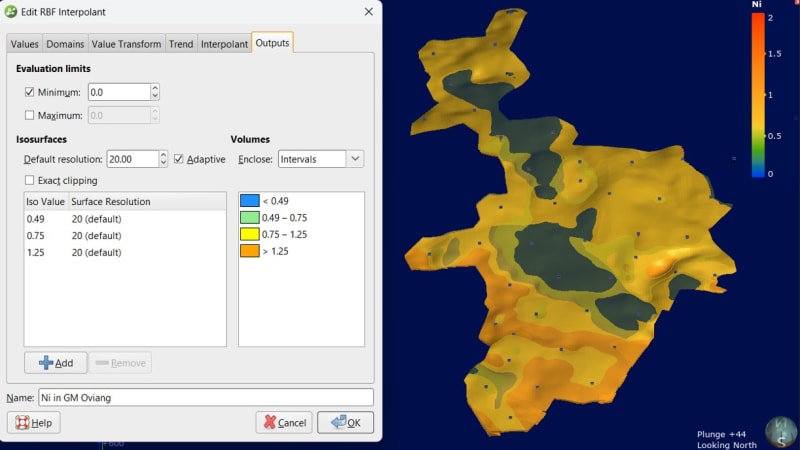





Leapfrog's RBF Numerical Model in Low Density Drilling (Case Nickel Laterite)
In many laterite nickel projects, especially during early exploration stages, we often face one uncomfortable reality: Our drilling density is still too sparse, but we already want to build a resource model. This is where the choice of interpolation method becomes extremely important. Recently, I compared RBF Interpolant (Leapfrog) and IDW on a nickel laterite dataset with relatively wide drill spacing. The results were very interesting and strongly relate to current discussions about whether we sometimes “over-force” geostatistics on immature data. What Happened in the Comparison? Using the same dataset: RBF Interpolant produced: smoother continuity, more geological-looking grade trends,more natural transitions between grade zones and minimal bull-eye effect. Meanwhile: IDW produced: stronger local influence around drillholes, more spotty distributions, clearer bull-eye patterns, higher local variability. This difference becomes very obvious visually. Why Does This Matter? Because in sparse drilling conditions: continuity is still uncertain, variograms are often unstable, anisotropy is not fully understood, and Ordinary Kriging may create a false sense of confidence. This is exactly why RBF becomes attractive. Instead of forcing a variogram model from limited data, RBF uses implicit mathematical continuity to generate smoother and more geologically coherent surfaces. The Interesting Part: Histograms The comparison also showed: RBF : lower variance, smoother distribution, more stable grade population. IDW : slightly higher variance, more local fluctuation, sharper spikes in distribution. This reflects the nature of each method: RBF prioritizes continuity, IDW prioritizes local distance weighting. Neither is automatically “better” they simply answer different geological questions. Should We Replace Kriging with RBF? Not necessarily. For formal resource reporting such as JORC and KCMI. Ordinary Kriging is still widely preferred because it provides: estimation variance, kriging efficiency, slope of Regression, defensible geostatistical validation. However using Ordinary Kriging on data that is still too sparse can sometimes be more dangerous than using a simpler method honestly aligned with the data quality. In Nickel Laterite, RBF can be very useful for: 1. Early-stage exploration 2. Wide drill spacing 3. Geological domaining 4. Implicit saprolite/limonite boundaries 5. Preliminary grade shells 6. Fast model updates The “best” interpolation method is not the most sophisticated one. It is the method that best matches: the drilling density, geological understanding, and confidence level of the dataset. CMIIW..