

Total Drilling Cost: The Metric That Quietly Makes or Breaks Your Mine
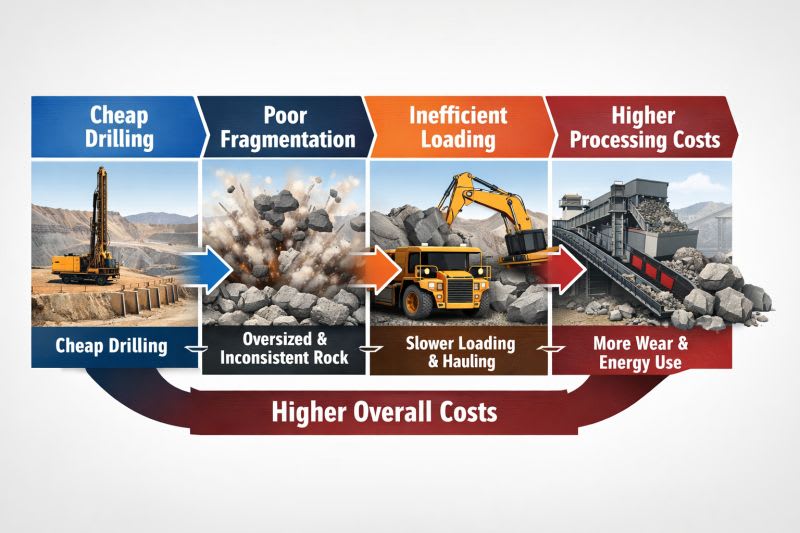
Consequent to a previous article, we have been asked to discuss briefly the financial implications of poor drilling. When we talk about drill and blast, the conversation usually leans towards explosives and their application, while the drilling component gets far less attention. Many operations still track drilling the way they always have: cost per metre drilled. It’s neat. It’s familiar, yet it’s dangerously incomplete. Drilling doesn’t exist in isolation. Every metre drilled sets the conditions for blast performance, downstream productivity, and ultimately profitability. When drilling is optimised solely to reduce the drill contractor’s invoice, costs are often pushed—quietly but significantly—into every stage that follows. That’s why Total Drilling Cost matters far more than drill cost alone. What Is TDC (Really)? Total drilling cost is not just: Drill contractor rates Consumables Maintenance Fuel and labour It also includes the consequences of drilling quality: Hole deviation and collar accuracy Burden and spacing variability Sub-drill consistency Redrilling Misfires and blast inefficiencies Poor fragmentation impacting loading, hauling,crushing Increased dilution, losses, or downstream bottlenecks A cheap metre drilled badly is one of the most expensive metres you’ll ever mine. The False Economy of “Cheap Drilling” We've seen this pattern repeatedly: Drill rates are pushed down Penetration rate becomes the primary KPI QA/QC is reduced Operators are incentivised on metres, not quality On paper, drilling cost improves. In reality: Blast performance becomes inconsistent Powder factor increases to compensate Dig rates slow Crusher throughput drops Maintenance costs rise Reconciliation gaps widen The operation spends far more trying to fix the blast than it saved on drilling. Shifting the Conversation: From Cost to Value High-performing operations look at drilling differently: Cost per effective hole, not cost per metre Accuracy compliance, not production metres Drill-to-blast alignment, not isolated KPIs System performance, not departmental optimisation They understand that drilling is a precision activity, not a volume race. What to Measure Instead If you want to understand your true drilling cost, ask: How much rework are we carrying due to poor hole placement? What is the variance between planned and achieved burden? How often do blast designs require modification to compensate for drilling? What is the downstream cost of poor fragmentation? Are drill KPIs aligned with blast outcomes—or working against them? These answers rarely sit in one department. Final Thought Drilling is the first act in value creation. Get it right, and everything downstream becomes easier. Get it wrong, and no amount of blasting “optimisation” will save you. If you’re still judging drilling purely on cost per metre, you’re likely paying far more than you think.