

Strategic Mine Planning in Feasibility Studies: Purpose, Parameters, Optimization, and Risks
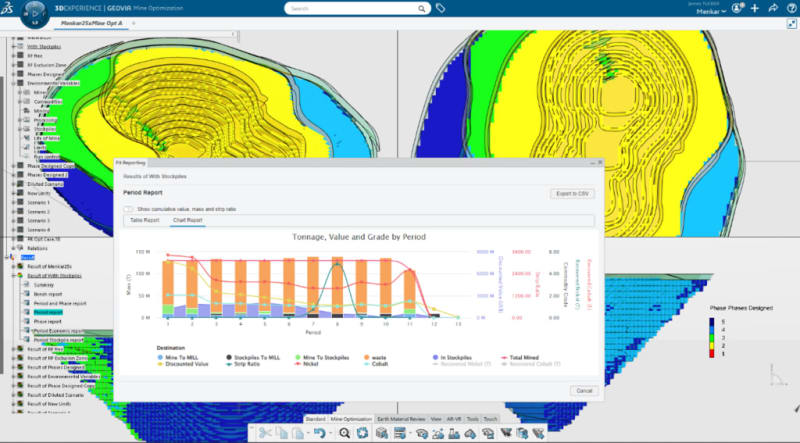
Strategic mine planning is the backbone of a mining feasibility study. It transforms a geological resource into a time‑phased, risk‑aware business plan that supports investment, design, permitting, financing, and closure decisions (Morales et al., 2019; Dowd, Xu and Coward, 2016). 1. Strategic Mine Planning: Definition and Scope Strategic mine planning is the long‑term, life‑of‑mine (LOM) planning process that determines: Which part of the resource will be mined (ultimate pit / underground extent) In what sequence and at what extraction rate material will be mined and processed With which capacities, configurations, and investments (fleets, plants, infrastructure) Under what assumptions about markets, costs, technology, environmental and social obligations For open pits, two core problems dominate (Morales et al., 2019; Dowd, Xu and Coward, 2016): Ultimate pit limit problem – define the mineable reserve within geotechnical and economic constraints Life‑of‑mine production scheduling – decide when to extract each block/panel to maximize net present value (NPV) subject to capacity, quality, and other constraints Strategic planning now extends beyond economic and technical factors to include environmental and closure costs, regulatory frameworks, and sustainability objectives (Oliveros-Sepúlveda, Bascompta-Massanés and Franco-Sepúlveda, 2025). 2. Role and Purpose in a Mining Feasibility Study At pre‑feasibility and feasibility level, the strategic mine plan is not just a technical deliverable; it is the central integrating element of the study. 2.1 Establishing Technical and Economic Viability A feasibility study must show that a project is technically feasible and economically worthwhile with an acceptable risk profile. Strategic planning provides (Marković et al., 2025; Morales et al., 2019; Dowd, Xu and Coward, 2016): Reserves and mine life: conversion of resources into economically mineable reserves, with pit/underground limits and life‑of‑mine horizon Production profiles: annual or period‑by‑period ore, waste, grades, and product tonnages Cash‑flow basis: time‑phased revenues, OPEX, CAPEX, sustaining and closure costs feeding NPV and IRR calculations (Marković et al., 2025; Oliveros-Sepúlveda, Bascompta-Massanés and Franco-Sepúlveda, 2025)Hybrid deterministic–stochastic models have demonstrated that deterministic feasibility outputs can be misleading. In a polymetallic open‑pit case, deterministic optimization yielded NPV of USD 130.8 M, while a stochastic model gave a mean NPV of USD 155.5 M with a standard deviation of USD 76.5 M, and revealed a 3 % probability of overall project unprofitability (Marković et al., 2025). This kind of analysis is central to a high‑quality feasibility study. 2.2 Sizing and Phasing Investments and Capacities Strategic mine plans drive major capital decisions: Fleet size and timing of acquisitions Plant capacity and debottlenecking (crushers, mills, concentrators) Expansion options and their triggers In a copper open‑pit complex, a multistage stochastic model identified optimal branching investment strategies (truck/shovel fleet changes and a secondary crusher) that increased expected NPV by more than US$170 M compared with a simpler two‑stage approach (Del Castillo and Dimitrakopoulos, 2019). Feasibility studies that ignore such dynamic investment options may under‑ or over‑invest. 2.3 Selecting Mining Options and Configurations For deposits amenable to both open‑pit (OP) and underground (UG) mining, feasibility studies must determine: Optimal choice among OP only, UG only, OP→UG, UG→OP, or simultaneous OP+UG Transition depth/location, crown pillar location, and extraction sequence Life of mine, strip ratio, blending strategy, and production smoothness as performance indicators (Afum and Ben-Awuah, 2021)A review of surface–underground options highlights the need for integrated (often stochastic) models at the prefeasibility stage to evaluate these configurations with indicators such as NPV, IRR, discounted cash flow, blending ratio, and mine life (Afum and Ben-Awuah, 2021). 2.4 Integrating Environmental, Social, and Closure Considerations Historically, feasibility‑level planning treated environmental and closure costs as peripheral. Recent work shows these are now core strategic variables (Oliveros-Sepúlveda, Bascompta-Massanés and Franco-Sepúlveda, 2025): Environmental and closure costs can materially affect NPV/IRR and even reserve definitions (Oliveros-Sepúlveda, Bascompta-Massanés and Franco-Sepúlveda, 2025)- Premature project termination due to environmental or social issues often leads to higher closure costs than planned progressive closure (Oliveros-Sepúlveda, Bascompta-Massanés and Franco-Sepúlveda, 2025)- Sustainable post‑mining land use must be planned strategically using tools such as SWOT and IE matrices, defining strategies for each land‑use option (Amirshenava and Osanloo, 2022)A Peruvian case study showed that integrating an advanced water quality model and closure cost tools into planning enabled ranking mine plans according to long‑term water quality impacts and associated mitigation costs, aligning short‑ and long‑term plans with closure objectives (Sanders and Fitzpatrick, 2022). 2.5 Supporting Project Finance, Permitting, and Social License Strategic mine plans are used to: Convince lenders and investors that cash‑flows are robust to key uncertainties (Marković et al., 2025; Del Castillo and Dimitrakopoulos, 2019)- Demonstrate to regulators that waste, water, and closure are planned consistently with legal requirements and policies (Oliveros-Sepúlveda, Bascompta-Massanés and Franco-Sepúlveda, 2025)- Show communities and stakeholders a credible trajectory from construction to closure, including post‑mining land use (Amirshenava and Osanloo, 2022; Sanders and Fitzpatrick, 2022; Oliveros-Sepúlveda, Bascompta-Massanés and Franco-Sepúlveda, 2025)Without a rigorous strategic plan embedded in the feasibility study, these commitments lack quantitative backing. 3. Key Parameters in Strategic Mine Planning Strategic mine planning uses a large, interdependent set of parameters. At feasibility level, their accuracy, uncertainty characterization, and inter‑dependencies are critical. 3.1 Geological and Geometallurgical Parameters Block model: The core input is a 3D block model with attributes such as (Morales et al., 2019; Dowd, Xu and Coward, 2016): Tonnage (volume × density) Grades of economic and deleterious elements Lithology, alteration, rock type, structural domains Geotechnical domains (strength, RMR/Q, joint sets) Geometallurgical variables – recovery, hardness, comminution specific energy, mineralogy Traditionally, block attributes are deterministic estimates (e.g., kriging). Modern approaches: Use equiprobable simulated realizations to represent grade and geometallurgical uncertainty (Morales et al., 2019; Dowd, Xu and Coward, 2016)- Build geometallurgical models capturing spatial variability of recovery, hardness, and comminution energy, sometimes through multiple scenarios (Quelopana et al., 2023; Mata, Nader and Mazzinghy, 2022)Incorporating geometallurgy and its uncertainty can change both pit limits and schedules, with measurable financial impact (Morales et al., 2019; Dowd, Xu and Coward, 2016; Mata, Nader and Mazzinghy, 2022). 3.2 Economic and Market Parameters Key economic parameters include: Commodity price forecasts and ranges Operating costs: mining, processing, G&A, logistics Capital costs: initial, expansion, sustaining, closure Discount rate, tax and royalty regimes, exchange rates Hybrid deterministic–stochastic frameworks characterize these parameters using probability distributions (often via Monte Carlo sampling) instead of single values, explicitly quantifying uncertainty in cash‑flows and NPV (Marković et al., 2025; Sepúlveda, Álvarez and Bedoya, 2020). 3.3 Technical and Design Parameters Important design and operating constraints include: Slope design: bench and inter‑ramp angles, controlling pit shape and depth (Morales et al., 2019; Dowd, Xu and Coward, 2016)- Mining capacity: annual total material movement limits, ore mining capacity, waste stripping capacity by equipment and infrastructure (Del Castillo and Dimitrakopoulos, 2019; Morales et al., 2019; Mata, Nader and Mazzinghy, 2022)- Processing capacity: plant throughput, multiple plant streams, down‑time and maintenance patterns, metallurgical plant modes (Quelopana et al., 2023)- Cut‑off grades: fixed or variable cut‑off strategies, often central decision variables influencing reserve size, mine life, and NPV Stockpiling and blending rules: maximum stockpile capacities, reclaim rates, blending tolerances for grades and contaminants (Del Castillo and Dimitrakopoulos, 2019; Morales et al., 2019; Quelopana et al., 2023)Geomechanical constraints such as haulage ramps, bench widths, minimum mining widths, and controlled strip ratios per period must also be honored; direct block scheduling solutions that ignore these often yield operationally infeasible plans (Morales et al., 2019; Malundamene et al., 2024; Dowd, Xu and Coward, 2016). 3.4 Environmental, Closure, and Sustainability Parameters Modern strategic planning quantifies: Environmental costs: waste rock and tailings management, water management, emissions and dust control, ecosystem impacts Closure costs: backfilling, capping, recontouring, revegetation, long‑term water treatment, monitoring (Amirshenava and Osanloo, 2022; Sanders and Fitzpatrick, 2022; Oliveros-Sepúlveda, Bascompta-Massanés and Franco-Sepúlveda, 2025)- Regulatory and policy frameworks: environmental standards, bonding requirements, SDG‑aligned policies (Oliveros-Sepúlveda, Bascompta-Massanés and Franco-Sepúlveda, 2025)- Post‑mining land use: parameters defining suitability and vulnerability of land‑use options (agriculture, forestry, renewable energy, recreation, etc.) (Amirshenava and Osanloo, 2022)Environmental and closure costs are no longer exogenous; they directly influence resource/reserve reporting and project economics, and must be represented in strategic optimization models (Oliveros-Sepúlveda, Bascompta-Massanés and Franco-Sepúlveda, 2025). 3.5 Energy and Renewable Integration Parameters With increasing emphasis on decarbonization, strategic planning now includes: Current and future energy mix (diesel, grid, renewables) Capital and O&M costs of renewable options (PV, wind, storage) Carbon pricing or internal shadow carbon values A SWOT‑based study shows renewable energy adoption in mining can reduce pollution, create jobs, lower operating costs, and enhance circular economy, though hindered by high initial capital and skills gaps (Pouresmaieli et al., 2023). Such parameters need to be reflected in feasibility‑level scenarios. 4. Strategies and Methods for Optimizing the Mine Plan Optimization methods have evolved from simple deterministic pit shells to comprehensive stochastic and adaptive frameworks. 4.1 Deterministic Optimization: Baseline Practice At feasibility, most projects still rely on a deterministic optimization chain: Pit optimization: Lerchs–Grossmann or equivalent network‑flow algorithms compute ultimate pit shells to maximize undiscounted or discounted profit subject to slope constraints (Anisimov, Bariatska and Cherniaiev, 2024; Morales et al., 2019). Modern software (e.g., Geovia Whittle) generates multiple nested pit shells under varying economic parameters, aiding selection of a final shell even for complex, multi‑ore‑body geometries. Phase (pushback) design: Intermediate pit shells define stages for operational practicability, controlling working widths, access, and strip ratios over time (Anisimov, Bariatska and Cherniaiev, 2024). LOM scheduling: Linear / mixed‑integer programming (MIP) or heuristic algorithms schedule blocks/panels over periods, maximizing NPV under capacity, precedence, and blending constraints (Morales et al., 2019; Dowd, Xu and Coward, 2016). Cut‑off grade and stockpiling policies: Often parametrically optimized (e.g., through nested LPs or heuristics) to maximize NPV while meeting product quality and capacity targets. NPV Pit Optimization Figure 1: NPV Pit Optimization Deterministic optimization is computationally efficient and embedded in commercial packages. However, it presumes single‑value inputs and does not quantify risk, leading to potentially misleading “optimal” plans (Marković et al., 2025; Fernanda et al., 2024; Sepúlveda, Álvarez and Bedoya, 2020). 4.2 Stochastic Optimization and Risk‑Based Strategic Planning Stochastic optimization explicitly addresses geological, technical, and market uncertainty. 4.2.1 Hybrid Deterministic–Stochastic Models with ISO 31000 A hybrid model integrates: Deterministic optimization (base case pit limit and schedule) Stochastic optimization over distributions of key parameters (prices, costs, ore grades) Risk analysis structured by ISO 31000 risk management principles (Marković et al., 2025)Monte Carlo simulation generates distributions for input parameters; these feed a stochastic optimizer that produces NPV distributions, not just a single value. In the cited case, VaR and CVaR show a 3 % probability of project unprofitability despite positive mean NPV, revealing downside risk masked by the deterministic case (Marković et al., 2025). This supports feasibility‑level decision‑making by: Quantifying downside NPV at chosen confidence levels (e.g., 95 % VaR) Identifying parameters that most drive risk Designing more robust pit limits and schedules 4.2.2 Multistage Stochastic Programming for Mining Complexes Mining complexes with multiple pits and processing streams face dynamic investment and configuration decisions: Changing fleets, adding crushers, modifying plant capacities Routing ore among multiple plants and stockpiles A multistage stochastic programming model: Uses a scenario tree with multiple recourse stages Makes sequential investment and operating decisions based on observed information in each period Embeds capital investment variables that activate capacities and costs when chosen In a copper complex, this approach generated a dynamic strategic plan with branching options for configurations; expected NPV increased by more than US$170 M relative to a two‑stage model, and the solution showed a substantial probability that the mine design should branch rather than follow a single fixed path (Del Castillo and Dimitrakopoulos, 2019). Adaptive simultaneous stochastic optimization at the Escondida complex likewise used geological simulations and branching plans to produce operationally feasible strategies that adapt to uncertainty, improving value and risk positioning (Fernanda et al., 2024). 4.2.3 Metaheuristics and Simulation‑Based Stochastic Planning Where exact MIP formulations become intractable, metaheuristic algorithms (variable neighbourhood descent, simulated annealing, evolutionary algorithms) combined with simulation are employed (Sepúlveda, Álvarez and Bedoya, 2020; Quelopana et al., 2023): These methods search large solution spaces for near‑optimal LOM schedules under multiple scenarios. Stochastic open‑pit planning models can include grade and price uncertainty and produce robust schedules that maximize expected profit and mitigate risk (Sepúlveda, Álvarez and Bedoya, 2020). Research suggests that including additional variables (environmental, social) into these stochastic frameworks would further improve realism (Sepúlveda, Álvarez and Bedoya, 2020). 4.3 Integration of Geometallurgy and Plant Operation Long‑term planning that ignores geometallurgy can under‑ or over‑estimate project value. 4.3.1 Geometallurgical Scenarios in Pit Limits and Scheduling A risk‑aware geometallurgical approach (Morales et al., 2019; Dowd, Xu and Coward, 2016): Builds multiple equiprobable scenarios of grades and geometallurgical attributes (recovery, hardness, etc.). Performs pit optimization per scenario, then defines a reliability pit that is feasible across scenarios. Uses stochastic integer programming to schedule blocks from the reliability pit, maximizing expected discounted value and minimizing deviations from production targets (Morales et al., 2019). Results show that including geometallurgical uncertainty can materially change optimal pit depth, pushbacks, and extraction sequences, thus affecting NPV and risk (Morales et al., 2019; Dowd, Xu and Coward, 2016). 4.3.2 Detailed Plant Modes within Strategic Optimization To bridge mine and plant optimization, geometallurgical detailing of plant operation has been introduced (Quelopana et al., 2023): The strategic algorithm is adapted (via Dantzig–Wolfe decomposition) to include plant operational modes (e.g., different comminution circuits) as linear sub‑problems. For each geological scenario, the model chooses not only which blocks to mine and when, but also how to process them (mode selection) (Quelopana et al., 2023). Case calculations based on the Mount Isa deposit show that a plant upgrade can significantly reduce mining equipment requirements without materially affecting NPV, demonstrating that strategic integration of plant modes can change investment and scheduling decisions (Quelopana et al., 2023). 4.3.3 Comminution Specific Energy and Global Optimization Global optimization that integrates geometallurgical variables such as comminution specific energy into pit, pushbacks, and scheduling steps can yield (Mata, Nader and Mazzinghy, 2022): ~9.7 % increase in NPV and ~5.2 % increase in ore production versus simpler strategies More stable strip ratios and better control of comminution energy over time This underscores the value of including such variables in block models and optimization objectives at feasibility stage (Mata, Nader and Mazzinghy, 2022). 4.4 Real Options and Strategic Flexibility Real options treat certain strategic decisions as options rather than fixed commitments. At project level, options include delaying development, staging expansions, scaling capacity, or abandoning (Ali and Rafique, 2024). At planning level, “planning options” include extraction sequences, cut‑off policies, slope modifications, and capacity switches (Ali and Rafique, 2024). Real options: Transform uncertainty into opportunity by allowing adaptive responses to market and geological changes (Ali and Rafique, 2024). Complement stochastic optimization: while stochastic models produce adaptive plans, real‑options valuation quantifies the value of such flexibility. The literature highlights that naïve single‑scenario optimization ignores this adaptive capability, whereas flexible designs can reconfigure in response to new information, better matching actual operating conditions (Ali and Rafique, 2024; Fernanda et al., 2024). 4.5 Multi‑Criteria and Sustainability‑Oriented Strategies Economic objectives (NPV, IRR) increasingly share space with: Resource utilization (rational depletion, recovery) Environmental impact and closure cost Social criteria (employment, community impacts) A multi‑criteria optimization applied to an underground coal mine combined geological constraints, infrastructure, and economic metrics (NPV, EBIT, FCFF). Millions of scenarios were screened digitally, revealing many better scenarios than the base case; the best scenario had NPV ~50 % higher than the base case, which ranked only 52nd of 60 (Kopacz et al., 2020). State‑of‑the‑art reviews emphasize operations research methods (LP, dynamic programming, stochastic programming, metaheuristics) as key tools to design sustainable surface mine plans aligned with SDGs (Pouresmaieli et al., 2023; Oliveros-Sepúlveda, Bascompta-Massanés and Franco-Sepúlveda, 2025). Key Parameters and Optimization Approaches in Strategic Planning Planning Focus Main Parameters / Decisions Dominant Methods Pit limits & reserves Block values, slope design, geotechnical domains Lerchs–Grossmann, network flow, global optimization in software (e.g., Geovia Whittle) LOM scheduling Block/panel sequencing, capacities, cut‑offs, stockpiles LP/MIP, stochastic integer programming, metaheuristics Mining complexes & investments Fleet, crushers, plant capacities, configuration branches Multistage stochastic programming, adaptive branching Geometallurgy & plant modes Recovery, hardness, comminution energy, plant modes Scenario‑based geomet models, Dantzig–Wolfe, global optimization Risk & uncertainty Prices, costs, grades, geomet, env. costs Hybrid deterministic–stochastic with Monte Carlo, VaR/CVaR, ISO 31000 Sustainability & closure Env./closure costs, PMLU options, energy mix Quantitative closure costing models, SWOT/IE, SDG‑aligned planning Figure 2: Core decision areas and optimization tools in strategic mine planning. 5. Risks and Potential Losses from Suboptimal Strategic Mine Plans Suboptimal or naïve strategic mine plans can cause large economic, environmental, and social losses. 5.1 Economic and Financial Risks 5.1.1 Misleading Economic Evaluation and NPV Overestimation Deterministic models that neglect uncertainty can substantially mis‑estimate project value and risk. In the hybrid risk‑based study, deterministic NPV was USD 130.8 M, but stochastic modelling showed mean NPV of 155.5 M with σ = 76.5 M and a non‑trivial (3 %) probability of project unprofitability (Marković et al., 2025). A feasibility study relying on the single deterministic number would understate downside risk. Stochastic optimization reviews emphasize that deterministic planning tools maximize profit under unrealistic assumptions and do not value risk appropriately (Sepúlveda, Álvarez and Bedoya, 2020). Investors and lenders may commit capital to projects whose downside risk is much higher than indicated by deterministic feasibility models. 5.1.2 Lost Value from Non‑Optimized Schedules The coal mine multi‑criteria optimization shows directly the cost of suboptimal plans: The “base case” schedule actually implemented ranked 52nd of 60 generated scenarios. The best scenario achieved NPV nearly 50 % higher than base case, with only small differences (