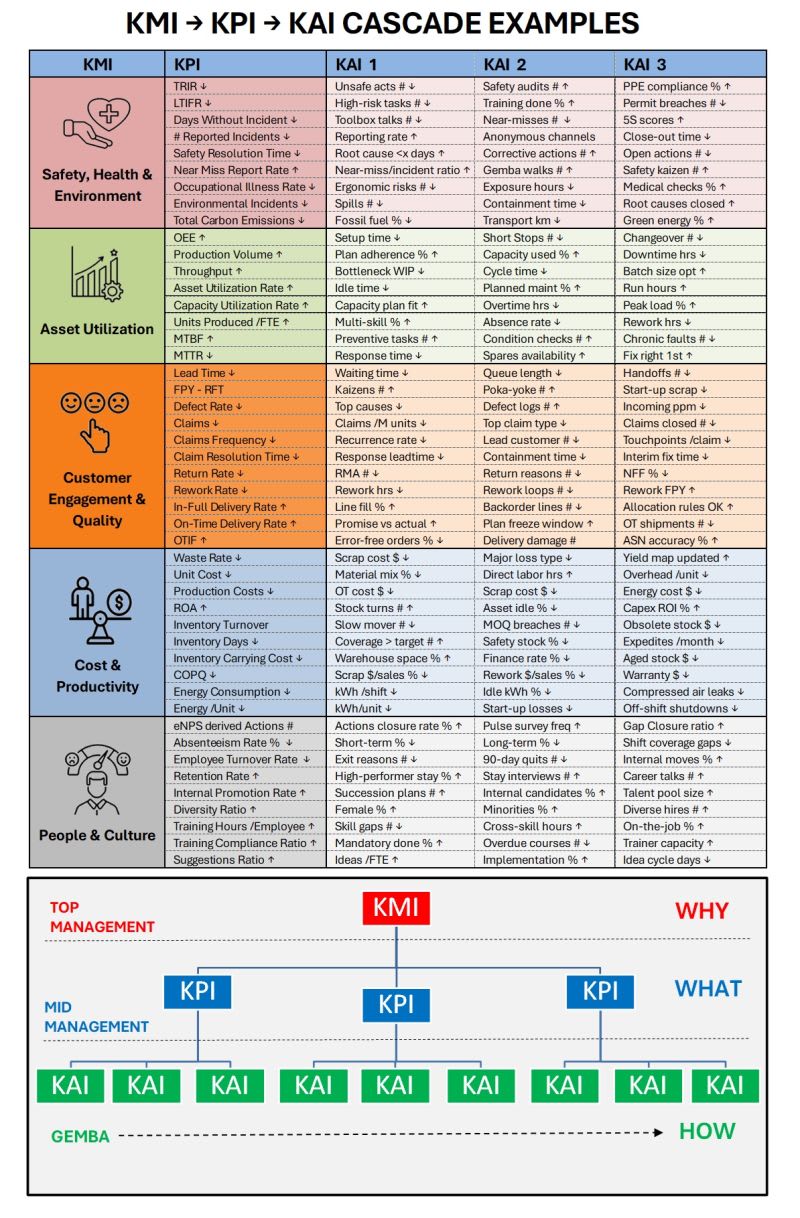


KMI → KPI → KAI Cascade Examples
From Hoshin to Gemba: Japanese KMI → KPI → KAI in Action In many companies, performance management quickly becomes a jungle of disconnected numbers. Japanese management philosophy offers a very simple and powerful cascade that solves this: KMI → KPI → KAI ✅ KMI (Key Management Indicator): The “WHY” KMIs are the few strategic indicators owned by top management. They describe what really matters for business over the term such as: 🎯 Safety, Health & Environment 🎯 Customer Engagement & Quality 🎯 People & Culture 🎯 Asset Utilization 🎯 Cost & Profitability Think of KMIs as the North Stars on your dashboard : there should be only a few ✅ KPI (Key Performance Indicator): The “WHAT” KPIs translate each KMI into measurable process metric. One KMI is usually supported by several KPIs, but total set should still be lean (10 max for site). Examples : Safety, Health & Environment: -TRIR, Days Without Incident, Emissions Asset Utilization: - OEE, Throughput, Capacity Utilization Customer Engagement & Quality: - RFT, Claims, OTIF Cost & Productivity : - Unit Cost, Inventory Turnover, COPQ, Energy Consumption People & Culture : - eNPS, Absenteeism, Turnover, Suggestions ✅ KAI (Key Activity Indicator): The “HOW” KAI's are specific actions at shop‑floor level that move the KPIs. They are concrete and small enough to be owned by a team. Examples : To improve OEE; KAIs could be: - Setup time ↓ - # of Breakdowns ↓ - MTBF ↑ - Short stops # ↓ To improve TRIR, KAIs could be: - Observations # ↑ - Safety audits # ↑ - PPE compliance % ↑ To improve Suggestions, KAIs could be: - Ideas/FTE ↑ - Implementation % ↑ - Idea cycle days ↓ The KAI key is ‘Activity’, not a result. Why KMI → KPI → KAI Cascade 1️⃣ Aligns strategy to Gemba Everyone can see how today’s kaizens, suggestions, or project contributes all the way up to Safety, Customer, Cost, or People objectives 2️⃣ Clarifies target setting You start with few KMIs, translate them into focused KPIs, then define KAIs, teams can influence every day 3️⃣ Enables performance management, not just reporting Reviews can follow simple logic: KMI trend ↓ → which KPI is off? → which KAI needs to improve/change? 4️⃣ Drives Continuous Improvement KAI's become natural funnel for Kaizens: If KPI is red, teams propose and track more Kaizens until it turns green. How to implement ✅ Start by agreeing on 4–5 KMIs that truly define success for your site ✅ Limit yourself to max 10 KPIs, clearly owned, each mapped to one KMI ✅ For each KPI, define 2–3 KAIs, specific activities you want teams to execute ✅ Review regularly KMI → KPI → KAI on the same page, as in visual, so everyone sees connection When you get this right, you create a clear line of sight: KAI improves KPI → KPI improves KMI → Every team, Every shift, Every individual, Every improvement contributes directly to the company’s success. *Plase follow + like + leave a comment (NOT an email address) & message me within LinkedIn for file